

Let’s analyze the running costs of Bitcoin mining against the massive opportunity costs of not pivoting to AI.
[Audio version in podcast format]
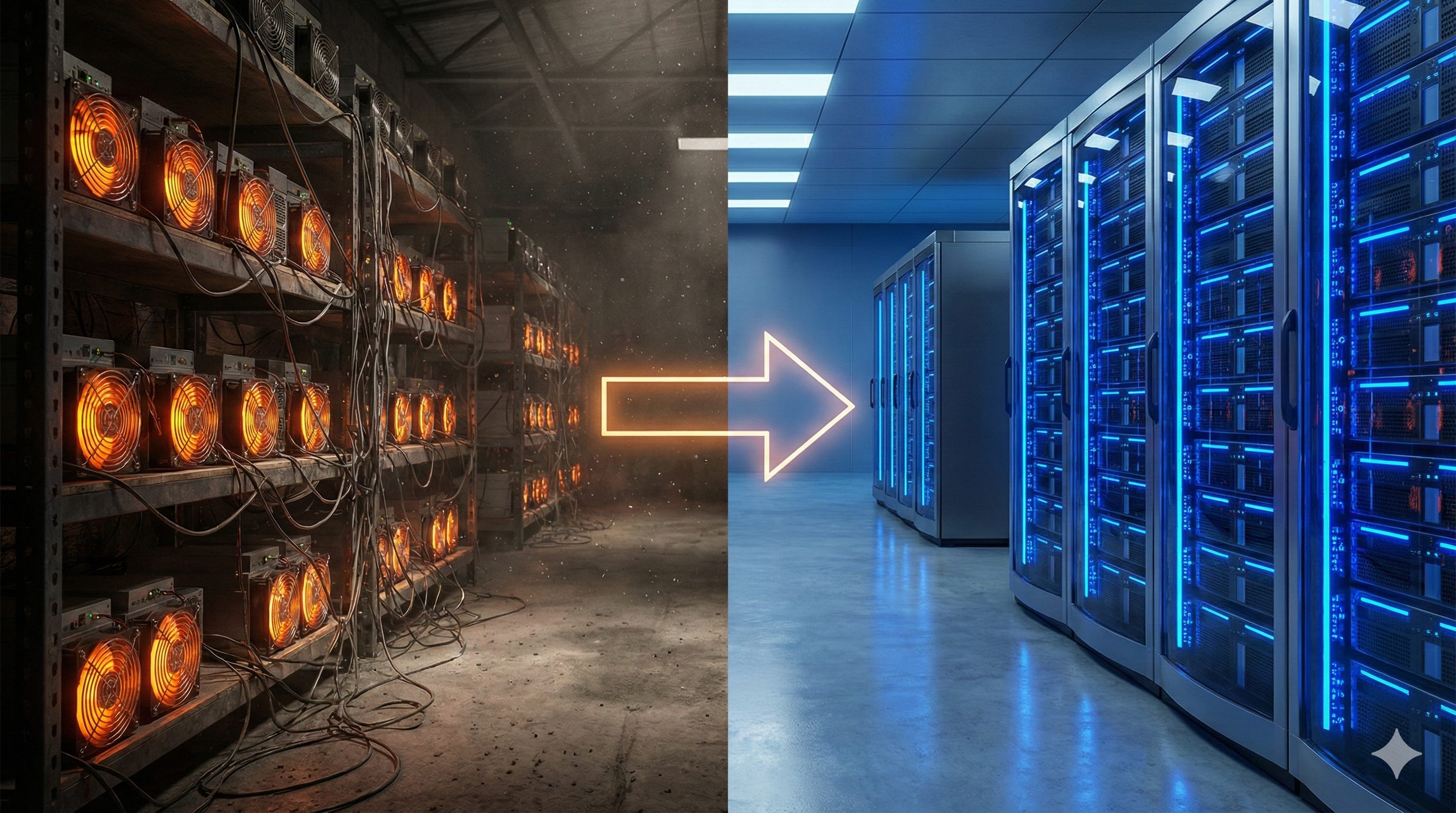
Nvidia offers a historical precedent. They began by selling GPUs primarily for Ethereum proof-of-work mining systems. However, as soon as AI represented a larger, more aggressive opportunity, they shifted from a mining-first to an AI-first approach. The question is: Could—and should—the same shift happen with Bitcoin mining companies at this stage?
We are no longer talking about just building chips; we are talking about the infrastructure required to run them. The demand for AI compute (token emission) is insatiable, and only massive data centers can satisfy it. In this landscape, energy is the most precious commodity. Bitcoin mining companies already possess the “holy grail”: huge facilities with secured energy contracts.
The dilemma is clear: Should they keep mining Bitcoin, or should they pivot to AI data centers?
The Economics of Mining: Energy is King
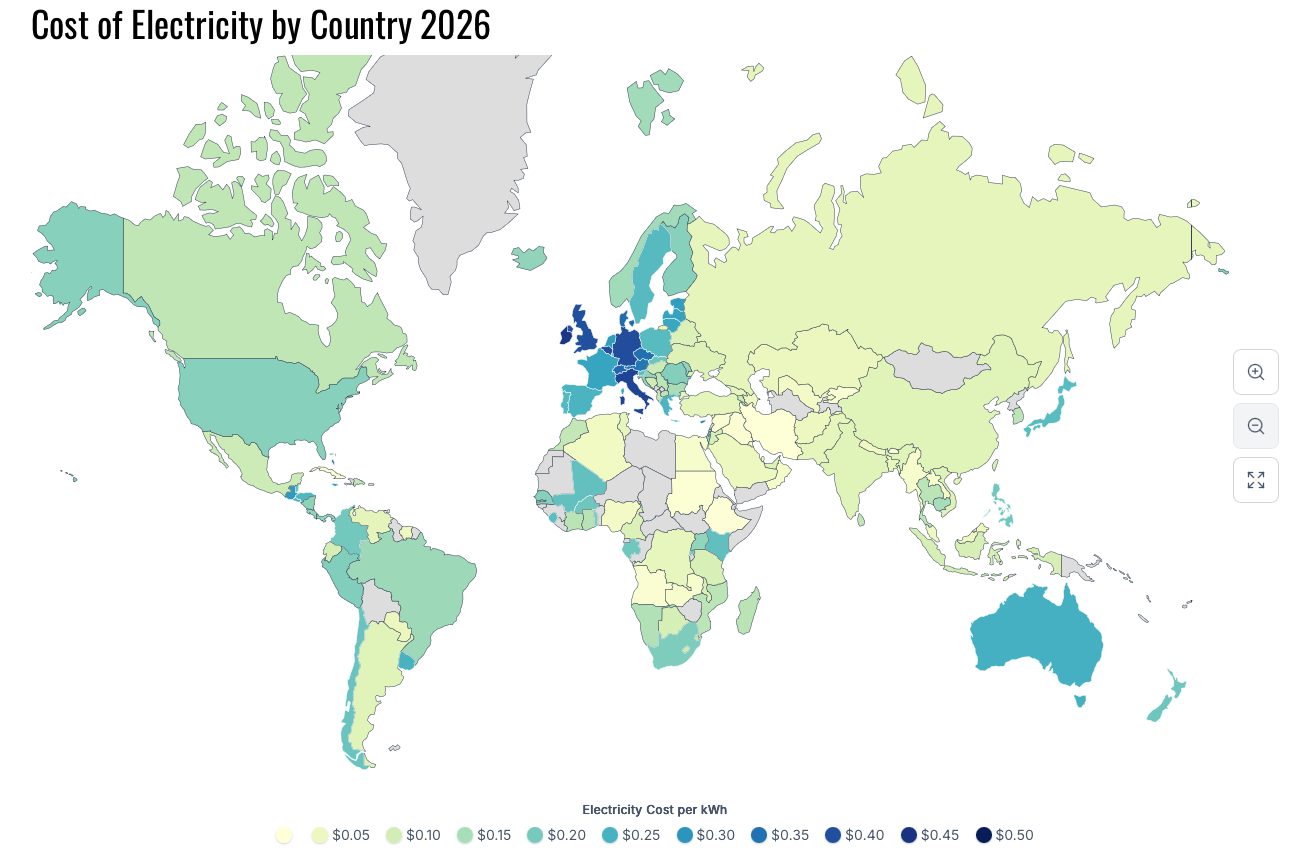
The primary running cost for Bitcoin mining is energy. This creates a massive disparity between regions. Comparing energy costs between Russia (often subsidized) and the US, the profitability threshold is completely different. Energy prices in the US can be nearly double those in Russia. This puts immense pressure on US-based mining locations, naturally reinforcing a scenario where it is more profitable to mine in Russia.
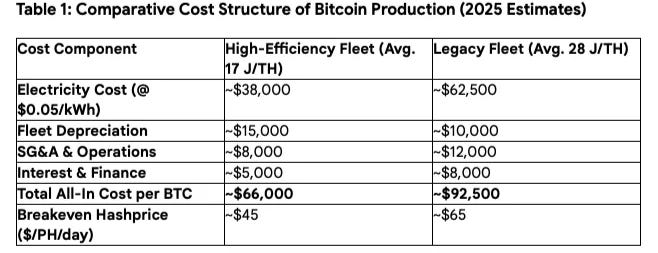
While costs remain roughly stable over time, profits are highly dependent on the Bitcoin spot price. In our current model, anything above $92.5k puts every mining solution in profit. The wider the margins, the bigger the incentive to expand facilities. This triggers a “gold rush” of infrastructure deployment where even less efficient hardware is reactivated. This influx of power increases competition, leading to higher Bitcoin mining difficulty.
The inverse is also true: lower Bitcoin prices compress margins, turning profitable miners into unprofitable ones. This leads to a decrease in power on the grid, lower competition, and subsequently, lower mining difficulty.
What moves the difficulty?
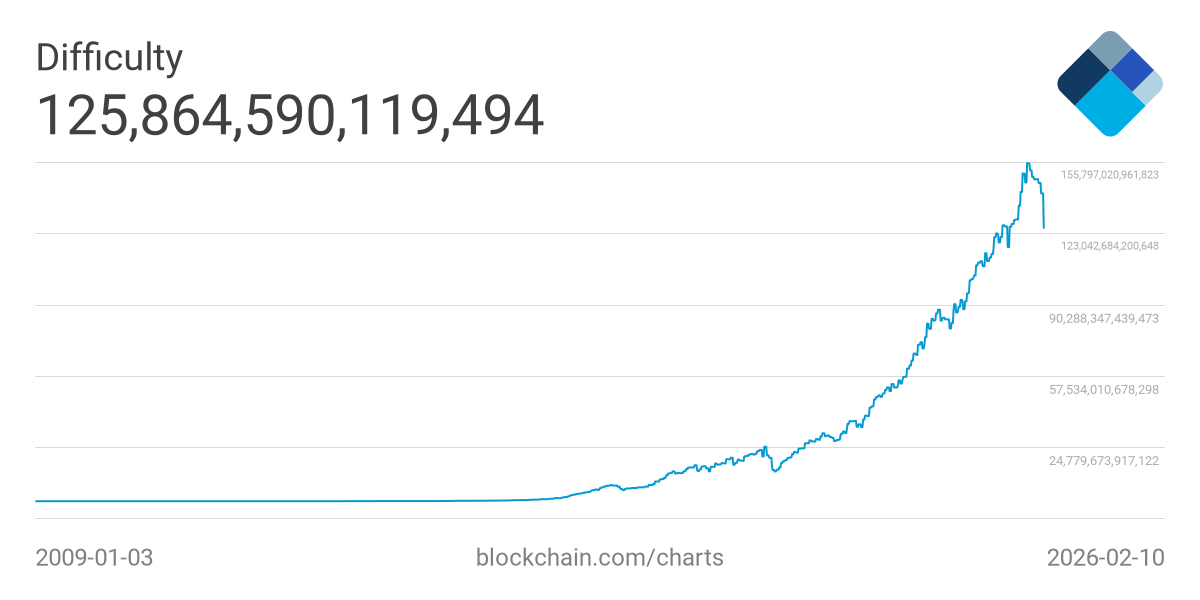
When price increases, the value of the block reward rises directly. Since electricity costs are fixed in fiat terms, miners’ profit margins expand instantly. These wider margins allow miners to plug in older, less efficient machines that were previously unprofitable. As more machines come online, the total computing power (hashrate) of the network increases. Since the Bitcoin protocol is designed to keep block production time at 10 minutes, the network automatically increases difficulty to compensate for the rising hashrate.
Energized, Grid-Connected Land: Mining vs. Data Centers
Until recently, measuring hashrate difficulty was the primary metric. But now, these massive mining operations face not just operating costs, but opportunity costs.
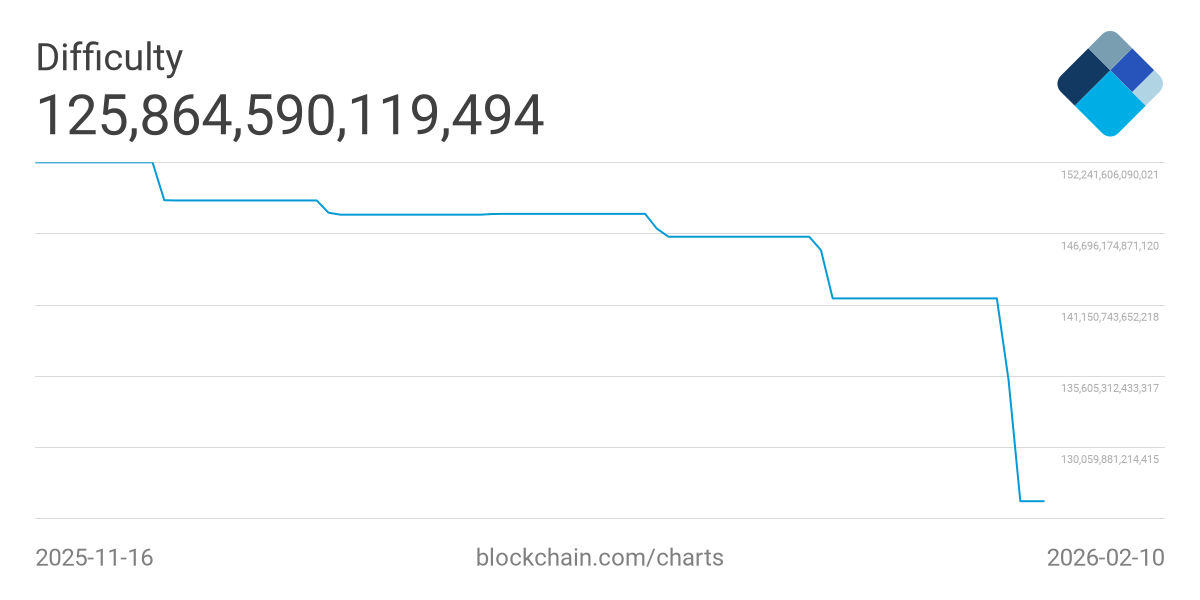
What worries me now is not just the Bitcoin price failing to support current mining costs (which has happened before). The real threat is that the opportunity cost of not pivoting is so high that ignoring it is delusional.
Mining Bitcoin and building massive AI data centers share critical similarities. Both require energized, grid-connected land to leverage energy for computation. Viewing both industries through an economic lens, a pivot from Bitcoin mining to data centers looks like a pure arbitrage of energy value.
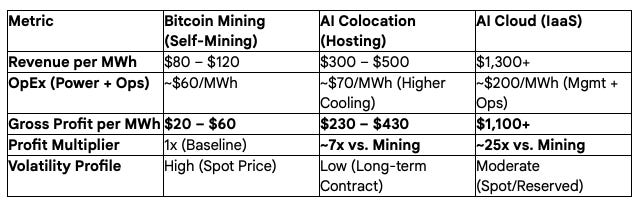
Let’s use the same unit to compare economic output: MWh.
Bitcoin Mining: Revenue per MWh is roughly $70 – $120, depending on market conditions. Assuming a power cost of $50/MWh, the gross profit is $20 – $70 per MWh.
AI/HPC Hosting: Gross profit is roughly $150 – $450 per MWh (assuming the same power cost).
AI Cloud: Gross profit can exceed $1,000 per MWh.
The AI data center bridge offers an extreme economic benefit and a far less volatile revenue profile. While Bitcoin mining is wildly dependent on the spot price, data centers rely on contractual income streams with guarantees. We are looking at 7x to 25x better profit margins with a superior revenue profile. The same power capacity can generate extreme extra revenue through a pivot.
The Transformation Cost
The single most important question is: Is it easy to pivot? And what happens if I want to go back?
Bitcoin mines and AI data centers share only the most basic inputs: land and electricity. Bridging the gap is substantial—it is not a renovation; it is often a total reconstruction.
The CAPEX for building a data center is far higher than for a mining solution.
Bitcoin Mining CAPEX: ~$0.5m – $1m per MWh.
AI Data Center CAPEX: ~$7.5m – $12m per MWh.
For a 100 MWh facility, the cost to pivot could exceed $1 billion. However, public companies can win through market appreciation. By pivoting, a company increases CAPEX spending, but because profit margins increase and revenue volatility decreases, the business inputs justify higher valuation multiples. This “multiple adjustment” can essentially finance the entire CAPEX program. It is simply a matter of the CFO doing their job.
The pivot, while costly, is rational. However, it takes time—up to 5 years to reconstruct a data center, even with energy contracts already in place. It is technically feasible, but high-friction.
The Reverse Pivot Problem
The biggest risk is that once you pivot, it is almost impossible—and economically unjustified—to go back to Bitcoin mining. A data center requires massive CAPEX and over-specification of infrastructure (redundancy, cooling, bandwidth) that is unnecessary for mining Bitcoin.
The capital return promises change forever. In AI, we are pricing a win of over $20 per $1 of energy cost; reverting to Bitcoin mining means pricing $0.20 profit per $1 of energy cost.
Granted, as more data centers come online and technology improves, AI margins will compress. But the gap is so massive that it will likely exist for a long time—unless a “golden bull run” occurs that puts the Bitcoin price at 10x the current spot. Consequently, the pivot is a one-way street for capital. Turning back is economic suicide.
The Security Dilemma
This creates a massive opportunity cost for Bitcoin miners, but also a risk for the network.
If the Bitcoin hashrate drops, it might not be due to a price collapse, but rather a pivot-induced migration. If 20% of the global power pipeline migrates to AI by 2027, the network hashrate will slow.
This is a geopolitical threat. If US and European miners pivot to AI for higher margins, mining may concentrate in locations with cheap, subsidized energy—like Russia. This reduces the decentralization of the blockchain and could threaten government support in the West. If the “friction to pivot back” is extremely high, this damage to Bitcoin’s security model could be long-lasting.
The Optimal Solution: A Hybrid Model
Data centers require 100% stability. Contracts enforce strict uptime; if energy fails, they lose deals. We are currently in an energy emergency, especially in America, where power is limited and costly.
In an energy crisis, downtime tolerance is critical. A highly optimized AI data center has no fallback; if the grid wobbles, they bleed revenue.
This is where the hybrid solution wins. Plugging Bitcoin mining into the grid provides a buffer for when stability is not optimal. It allows companies to monetize “dirty” or unstable power by mining Bitcoin instead of providing AI services.
AI: High margins, low volatility, requires perfect stability.
Bitcoin: Lower margins, higher volatility, tolerates instability.
It is similar to having both solar and nuclear energy. Solar is volatile but sustainable; nuclear is stable but costly. The optimal grid uses both. Similarly, if you have perfect grid conditions, you mine AI. If you have unstable conditions, the profit logic reverses, and Bitcoin becomes the savior.
Bandwidth constraints also support the hybrid argument. A Bitcoin mine can effectively run on a 5G LTE hotspot or a Starlink connection. An AI data center cannot; it requires massive dedicated bandwidth (400 to 800 Gbps). If a fiber optic cable is cut, the data center fails. If you have Bitcoin mining in the background, you still have the power to generate cash flow.
The hybrid model isn’t just a hedge; it is the only robust architecture for an energy-constrained future.
This is intended to be a thought exercise, and not financial advice. Reach out in open conversations, DM me or comment anytime.
I’m aiming to provide clarity about the world day-by-day, and I hope you get smarter and more financial intelligent every day. Each day we increase our chances of winning.
Thanks, Joao