

I usually send these letters later in the day, but I’m trying something different today. I want you to be fresh when you read this, energized for the day ahead, rather than catching you when you’re tired. As always, I’ve included a podcast format if you’d prefer to listen to the themes I’m covering. First, let me justify why this letter is a “must-read” today.
[Audio version in podcast format]
Michael S. Barr speech
Full notes on the speech

I want to start by highlighting a significant speech from Michael S. Barr, who provided a deep dive into the current state of AI and his vision for its impact on the labor market. AI promises to be a “general-purpose technology”—the kind that changes the “invention in the method of invention” itself, drastically increasing R&D efficiency. Much like computers fundamentally improved the process of discovery, AI is poised to do the same.
While massive technological disruptions often trigger short-term anxiety regarding economic and social consequences, history suggests that innovation ultimately leads to broadly shared increases in productivity and living standards. In the long run, the effects of AI are likely to be profoundly positive for economic growth and the labor market.
Data shows that AI adoption among top companies is growing aggressively; 80% of firms now use it in at least one business function. While adoption is fast by historical standards, most companies are still in the “experimentation and pilot” phase. We should remember that the productivity gains from 20th-century electrification took decades to materialize because they required a total redesign of factory workflows. This follows the “J-curve” of technology adoption: adjustment costs lead to short-term losses before firms realize massive, long-term gains.
Barr outlines three potential scenarios for AI’s role in the labor market:
Gradual Adoption: AI follows the path of previous general-purpose technologies. Productivity grows steadily, and adoption is slow enough that widespread joblessness is avoided. While skill mismatches may cause short-term unemployment, workers eventually retrain, and real wages rise alongside output.
Rapid Growth (The “Jobless Boom”): AI capabilities grow exponentially, leading to rapid displacement across professional and service sectors. Autonomous systems replace manual labor, and AI-centric startups displace legacy firms. While the economy becomes vastly more productive, the demand for human labor collapses, forcing a radical rethink of social safety nets and education to ensure gains aren’t concentrated solely among capital holders.
Stalled Growth: AI hits a wall due to data exhaustion, electricity shortages, or capital constraints. (One estimate suggests AI investment will require $1 trillion in new debt over five years). If immediate productivity gains don’t materialize, business interest may fade, leading to an “AI bust” where the boost to aggregate productivity remains modest and eventually fades.
Personally, I lean toward the third scenario. I suspect GenAI will follow the path of other revolutionary technologies where energy becomes the primary bottleneck. As companies hike CAPEX to the point where free cash flow nears zero—forcing them to issue corporate bonds just to keep up—the short-term earnings profile suffers. This pain is already reflecting in the stock market. Investors are beginning to rotate away from the “Magnificent 7” and AI-first companies. For instance, Rob Citrone is betting on a US stock underperformance in 2026, actively shorting the market.
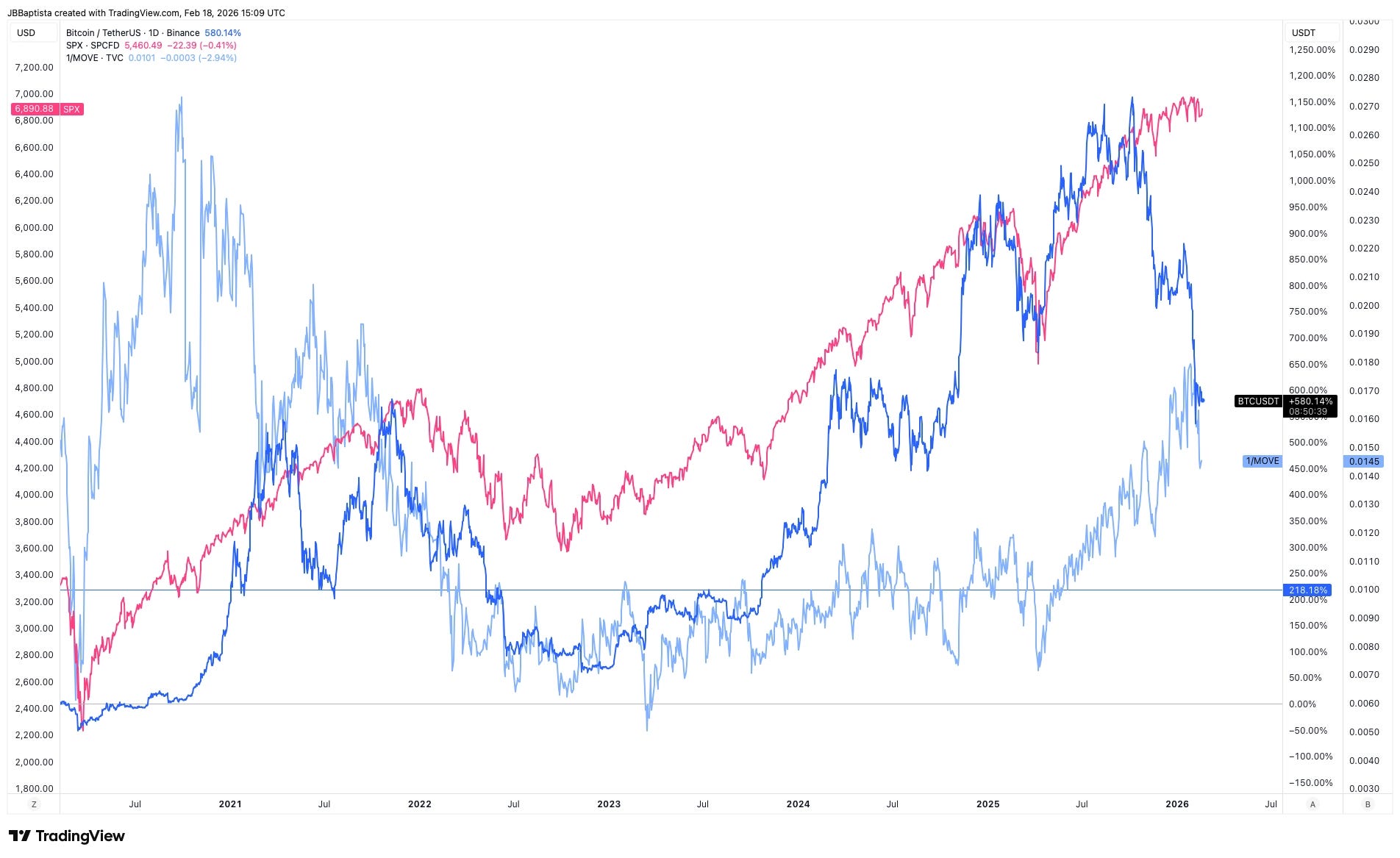
While S&P 500 earnings continue to beat expectations, investors are increasingly anxious. Traders are watching the SPX break support levels while keeping a close eye on the MOVE index. Historically, the SPX correlates with 1/MOVE; the recent rise in MOVE indicates growing stress in US equities. Conversely, Bitcoin has shown a long-term negative correlation with 1/MOVE, particularly during drastic market shifts.
Quantum threat
“Quantum threats” are often dismissed as FUD, but the risk is real. A future fork will be necessary to make the Bitcoin network quantum-resistant. However, this creates a “zombie coin” problem. If Satoshi is indeed dead, those coins (currently in old P2PK addresses) cannot be moved to a new signature. A soft fork can protect active users, but more than 15% of the supply locked in this old addresses would remain vulnerable to quantum attacks. If an attacker were to unwind that 15% and dump it on the market, Bitcoin could theoretically collapse back to $1,000.
Quantum threat is not a threat to the bitcoin standard, but a threat to bitcoin price. Huge asymmetric risk.
While solutions like BIP360 (a quantum-hardened storage proposal) exist, the controversy lies in whether to “burn” or “freeze” old coins that don’t migrate by a certain deadline to prevent a market crash.
Capital is migrating, crypto opportunity
Despite these long-term fears, new capital is still flowing in. Dragonfly recently raised $650m to invest in crypto, specifically focusing on agentic payments and tokenization.
I’m also watching consumer-facing projects like PumpFun. They continue to innovate, recently launching a creator fee-to-cashback exchange to align incentives between token launchers and traders. PumpFun is currently generating over $1m in revenue per day—even in a “bear market”—with $47m revenue in January alone. By revenue, PUMP is the #4 crypto project over the last 30 days, trailing only Tether, Circle, and Hyperliquid. PumpFun position as a crypto-native application that could be an app that sustains on speculation, it similar to gambling playing field, and new version of gambling in the modern world. A better application than going to the digital casino, where win-with-friends is a trend that will be live long-term.
Speaking of Hyperliquid, it remains the clear leader in the perp DEX space. It has 95% higher open interest and 150% higher fees than its competitors, monetizing its volume at a much higher rate. While others rely on airdrop farming, Hyperliquid has built genuine user stickiness.
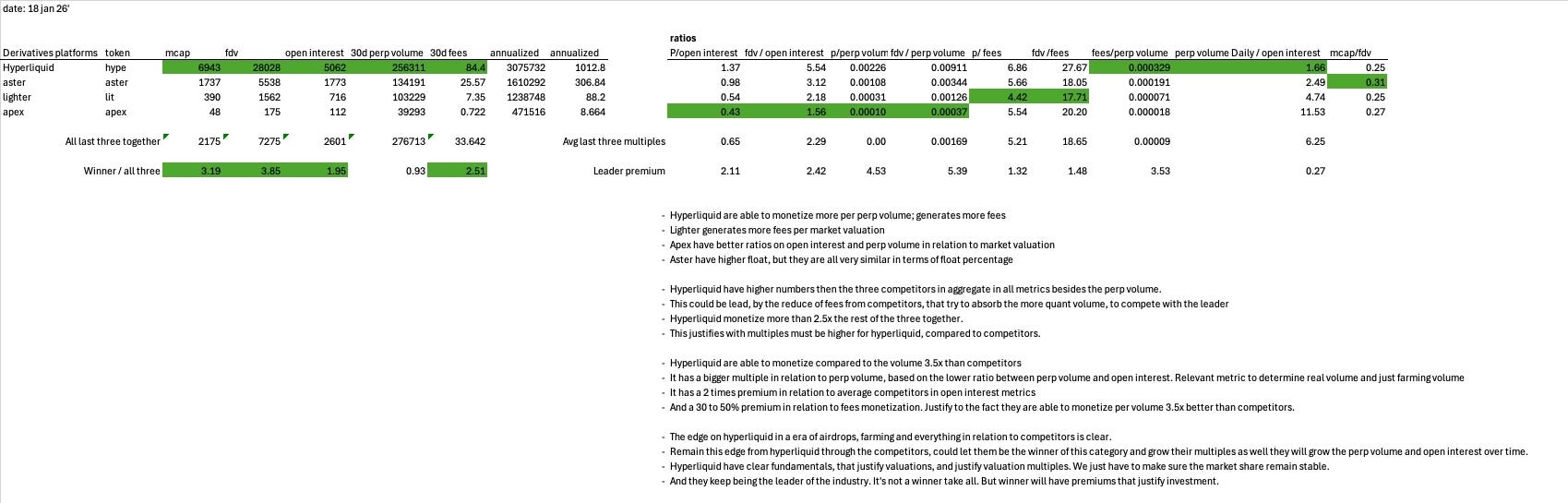
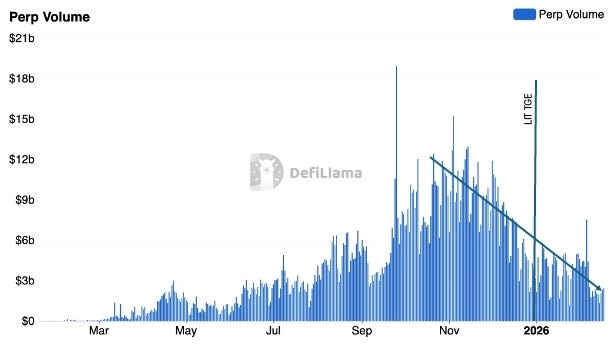
Competitors like Lighter are struggling to maintain volume post-TGE because they lack that same fundamental edge.
Geopolitics short-term threat
Finally, keep an eye on geopolitics. With Iran remaining a major focal point, Oil is volatile while Polymarket odds remain high.
Remember: Bitcoin is often the “short of choice” during geopolitical shocks. If a major escalation occurs in the next two weeks, expect a Bitcoin dump.
This is intended to be a thought exercise, and not financial advice. Reach out in open conversations, DM me or comment anytime.
I’m aiming to provide clarity about the world day-by-day, and I hope you get smarter and more financial intelligent every day. Each day we increase our chances of winning.
Thanks, Joao