

Days ago I built this report on tokenized stocks. And now I’m publishing a few pieces into the public. Tokenized stocks will 1,000x in a couple of years. And the upside is enormous.
It change a little bit the current status for tokenized stocks. But this gives a a great spectrum so far. It will also be important to track the evolution of tokenized securities.
Tokenized stocks situation
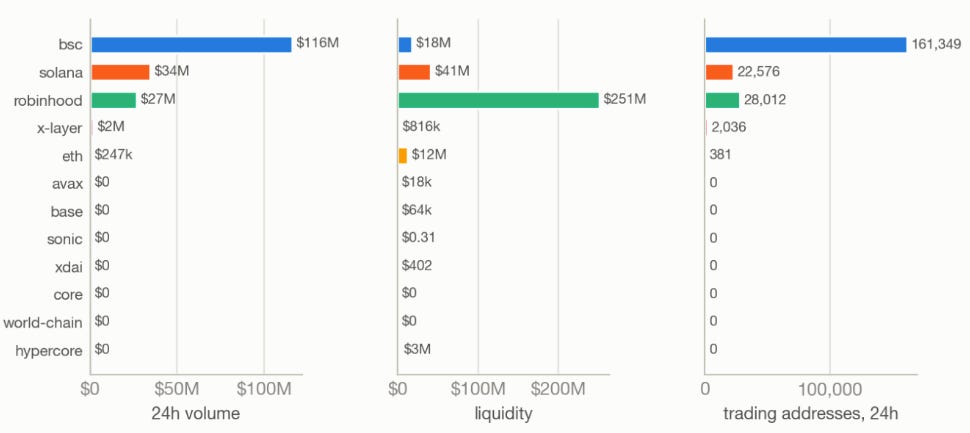
Tokenized stocks basically live on three chains, BNB Smart Chain, Solana and Robinhood Chain. BNB Smart Chain is the chain that produces the highest volume under the most amount of trading addresses, but it offers the worst liquidity venue. Robinhood offers more than $250m liquidity to trade over $27m volume a day, over 28 thousand addresses are trading tokenized stocks on robinhood chain. Without counting BSC, there’s over 50 thousand addresses trading tokenized stocks onchain so far.
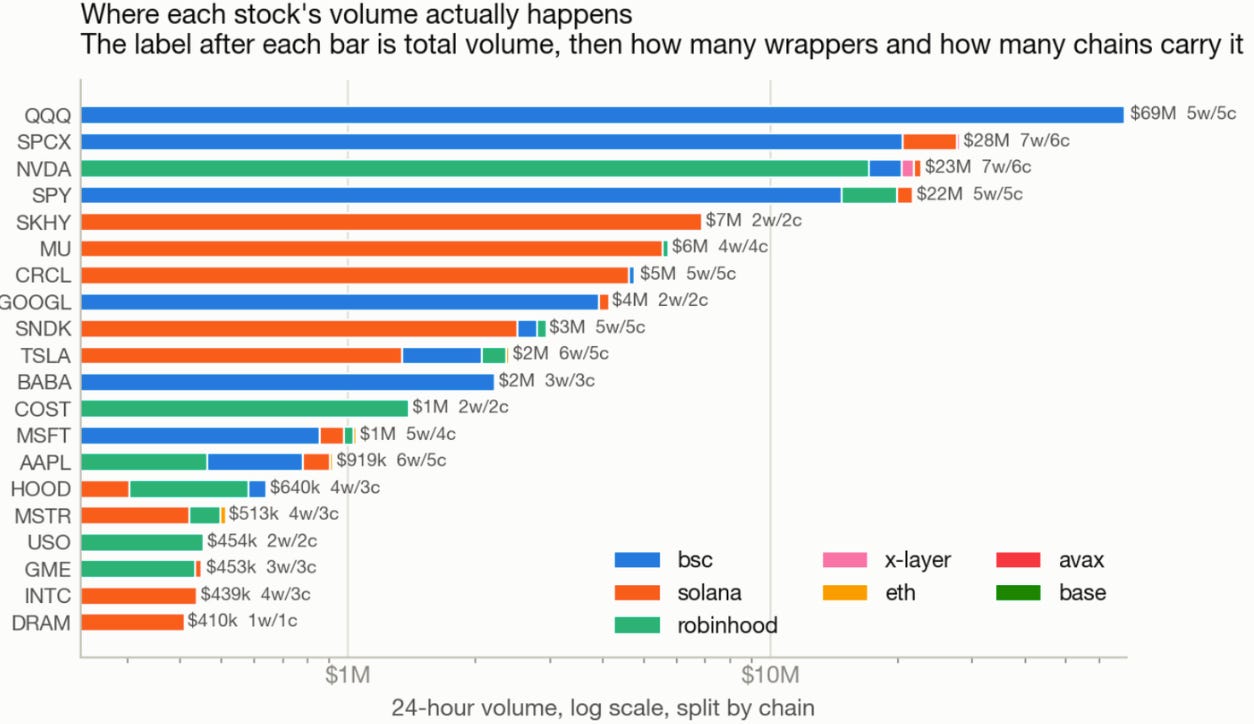
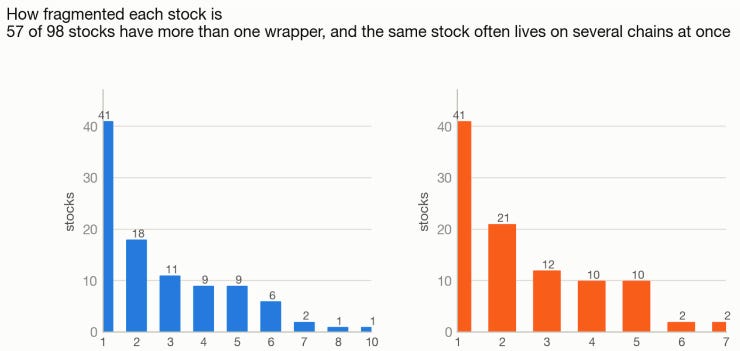
There’s 98 underlying stocks with direct tokenized tokens wrappers. 98 stocks alone created 249 wrappers, under 2,309 pools in 62 different venues. Each stock originates one average 2.5x token wrappers representing the same underlying stock. And per token wrapper it originates 9.3x pools. This values will expand much more, this happens because the incentives to create a new wrapper rather than use the competitor are huge. Similar to ETF issuers, there’s a plenty of different issuers and in a variety of different ETFs. But in terms of volume, there’s a more concentrated market rather than AUM, based on better fee tiers and higher liquidity, similar is and will happen on tokenized stocks. Best liquidity and best fees will win volume. Is to soon to say who is the winner because the top 5 underlying stocks concentrate 83% of volume, this market still embryonic.
Robinhood have 6.25x times the liquidity locked on LPs, $250m, compared to solana, $40m, with lower volume. In terms of chains is there an oligopoly market, dominated by three chains, basically two, a few are entering and have high incentives to enter the space: HyperCore and Base. Many more after regulation clarity could emerge, from banks and finance institutions. But in terms of venues that are concentrated the liquidity are quite limited, it exists pancakeswap specifically for BSC, and then Uniswap and raydium. ZeroFi and Meteora follow that path, but still left behind.
There’s a fight to win this market, as big and promising as this is. Like expected, the majority of the volume, so far, and will continue, is dominated by bots rather than humans, 88% on average of the volume is dominated bots. This happens because of the incentives to arbitrage and work the inefficiencies that this liquidity have.
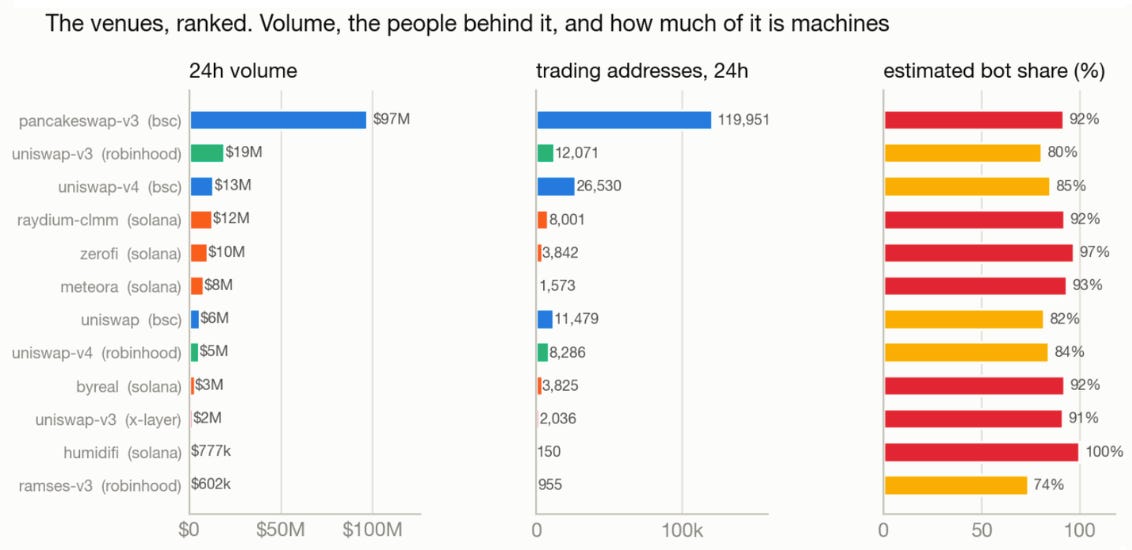
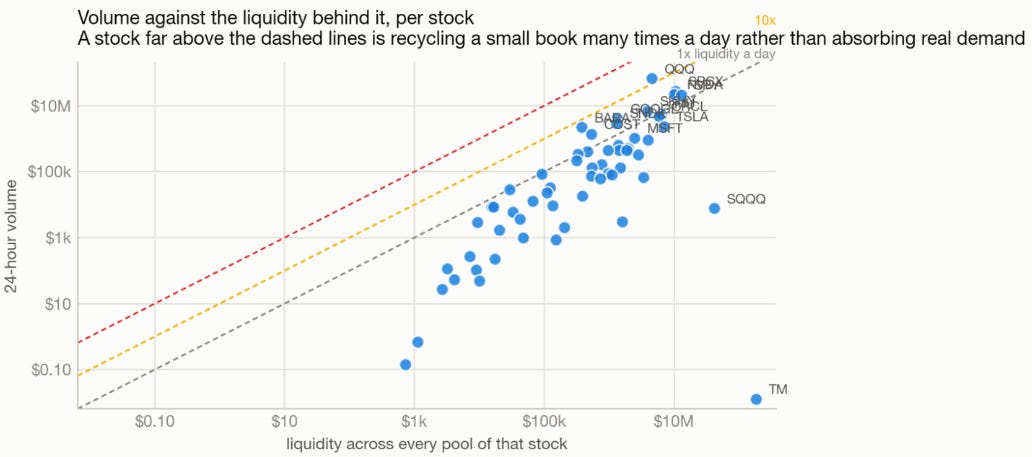
As we increase liquidity higher it is the percentage of bots trading, align with more opportunities emerges with it, and also align with the positive correlation between liquidity volume, that will be our critical assumption to this research going forward. Ceteris paribus, growing liquidity leads to growing volume, and a correlated way. This is fundamentally test because with higher liquidity it unlocks higher opportunities to trade, arb and cover market inefficiencies.
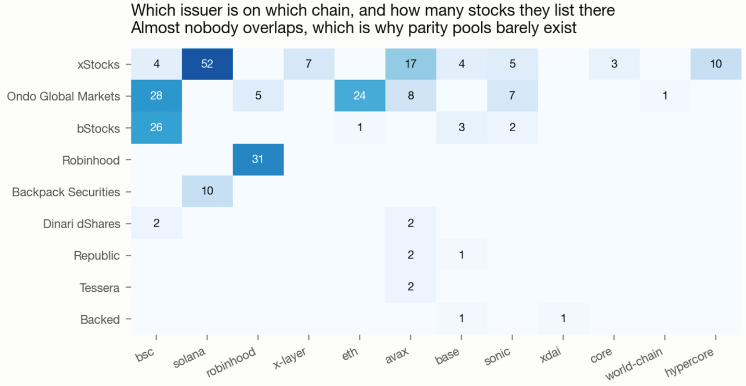
Fragmentation of stocks are start happening, as expected, with growing the experimentation of tokenized stocks. I’m expecting much more fragmentation, with multiple issuers issuing the same stock, as so far they are not optimizing it. There’s a big cohort of tokenized stocks issuers that are not yet issuing tokenized tokens, because of regulatory clarity but they will after the green light. So far issuers are being smart, the majority of stocks have a single wrapper in each chain that represents that stock, issuers are not overlapping tokenized stocks. The model is to be the first tokenized that specific stock, after being the first, there’s no incentive behind the second, that’s the lesson they are passing. It works, but as soon as there is no tokenized stocks left to issue and as an issuer want to scale and capture more market they will have only solution, to overlap all their competitors stock.
This is core reason, and it’s critical data point that explains why parity pools are scarce. To create a parity pool it is required to have at least two different wrappers with significant volume fighting each other for distribution, where the parity pool serves as cross-border, it is happening on SPCX-SPCXx pool.
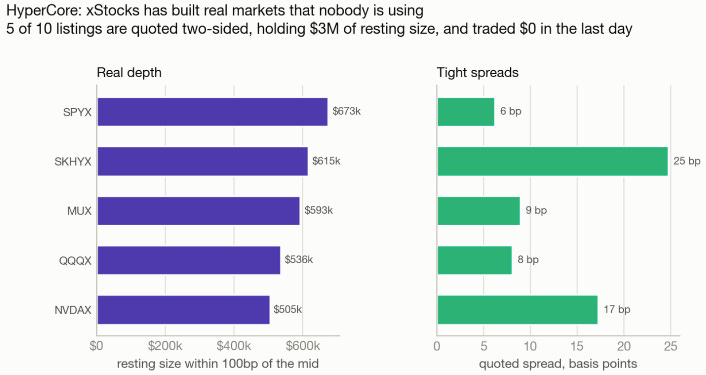
This first version of tokenized stocks is a version that liquidity runs on AMMs, on public liquidity pools inside DEXs. But as we grow the market, and clear Hyperliquid is driven to capture this market as well, a better liquidity venue is emerging, HyperCore by Hyperliquid now enabling permissionless HIP-1, similar architecture than HIP-3, with xStocks directly deploying five-tokenized wrappers. HyperCore is a much better venue to trade with tight spreads but so far, it lags of real volume.
Orderbook centralized models provides a much better spread in comparison to normal AMMs. It offers tight spreads in all tokenized stocks, in comparison to all pools. This is not a single point of a specific venue, or chain, it is a critical structure of the AMM design.
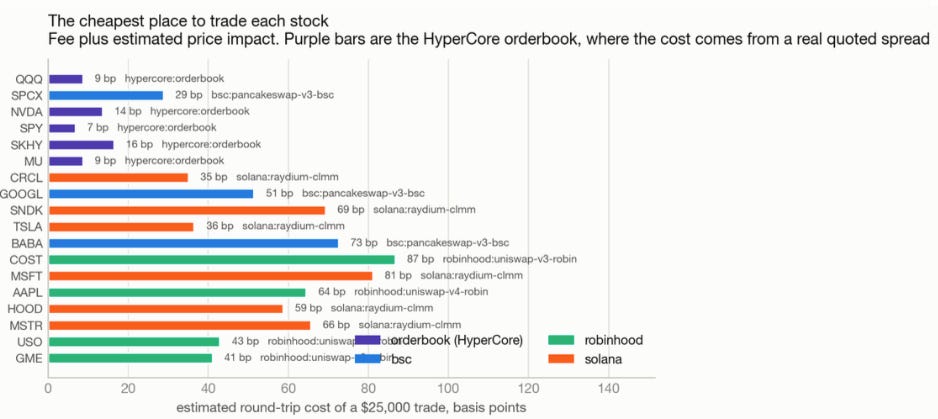
Even with a tigher spreads, retail traders, and particularly bots, sit onchain to capture the inefficiencies. On hyperliquid smaller spreads also means lower market inefficiencies. For traders that aim to market order it is clear the best venue to do so, but then ends up under a critical form, of where the capital and the user is: Wealth status.
The tokenized market on Ethereum mainnet is slow and inexistence. There’s only one issuer, Ondo, and that issuer is dyeing slowly. With 25 wrappers, 270 poosl across 8 venues, is doing $7m volume over 15-days period, on $12.4m liquidity.
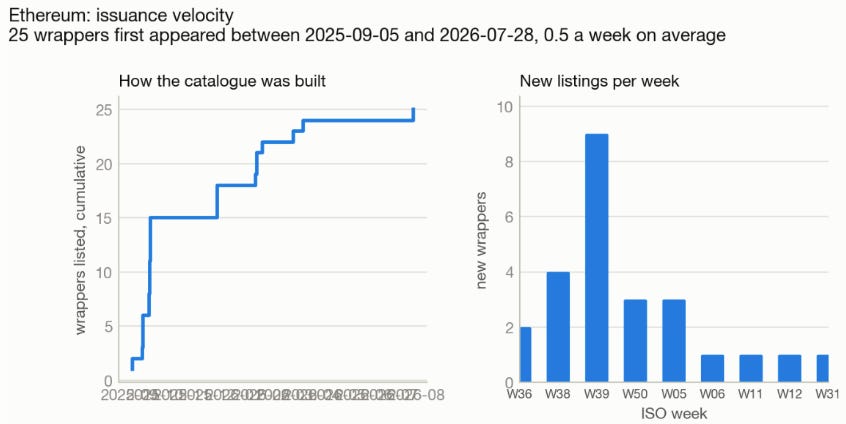
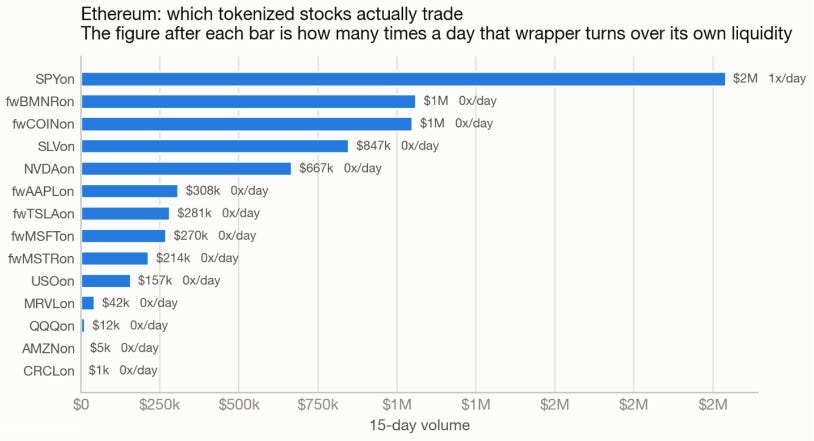
Market is saying that Ethereum mainnet doesn’t work to trade tokenized stocks, is slow and costly. Bots does not survive on Ethereum, because of gas : Explain on Gas Report. And in a world where 88% of volume is dominated by bots, volumes leads liquidity yield, and liquidity leads to volume, there’s no incentives to deploy capital on a zero-yield. Even this mean say, SPYon, a specific index token is the one capturing the most amount of volume, $2m a day. Etheruem is far behind any chain, by default, because of the robustiness of the chain.
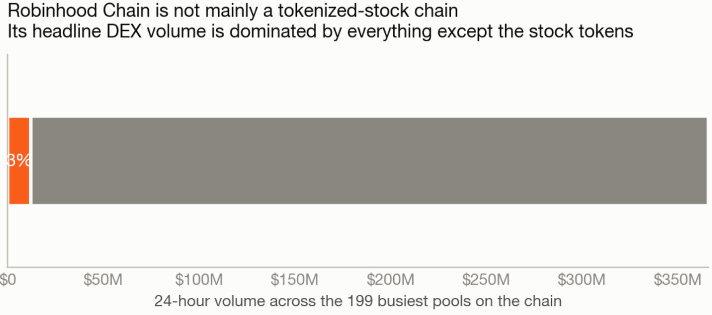
Robinhood chain works differently than all the other chains, it controls the whole stack: issues the tokens, runs the chain and distributed the tokens to their own customers wallets. But so far only 3% of the total chain volume is attach to tokenized stocks. It’s a big headline, big emerging market but is not where the volume is going through.
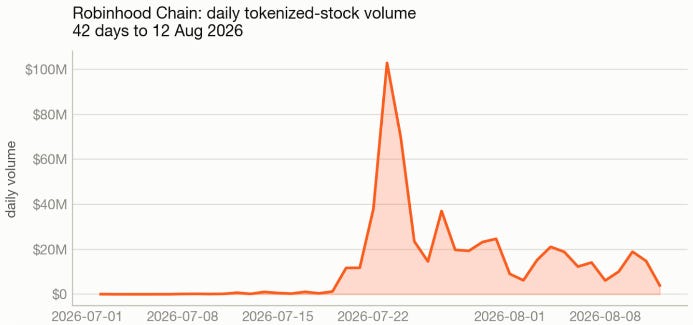
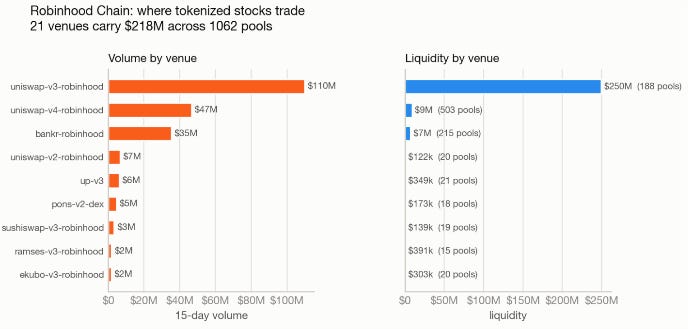
On Robinhood chain, Robinhood as issuer controls 95% of the total market share. Partnering with Uniswap to be the first partner for robinhood DEX infrastructure, it is the venue where $250m+ liquidity is concentrated and more than $200m volume in 15-day is concentrated.
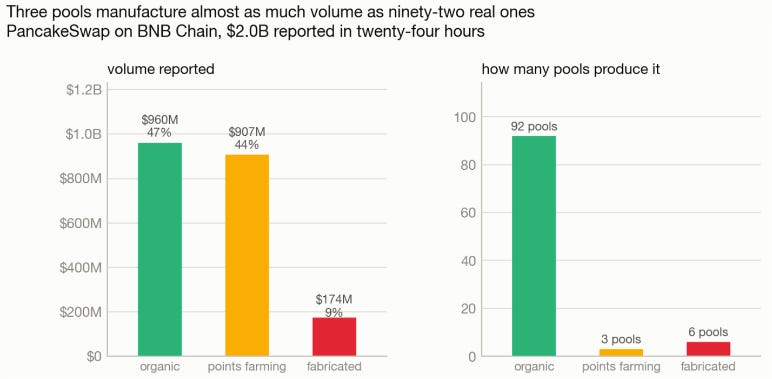
BSC and pancakeswap had huge numbers, but I discounted it all, because this are not real numbers, and for that reason is not valid to assume that this ecosystem is sustainable. Pancakeswap have 46% of all BSC volume, much higher dominance than Uniswap on Ethereum at 33%. On all this volume only 47% of the volume is organic, 44% is for point farming and 9% is fabricated. Binance alpha allows binance users to directly trade onchain without living binance.
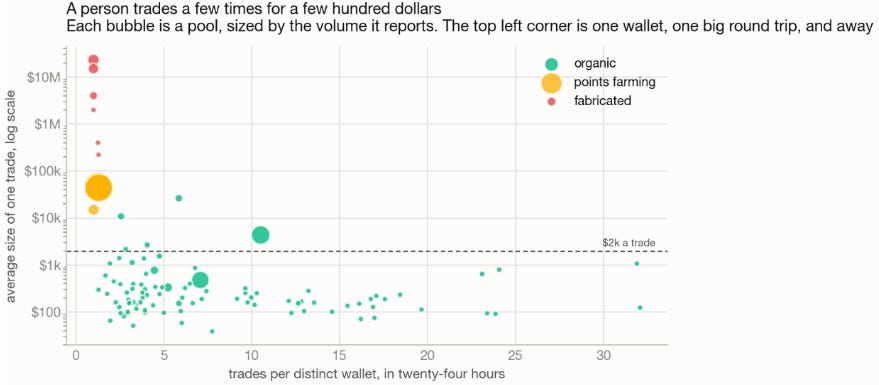
This specific alpha program awards users with points based on traded volume, give access to airdrops and token sales. 18878 addresses are farming incentives, and these wallets are probably (unproven) owned by a few humans. For all these reasons I discounted BSC data numbers and pancaleswap numbers, it all leads to the same machine – binance.
Thanks,
Joao