

It’s hard to bet against CZ. I won’t try to do that, and I don’t recommend anyone else do it either.
But...
Even for the ASTER token, Hyperliquid shows better numbers than Aster DEX itself.
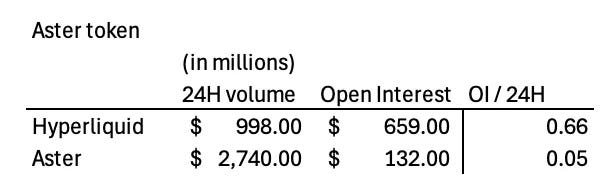
ASTER follows the same playbook as hyperliquid, offering similar token allocations to the public. The difference is leadership. CZ is the leader of this Aster, and that matters a lot.
Volume and open interest are two different but equally important KPI:
Volume is where exchanges earn revenue. Volume represents the aggregation of each trade, and each trade generates a fee.
Open interest creates sustainability. It reflects holders who keep contracts alive on the exchange.
Aster currently generates strong fees from the high volume. It is in fact 2.5x higher than hyperliquid. That’s what supported the rally.
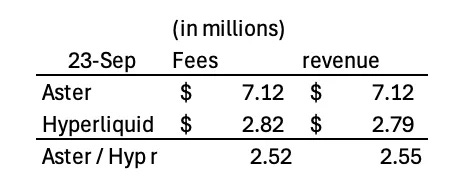
The question isn’t if sustainability matters. It does. Traders must keep trading on Aster. Over time, KOLs lose influence, incentives fade, and activity slows, if a good product don’t consolidate the users.
ASTER is now value at 0.43 of HYPE, overnight. Whether that gap widens or shrinks is the real debate.
This market isn’t a winner-take-all. Many players can coexist. “Rising the tide lifts all boats”.
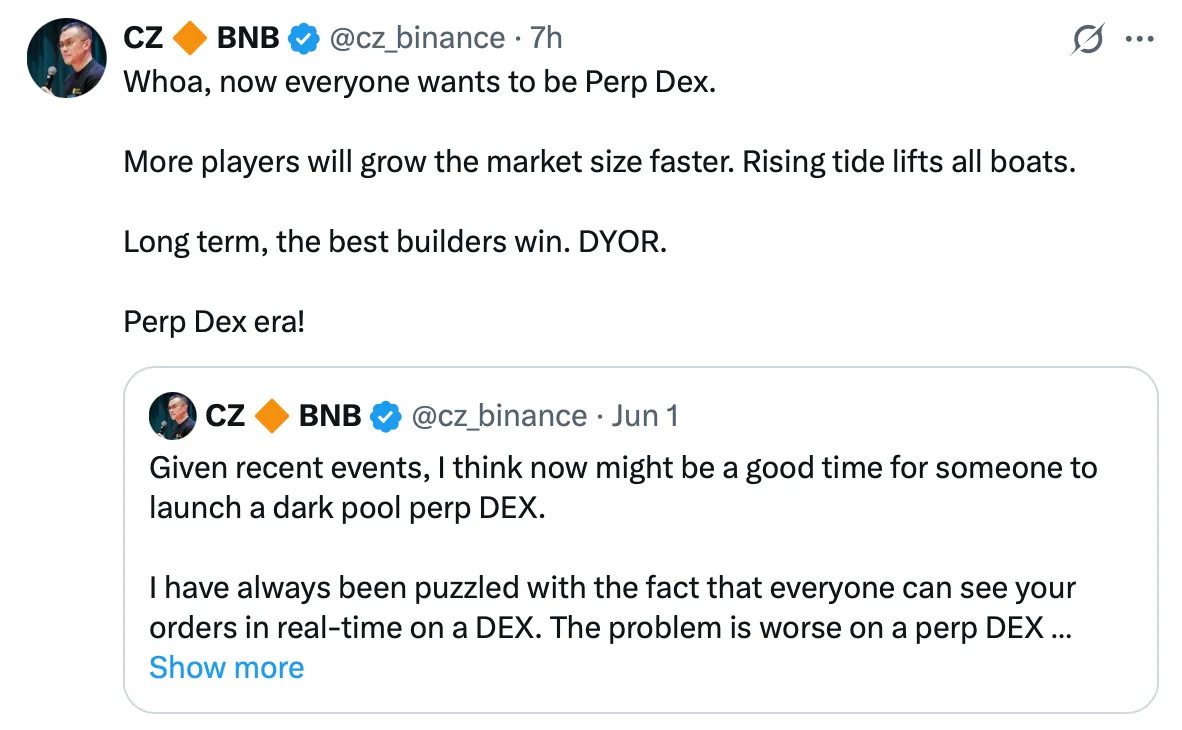
But early on, based on valuations and trading volume flows should be shifting from Hyperliquid to Aster, as both share the same playbook and likely the same users.
Still, it’s unclear if users are truly migrating. Hyperliquid’s fees and open interest remain strong and consistency. Bridges are not showing massive one-direction flows.
CZ’s impact is significant, and it shows.
He first started engaging with Aster in May 2025, with little effect, by commenting on the application profile. It was on June 5, however, he posted directly about Aster, comparing Aster to binance.
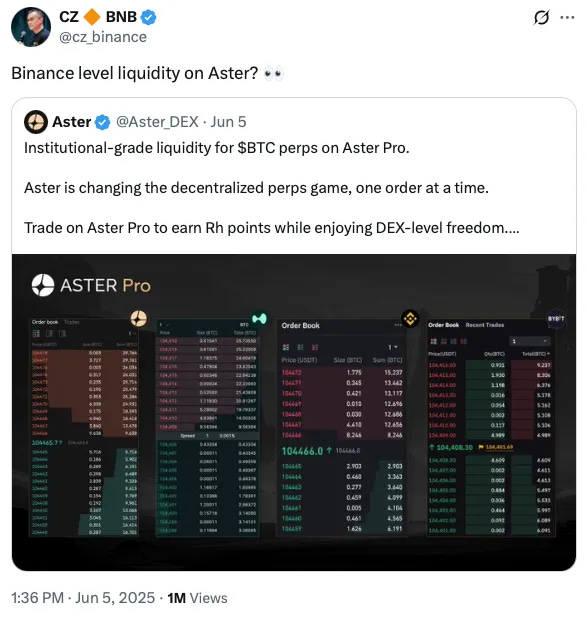
This post shifted attention overnight. It was a complete 180. Aster protocol daily fees jumped 10x.
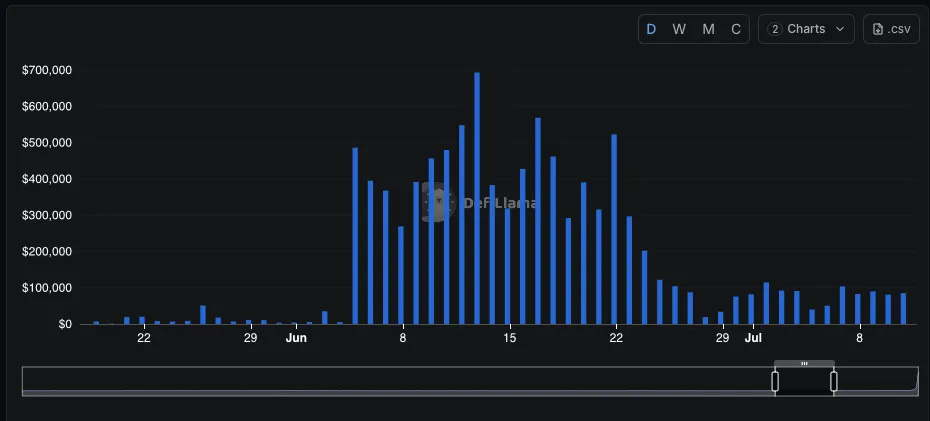
It lasted 20 days before returning to normal. This showed weak user stickiness. Meanwhile, Hyperliquid kept growing steadily, with rising fees and product strength.
CZ pushed Aster heavily in June, but groth faded quickly, until something else happened.
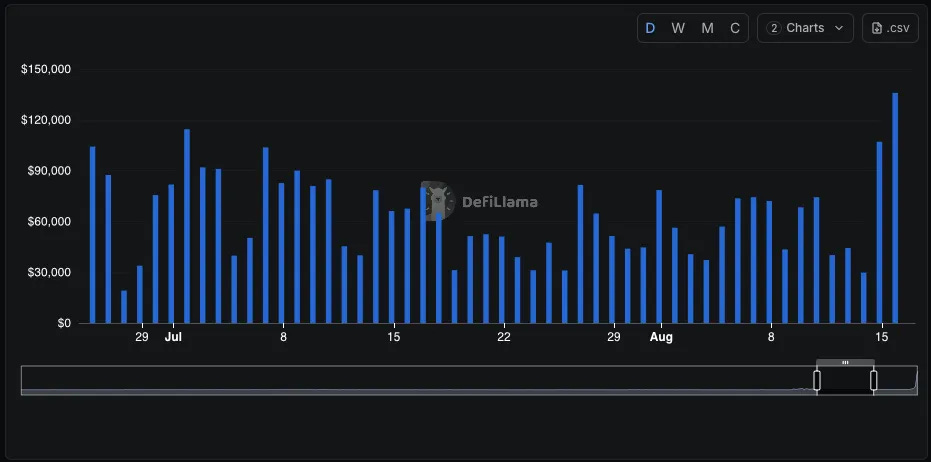
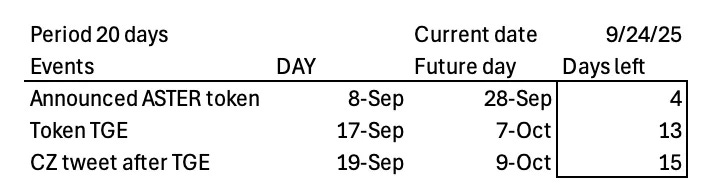
On September 8, Aster announced it’s token launch with a large airdrop for early supporters. It started a farming campaign, and explains all the volume/fees increase. The TGE followed on September 17, and CZ promoted it again on September 19.
These events explain ASTER strong token performance. Credit to the team for timing it well and staying patient.
Credit to the team, that time everything perfectly well. It’s a complete show of performance. And now they are being compared to hyperliquid a $45b protocol.
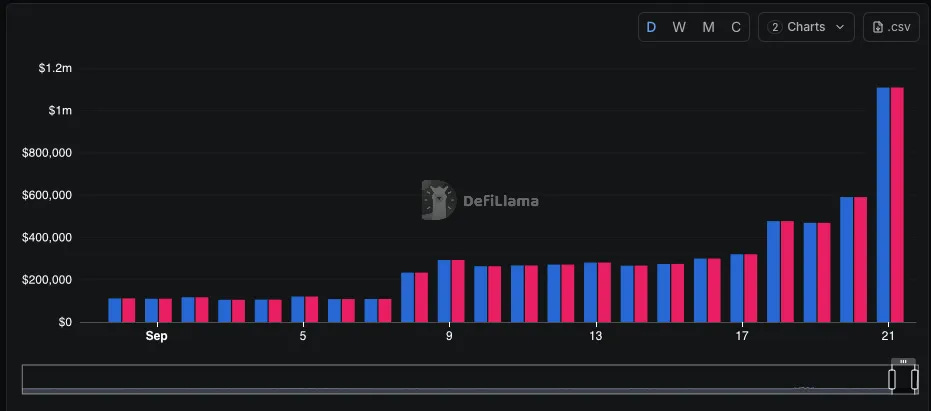
The big question is, is this sustainable, or another 20-day spike?
If it follows the last pattern, the rally could end in 4-15 days.
Aster performed the stage 1 airdrop. Now, it is the FOMO season. Traders FOMO’ing the performances of the token, Stage 2 airdrop is live. Again, much of this volume comes from airdrop farming in stage 2, which distributed part of the 53.5% supply.
Once users farm enough points that are comfortable and settle, they live the protocol waiting to the token distribution. But, as hyperliquid, further airdrops can be delayed or never happens. This type of action coudl reduce exposure to Aster, easing sell pressire at high valuations, and vapors the performance generated.
This fee surge won’t last forever. Rational CZ will notice the overvaluation and shift attention to the next big project.
That could be Trust wallet, which he mention recently. Comment on an integration with Aster perps inside trust wallet application. Could lead an increase in internal activity, generation of fees while locking users to a “super-app” thesis.
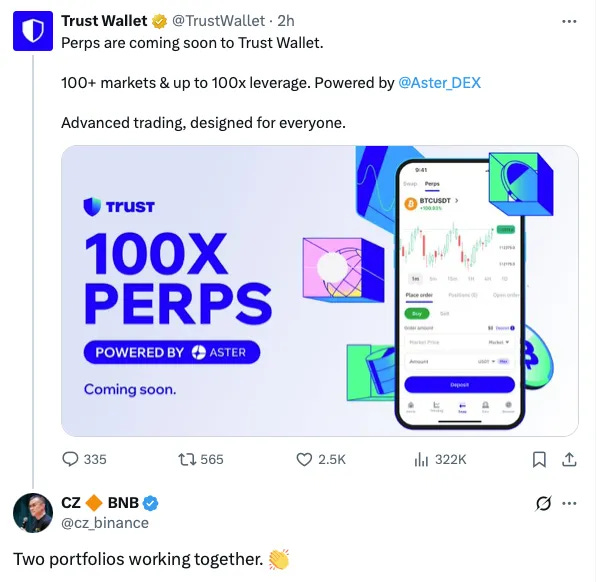
The push to build a super-app trust wallet is notorious. Trust wallet is alive for a while, without that much attention around it. Metamask, phantom completely dominate the space.
But a higher thesis could change everything.
Trust wallet might become CZ’s second trench. He already posted about a “renaissance of TWT”. And the push by trust wallet team to do a renaissance to the token.
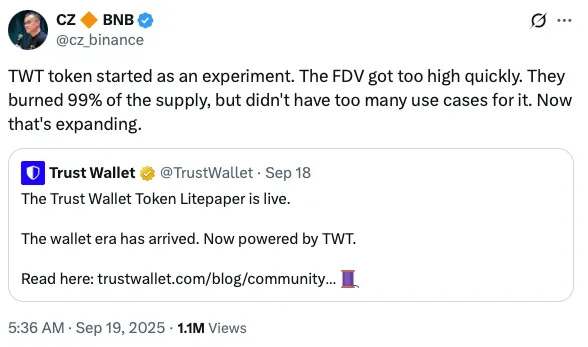
They aim to be a super app, empower “210M” users (likely inflated but those are the numbers) across chains, not just BSC.
A new litepaper outlines new TWT “utilities”. And potentially brings more use case for the token holders, bring more value to hold it.
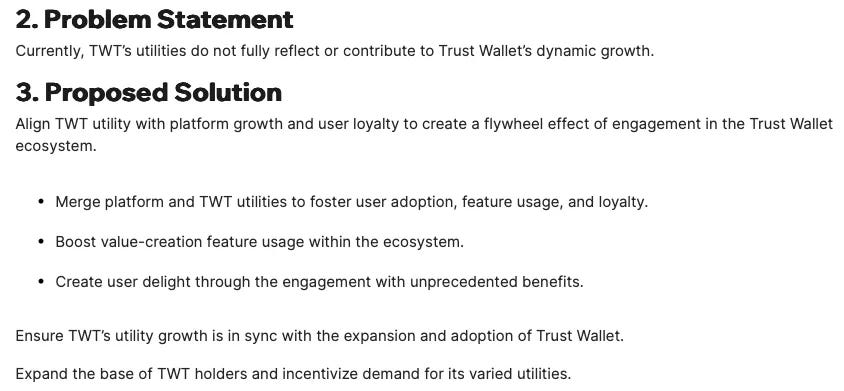
Utilities like:
Build a loyalty program;
DeFi collateral use;
Fee and gas discounts
Access to support, services and tools
Voting power and community access
This data can be biased, and innacurate, but despite the push, trust wallet fees remain low. And growth could accelerate rapidly as soon as the app start getting real use cases.
The binance acquisition and further integration was what drives the most amount of app downloads. YoY downloads grow aiming to achieve 1 billion users by 2030 with features like trust card, trust pay, and advanced trading.
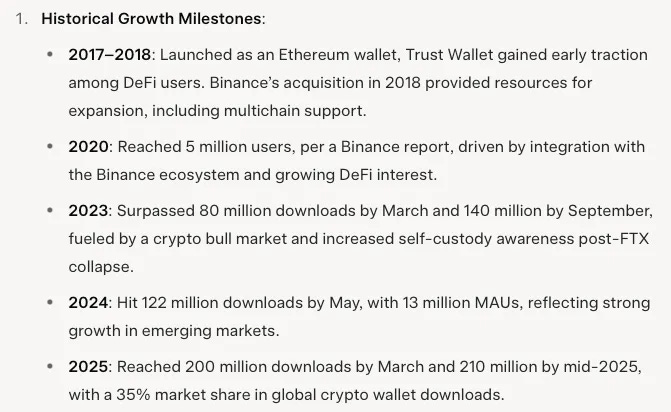
It looks that they want to make a shift to bring value to the token. But it’s still unclear what happen to the revenue, how much is the revenue and internal numbers be like.
It is a token-revenue or it is a equity-style business.
TWT lives only inside the app and a few exchanges: binance, bybit. Future catalyst are the open the door to new venues like hyperliquid, Aster (decentralized exchanges) and Upbit, OKX, Coinbase, Kraken (centralized exchanges).
TWT is trading near $500m MCap and $1.2b FDV. With these upcoming feature unlocks and attention flow, the token price could move much higher, rapidly.
Before this move began, daily trading volume was around $15m. At that level, even mid-sized positions could move the market.
With this series of strategic announcements, the token price surged and volume spiked to 30x the daily average. This shows how reactive the market can be to these kinds of actions.