


(This is an internal thought about left - right policies confronts. This should guide us for further conversations, not as a financial advice.)
Follow for more research!
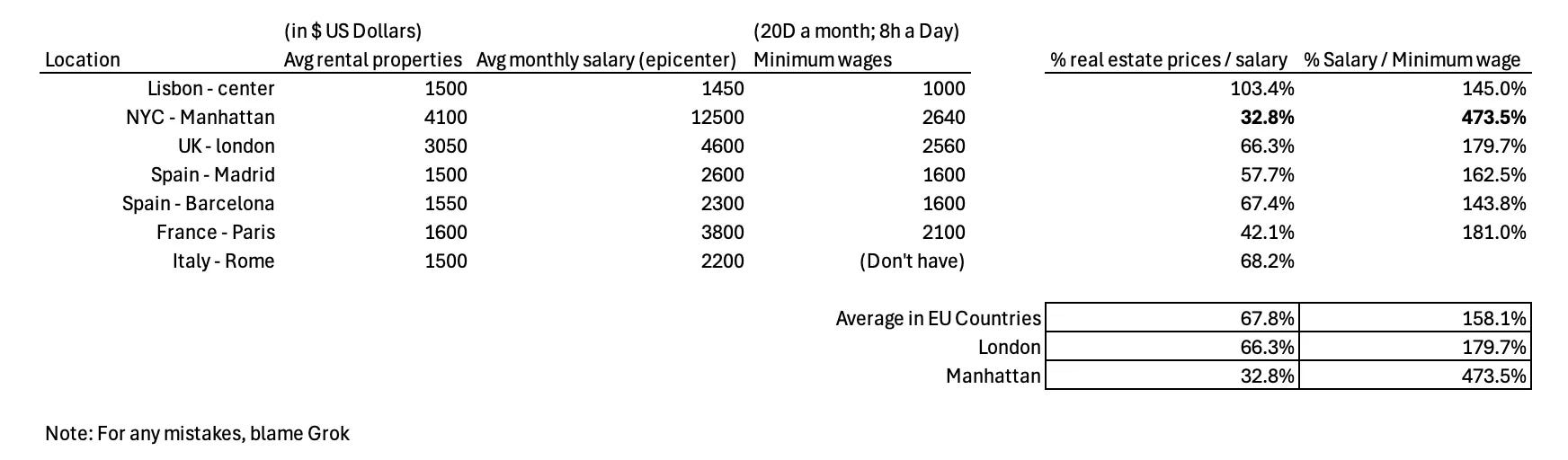
When I observe the rise of socialism in NYC, I compare it to numbers in Europe. American psychology seems widely more alarming and volatile. Historically, Europeans are more patient and less volatile, whereas Americans are louder and more active.
Seeing socialism rise in NYC requires me to confront numbers to understand why this is happening. I need to know the fundamentals behind the rise and determine if it is a valid move or just noise. I used a native app, Zillow, to see the first numbers. I automatically saw comfortable rentals, especially listings at 3 and 4 thousand dollars for good Manhattan locations.
The cost of living, particularly food, is certainly elevated in US. I know this from living in Chicago a few years ago. If you value healthy food, prices increase significantly. This justifies why over 40% of Americans are obese. But food costs are about supply chain issues, tariffs, and taxes. If the free market works, costs will go down, so this is not a reason for concern in my analysis. Wealthy individuals tend to value health more. Un-wealthy individuals often value wealth over health, so the cost of specific healthy products is not their main worry.
Properties are limited. If the population and the number of companies in an area increase, real estate prices will also increase. Building new properties takes time. When a city is in a demand shock, supply cannot reach the entire audience, and prices go up.
Controlling real estate prices over a 5 to 10-year horizon is simple. If you want to lower prices, you reduce incentives for rich people through higher capital gains taxes or inheritance laws. You also enforce new laws or taxes for corporations. In a few years, companies will leave, and people will move to the new locations. Rich people also leave, and you end up with a zombie town. If you want to increase real estate prices, do the inverse. Create stimulus for companies to develop there and improve facilities for new architecture. Lower all taxes on capital gains and inheritance. Improve capitalism. You will see a flow of companies and people moving to your town.
It is as simple as that. But you must be aware of the consequences of your actions. Once you make a change, the reversal is hard. People and companies will be threatened by the change and will lose trust in the policies. You cannot test back-and-forth politics. You must be sure about your take for the long run.
The rise of socialism in NYC is sustained by an increase in real estate prices and cost of living. But when I check the major location, Manhattan, I do not see a problem in their fundamentals. The government should facilitate the free market, policies, and taxes for its population, working on a 5 to 10-year horizon. NYC is the most capitalist city, and seeing it move more to the left is a concern for capitalism.
It is far behind Europe, as we can see in the numbers. Europe is moving from left to right in the majority of countries, including Portugal. After having left policies in last years, ending up with bigger and more robust problems - lack of growth, innovation, wealth, safety, low quality immigration and high quality emigration, degrading infrastructure, lack of capital and companies.
The solution to this “cost of living” problem is not left policies; it is right policies. This includes lowering the barriers to development and increasing jobs by facilitating companies locating there. Concentrate capital, people, and knowledge in the city so that all locals win. At the same time, you must increase policies that give comfort to the less wealthy-like better transportation between the outside and the center. Safety in all areas and transports, no tax on tips, better public schools, and easier access to debt for schooling are essential.
These are key points where Europe, using Portugal as an example, is good. The majority of universities, including the best ones, are public. If you solve the knowledge and education system, you solve one of the top issues of the population by providing the “same opportunity” to all citizens.
Government money should be used to spend on non-profit-driven products, in partnership with non-profit organizations. Build a much better education system, security programs, infrastructure, and a public health infrastructure in partnership with private ones. Create a public insurance system for less privileged people.
And that’s it. Let the rest go to the free market, reducing friction in all areas.
Thanks,
Joao