

[Brief in podcast format]
Enough of the war news. This letter will be short and concise, highlighting key situations and warning of potential risks.
We all know the US is attacking Iran, using Israel as the front face. Sources show the Iranian regime has consistently used propaganda against US and civil attacks against populism. While Trump used the “liberation of civilians” as a justification—a noble promise on the surface—this would not be happening if the US didn’t need more oil, or if China weren’t the primary buyer of Iranian crude. The critical tension between the US’s need for oil and China’s control of the Iranian stockpile is the most important variable in this attack.
The problem is that Trump expected a “Venezuela-type” result: kill the leader and the regime collapses. That didn’t happen, and it won’t. Instead, US bases across the Middle East—in Dubai, Abu Dhabi, Saudi Arabia, and Kuwait—are now under fire. Iran is escalating further by striking British bases in Cyprus. This escalation is real; with Polymarket pricing the end of the war by April 30, we are looking at least two more months of conflict across the region.
This shift from a periodic shock to a multi-week war of attrition increases the risk for both sides. They will fight until their arsenals are vaporized. As with all wars, deficits will go through the roof. Because the US is not in a healthy debt situation, US Bond risk is rising, putting upward pressure on rates and interest spending. To restock the arsenal spent on the Iran war, the administration will have to increase the deficit, forcing reserve assets price to adjust accordingly. This is especially true for Bitcoin, where energy costs are directly correlated with production price, and price is correlated with debt expansion.
Iran would be a “nothing burger” if they didn’t have oil and the Strait of Hormuz—the most important strait in the world, where 20% of all natural gas and oil flows. China has been clear: they support Iran economically because they need that oil, but they aren’t going to provide military support (in my perspective … yet. Depending how far can it go). The danger is if China feels it is an emergency for them to control Iran oil because the US cannot. If US block the China oil buyout programs in all over the world (first Venezuela, now Iran, next Cuba). There is no other option than China fights with “big arms.” It is a low-probability event, but if it happens, we are looking at World War 3.
In the short term, I expect most traders to view this as a Ukraine-type war, where Bitcoin lost -46% during a +44% oil spike. However, I am looking closely at the 2011 Libyan civil war, where oil spiked from $85 to $114 and Bitcoin jumped from $0.80 to $31. This conflict is more closely related to that Middle Eastern dynamic than to Ukraine. Bitcoin’s refusal to dump on the initial news gives me confidence in the “risk-off debt spiral” simulation, which pushes Bitcoin to new highs. The morning reaction—a +5% swing in Bitcoin alongside a +5% oil increase—supports this. I’m long bitcoin on this event.
Within this tension, there are two specific topics I am studying that will provide guidelines for future opportunities and problems: the use of AI on the battlefield, and the first real attack on the Middle East since it became a global growth hub.
Regarding AI, the administration has reportedly been using Claude LLM to run war simulations and build out strategies. Sources mention that the successful capture of Maduro was made possible by Claude’s reasoning capabilities. This Iranian conflict is the first “clear war” to use AI for intelligence support, matching one of my 12 predictions for 2026 and the catalyst problem I highlighted in my AI thesis.
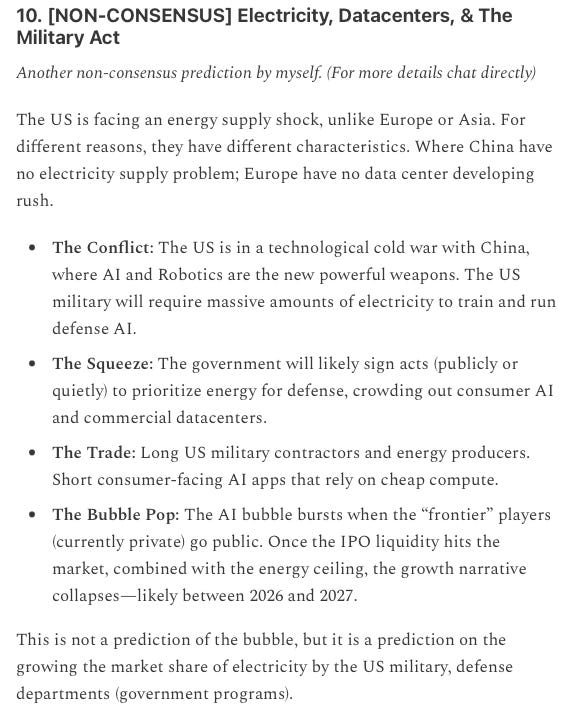
This suggests that the Department of Defense will scale its use of AI infrastructure originally intended for enterprises and civilians. In an emergency, the Pentagon’s needs supersede those of the public. A war simulation with a 10-million-token budget is more important than 100,000 customers asking for weight loss tips or dating advice. This shift in task relevancy recently pushed Claude’s servers to the brink, compounded by direct attacks on AWS datacenters in Dubai
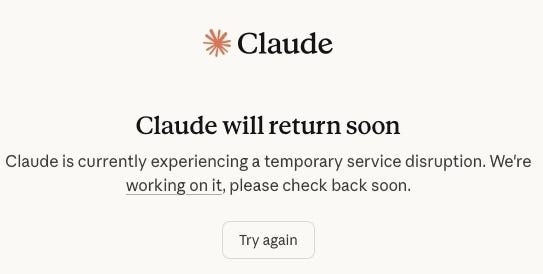
I can say with high confidence that the Pentagon still has priority access to Claude, as it is a matter of national emergency to keep this “super-intelligence” working. Consequently, more datacenters must be built on US soil. As compute is pivoted to support national security, the cost of running civilian AI applications will face even more pressure.
Beyond the technology, I am concerned about the growth of the Middle Eastern economy. Major growth hubs—Dubai, Abu Dhabi, Saudi Arabia, Kuwait—are being bombed. This will stay at the top of people’s minds when they consider developing or living there. I have friends who are scared to death, watching US military evacuations and hearing bombs near airports, hotels, and datacenters. This creates massive friction for a growing economy.
UAE ETFs are already down 8% in a week, dropping more than 5% today alone. With no flights in or out of the region, a sense of fear is settling into the international community. If this lasts for more than a week, it threatens the economy long-term. The collective power of the Middle East will eventually react; they cannot tolerate missiles flying over their land, even if the targets are US military bases. Tax-free living is nice, but only if you are alive. This fear will outlast the period of the war itself.
This will be a case study in whether security threats can derail Middle Eastern growth, making it the “second Brazil”—an emergent economy that lost its path to external forces—or if they will pivot to a more secure system that restores trust.
The main question is how to position. I don’t believe today’s Bitcoin upside will be faded; I am long Bitcoin over any other reserve asset. But my biggest opportunity isn’t Bitcoin—it is Hyperliquid. This weekend was the turning point for the platform. While tracking Iran news on CNBC, I noticed that analysts were citing Hyperliquid as the venue to watch for real-time commodity price.
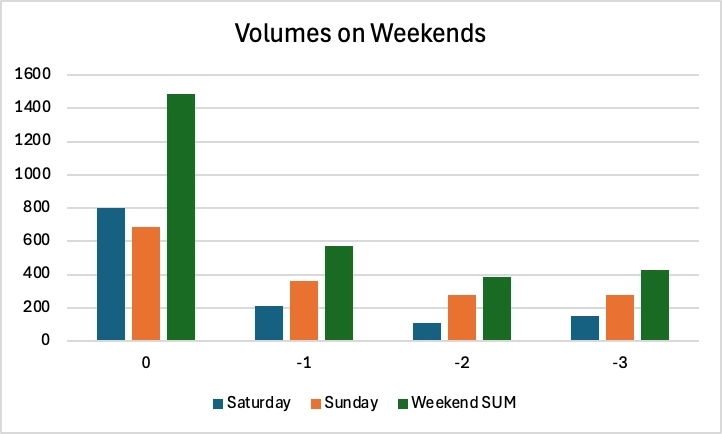
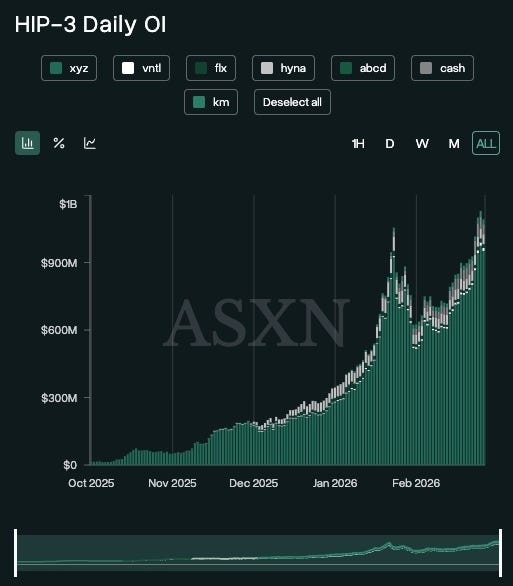
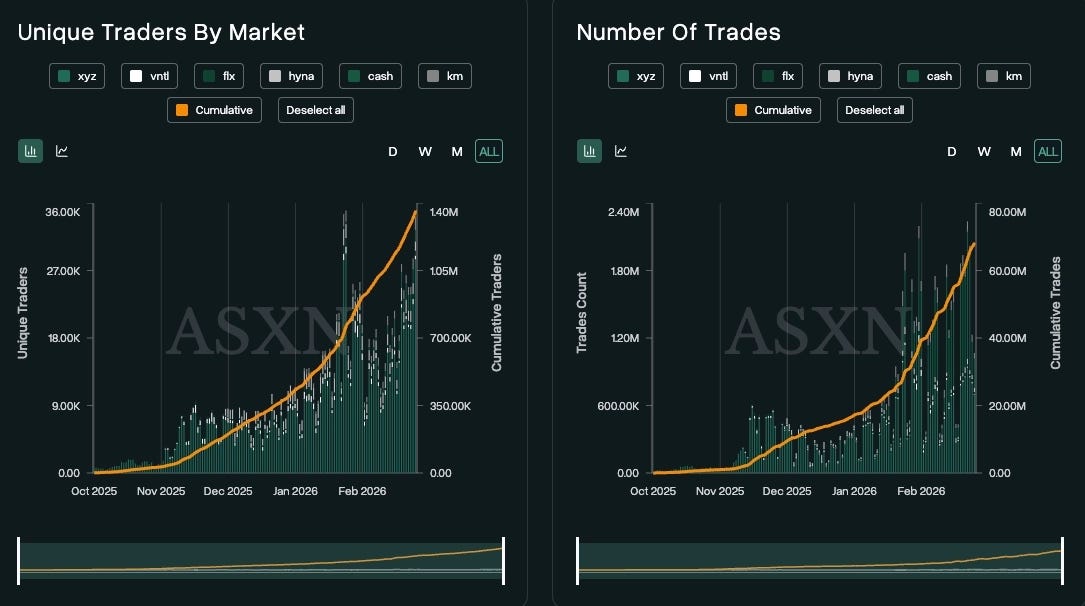
Hyperliquid is no longer just a “crypto venue”; it is now the most used 24/7 trading venue for commodities. CNBC mentioning it during the biggest geopolitical event of the year creates an unprecedented track record. Last weekend, Hyperliquid traded three times the volume of the previous three weeks. HIP-3 already counts 1.3 million unique traders and over $1 billion in open interest. For a product less than six months old, this is huge. HYPE is directly tied to this evolution, and this weekend alone saw over $1.4 billion in perp volume for HIP-3 products.
This is intended to be a thought exercise, and not financial advice. Reach out in open conversations, DM me or comment anytime.
I’m aiming to provide clarity about the world day-by-day, and I hope you get smarter and more financial intelligent every day. Each day we increase our chances of winning.
Thanks, Joao