

[with Brief in podcast format]
Oil prices are now at $90ish. Where the majority of the market didn’t expect the war to escalate this much, it is clear that the situation is intensifying under Trump’s “fire,” with B-2 bombers having dropped dozens of bunker-busting “penetrator” bombs to destroy the regime’s crucial infrastructure. Trump is warning that there will be “no deal” except under “unconditional surrender,” aiming for a policy of “MIGA”—Make Iran Great Again.
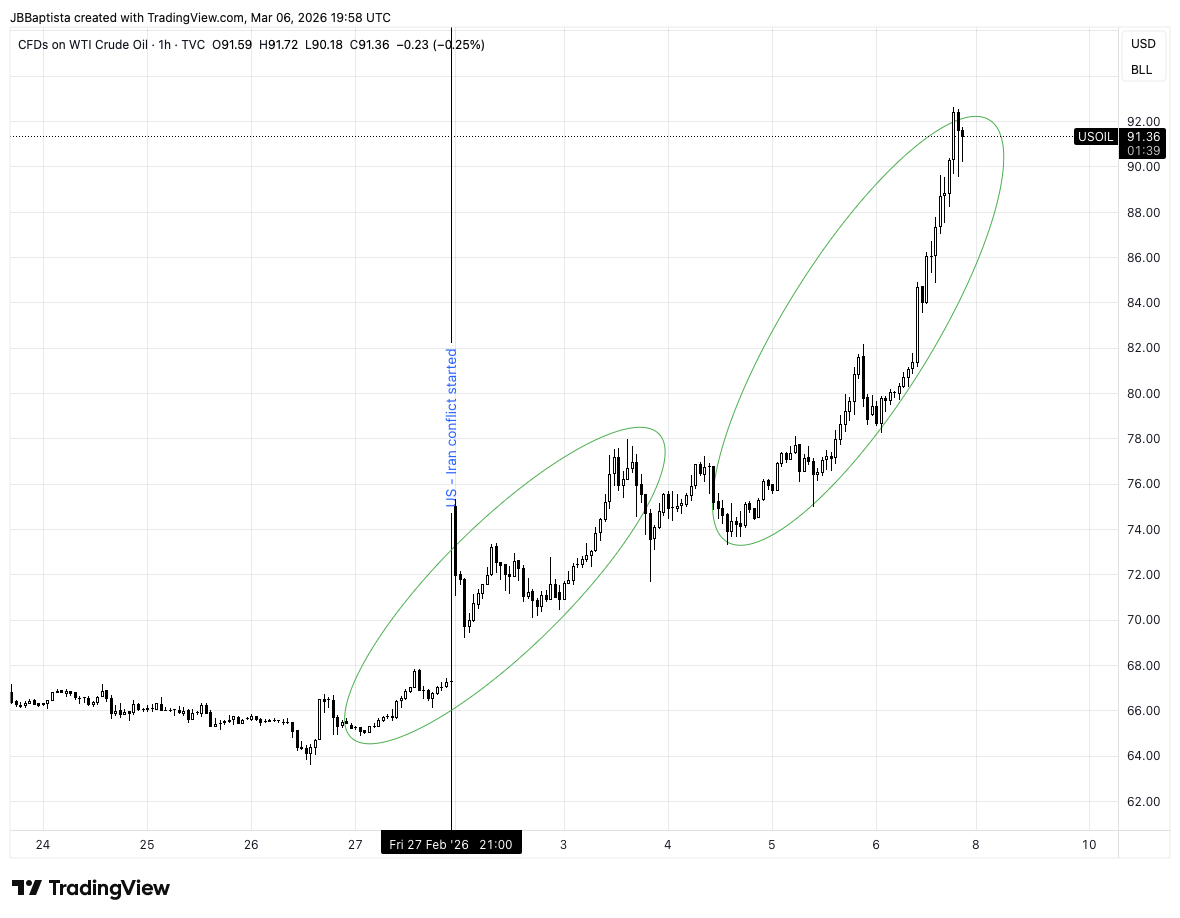
This military escalation has triggered a surge in political volatility. The war in the Middle East is claiming not only higher volatility in oil and geopolitical instability but also heightened China-US tension. China has effectively lost control over Iran and its supply of cheap oil; in the event of a total regime collapse, their ability to source discounted, sanctioned oil—which they have relied on for years—is under direct threat. China has remained relatively quiet because they are in a bind: if they defend the US, they betray their allies; if they defend their allies, they go against the world, selling weapons on one side while buying oil on the other.
Historically, in times of war, nations involved but without a direct land threat tend to grow their economies substantially. The clearest examples are WWI and WWII, which facilitated the massive expansion of the US relative to Europe. While nothing of that exact scale is happening yet, the US is emerging as a clear winner in this conflict.
Conversely, the rest of Asia, including China and the UAE, stand as the biggest losers. As missiles and drones spread across the Gulf and target various Middle Eastern countries, the resulting tension has caused a collapse in flight traffic and pressured business interests to flee. China, which was highly dependent on Venezuela and Iran, is now watching its two biggest dictatorial allies face death or imprisonment. Xi is losing his grip on global control; it is only a matter of time before the Chinese economy feels the full weight of this pain.
The timeline is tactically perfect: Trump and Xi are set to talk in late March, and by gaining leverage through these regional collapses, Trump ensures Xi is unable to bargain from a position of strength. The goal is likely to seize control of Iran to further leverage negotiations—first Venezuela, now Iran.
I believe this is a mission to contain China—a mission being executed by the intelligence community rather than just the president. Regardless of who was in office at this exact moment, this war was likely inevitable given the current conditions; Trump simply created the “political marketing” and the tactical conditions to accelerate it.
This shift was foreshadowed in September 2024, when the UAE was designated a US Major Defense Partner—the highest tier of defense relationship. With an annual defense budget of approximately $22.8 billion, the UAE was clearly expecting an attack even when the rest of the market was not. Their defense systems have now proven their worth with over 95% efficiency, yet even a small error rate causes significant damage on the soil and instills fear in the civilian population.
Despite the apparent normalization of life in the ground—with restaurants full and malls packed—the UAE is under clear threat. While the general public maintains a routine, the “smart money”—the millionaires and billionaires—are increasingly concerned about their safety. Billionaire Khalaf Ahmad Al Habtoor was the first to publicly voice these concerns against “Operation Epic Fury.” Consequently, the volume of business flights into Oman has climbed, serving as a reliable proxy for the capital flight occurring in the Middle East.
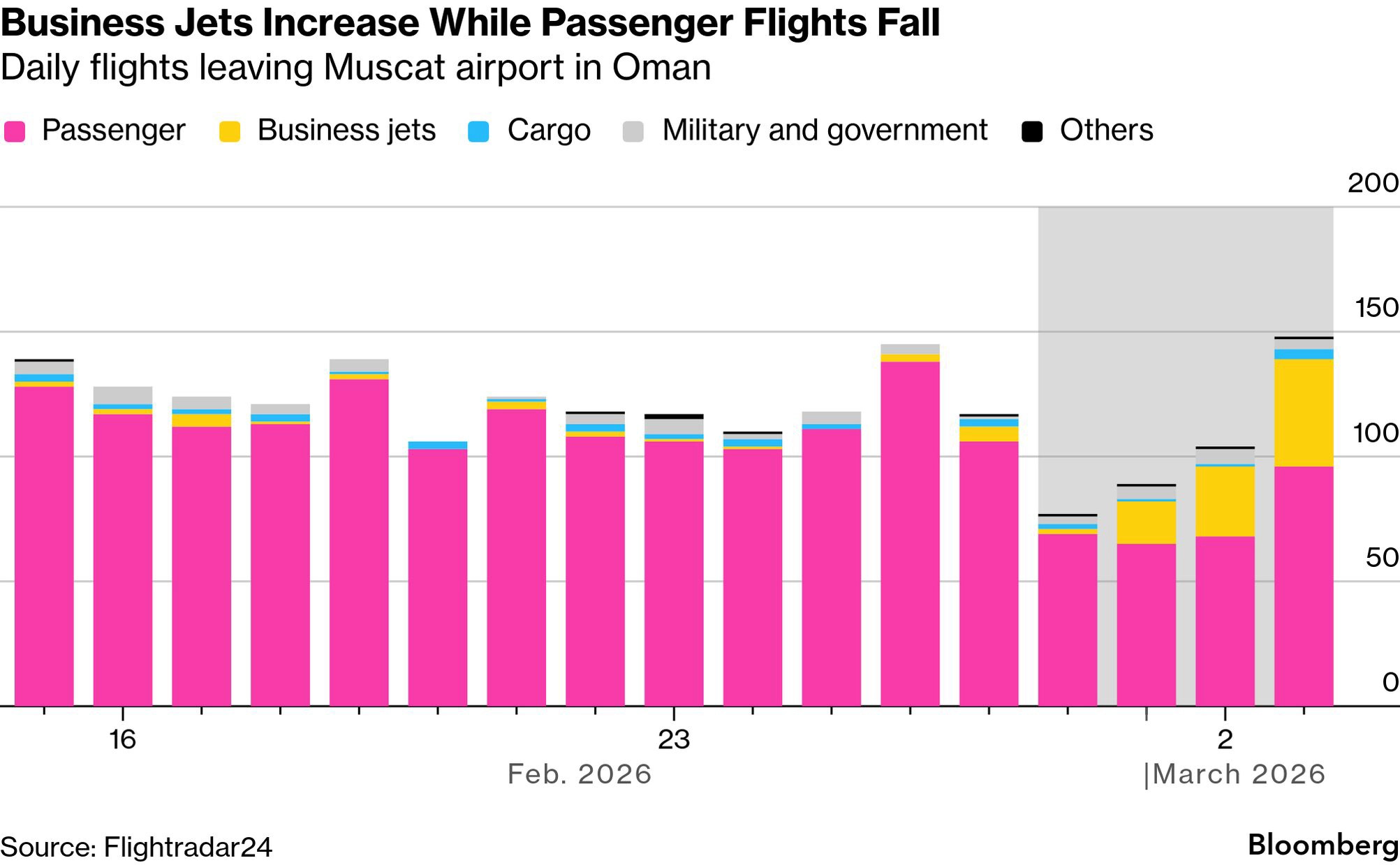
The UAE economy is highly dependent on expats. The shift from an oil-based to a non-oil economy, especially in Dubai, is driven by its reputation as a “safe haven”—the Switzerland of the Middle East. The UAE has aggregated more than 240,000 millionaires and dozens of billionaires, with huge hedge funds moving in from the UK. However, this capital is not guaranteed; it stays for two reasons: 0% tax and safety. If either criterion is compromised, the decline will be swift.
When there are losers, there are winners. Predicting who wins is often less risky and more profitable than predicting who loses.
The wealthy individuals fleeing Europe, the UK, Asia and US are not going back to their countries; they are searching for a new solution that accommodates their needs. The clear answer is not Switzerland or Monaco, nor is it Miami. The answer is Singapore. Singapore has proven itself as a “safe haven”, a tech first country, and tax-free or very low tax for most use cases. While it is more bureaucratic and is currently tightening its policies, it remains the most competitive destination aligned with the vision of the global elite.
Economically, Singapore’s ports and airports are set to grow substantially as businesses diversify away from the Middle East. The disruption at Dubai’s airport will be top-of-mind for many companies, positioning Singapore as the ultimate solution for capital and goods.
At this stage, there appears to be no solution other than regime change in Iran. While the fall may not be immediate, it is inevitable. Polymarket is currently pricing the probability of a regime collapse by year-end at 51%.
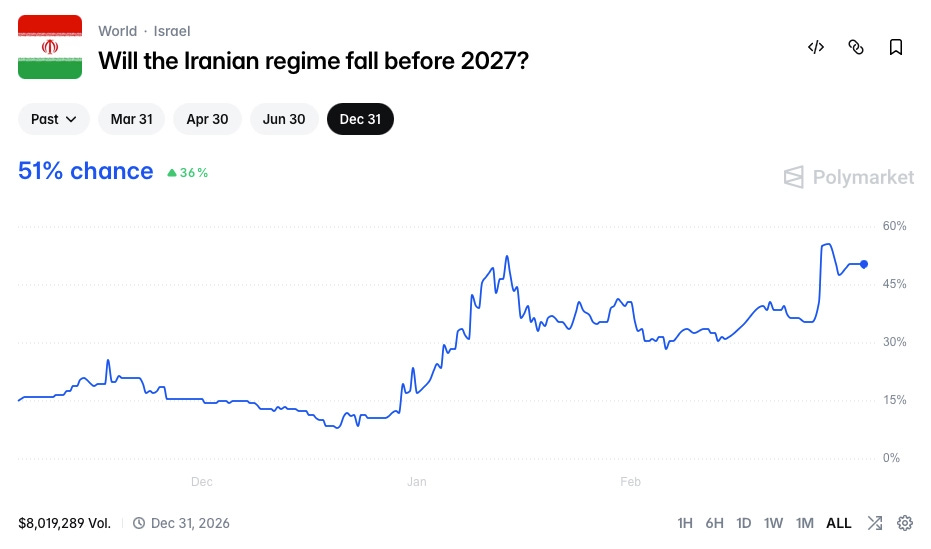
This massive piece of land has created consecutive disruptions in oil and the Strait of Hormuz while its population lives in poverty. Iran has become a threat to the US agenda by fueling its biggest competitor, China. By attacking its Gulf neighbors, Iran committed a predictable suicide; Middle Eastern countries are incensed as Iran’s drones directly threaten their economies.
While the immediate reaction should have been retaliation, the US intelligence community, in partnership with the UAE, predicted this outcome and strategically positioned themselves. Polymarket odds for a massive retaliation jumped to 75% on the initial strike news but have since settled to 25%, suggesting that a direct, all-out fireworks display is not the most likely scenario.
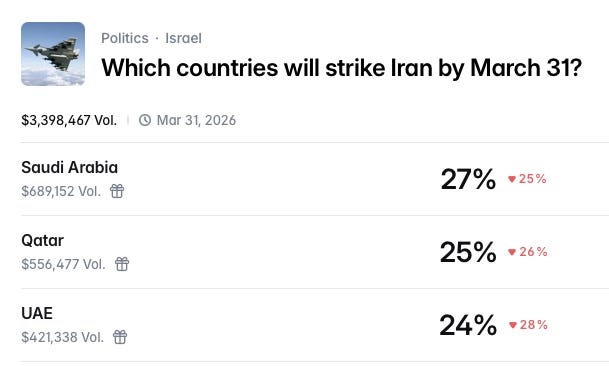
However, war and volatility always provide opportunities. If an attack does occur, these nations—UAE, Saudi Arabia, and Qatar—will likely strike together given how interconnected their economies are, GCC and OPEC frameworks. Their mission is the same: peace in the Gulf and the Strait. Strength the middle east economy and unlock extreme wealth for all. But if I had to bet, I would bet on “no fireworks” for now.
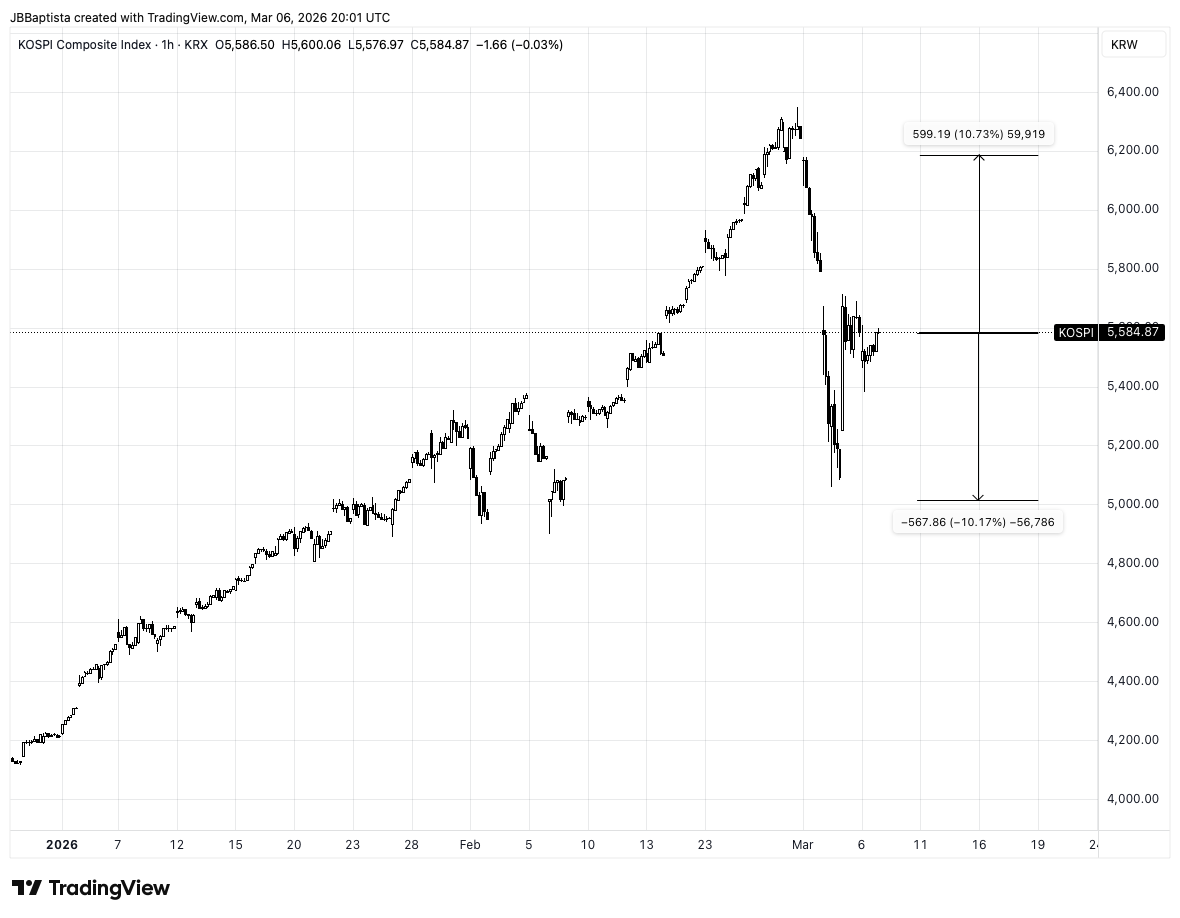
Two days after the worst day in its history, the KOSPI is up +10% from its local bottom. This pullback is an “after-storm” relief, but this weekend will be crucial. We must see the Strait of Hormuz open; otherwise, further collapse is expected for Korean markets next week. The binary option is clear: if a deal happens this weekend to control the flow of oil, it is positive for KOSPI. If not, we likely see the KOSPI under $5,000 next week. It is not a -1/+1% move; it is a -10/+10% move. My inclination is that no deal happens.
This geopolitical shift aligns deeply with my major thesis for a significant Bitcoin and crypto boom in 2026. The Korean market is huge for crypto and is populated by “tech-optimistic degens.” Retail traders and firms there love leverage. With their native stock market constrained by oil problems, they will move their attention to hyper-liquid markets like Bitcoin.
The easing cycle in the US, combined with unemployment exceeding last expectations and the cost of war, will force the “printing machine” back on. As Trump said, there is an “infinite” missile supply, and war makes it easy to justify printing. I believe the forces pushing for an easing cycle this year will be much stronger than the market expects.
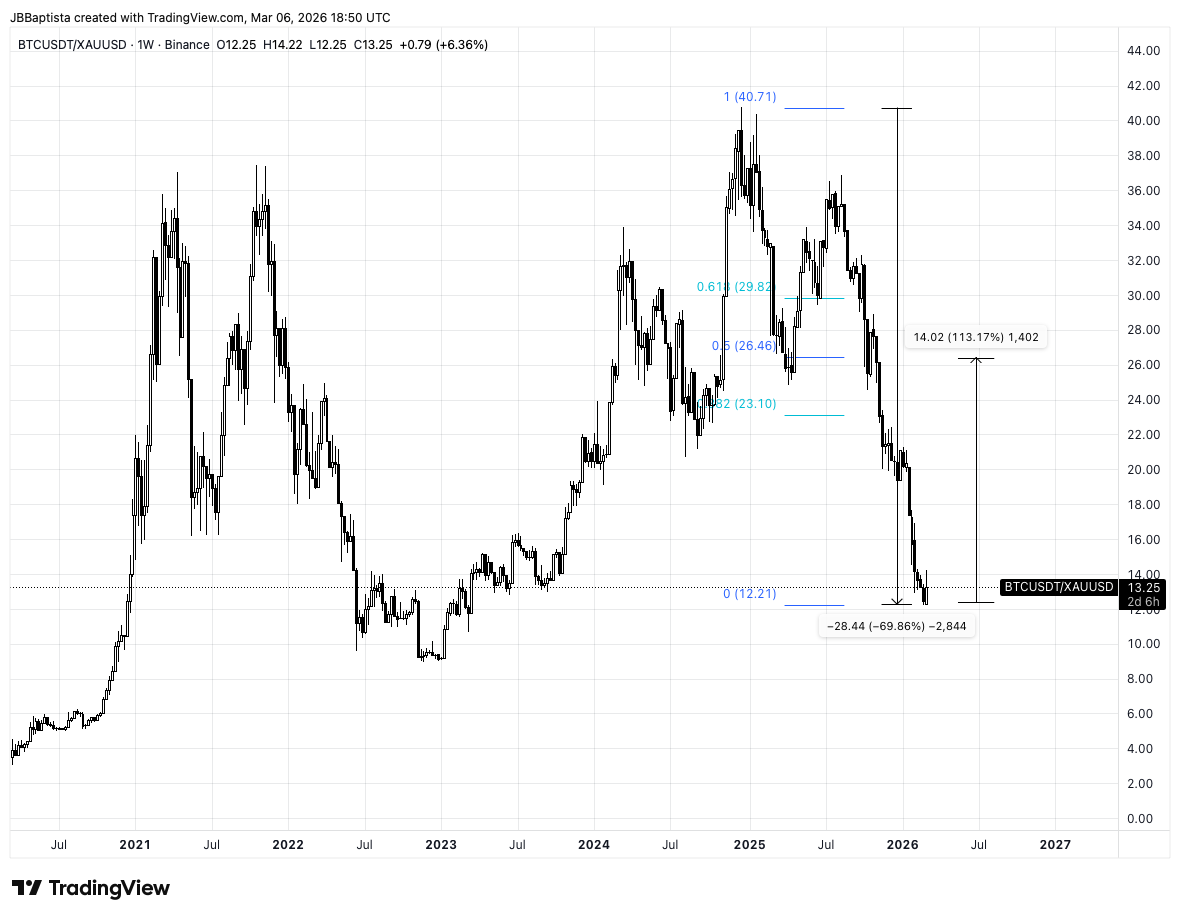
While the rush to Gold was the story of 2025, Bitcoin is increasingly viewed as the reserve asset for the next phase. Bitcoin lost 70% of its value against Gold in 2025; even a 50% “mean reversion” would see Bitcoin double against Gold. In predictable situation of both assets going up, is likely that bitcoin will have to triple to converge to the mean.
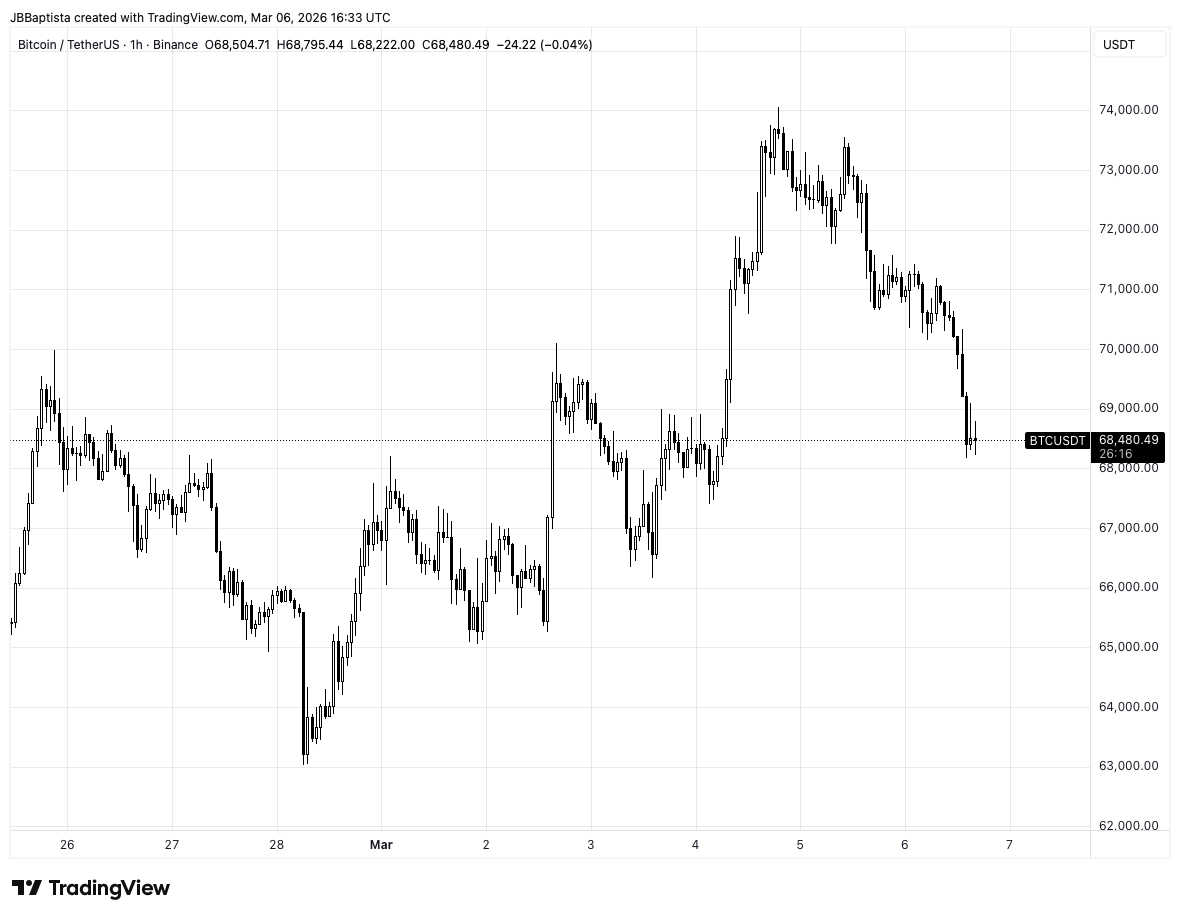
Bitcoin is down 8% over the last two days, sitting at $68k. This volatility offers a prime entry point to accumulate. (NFA, always). For those looking for high-leverage exposure to volatility, the BTC-120K-25DEC26-CALLs are currently at an attractive entry price.
All eyes are on geopolitical tensions and geopolitical trades. In a world of hyper-trading, hyper-financialization, and hyper-speculation, volatility and trading volumes continue to grow overall—and HIP-3 volumes are growing right along with them. In the world of distribution, where whoever controls the channel wins the premium, Robinhood worth 50% more than Nasdaq.
Applying this logic to crypto, I’ve been thinking about who truly owns the distribution. I end up, once again, looking at Hyperliquid. However, Hyperliquid doesn’t just own the distribution; it also owns the infrastructure and the liquidity, aggregating all markets in an unprecedented fashion. Pump.fun is capturing the distribution in a similar way: they started with token issuance, moved to creating the liquidity layer, and now own the frontend platform, controling the full stack. They are currently shifting from a meme-first platform to an all-token trading platform, leveraging the two most valuable assets in this space: distribution and liquidity.
While both companies are aligned with this mission, they trade at completely different multiples.
This shift suggests that DEX aggregators—the routers of these trades—will likely become more valuable than the DEXs themselves because they ultimately own the customer relationship. Meanwhile, traditional DEXs are being squeezed by the pressure to create lower-fee pools; as they grow, they consistently erode their own path to monetization, especially in a world of proprietary AMMs.
This is not to say DEXs will disappear. On the contrary, they will remain highly valued and crucial. A combination of both AMMs and proprietary AMM systems is necessary to unify liquidity and create predictable outcomes during black swan events. While that is a topic for another article, the continuous risk posed by the lack of deep DeFi liquidity in our open economy is massive. October 10 proved that we aren’t just looking at a “Binance problem,” but a systemic vulnerability within the very DeFi structures we value most.
This is intended to be a thought exercise, and not financial advice. Reach out in open conversations, DM me or comment anytime.
I’m aiming to provide clarity about the world day-by-day, and I hope you get smarter and more financial intelligent every day. Each day we increase our chances of winning.
Thanks, Joao