

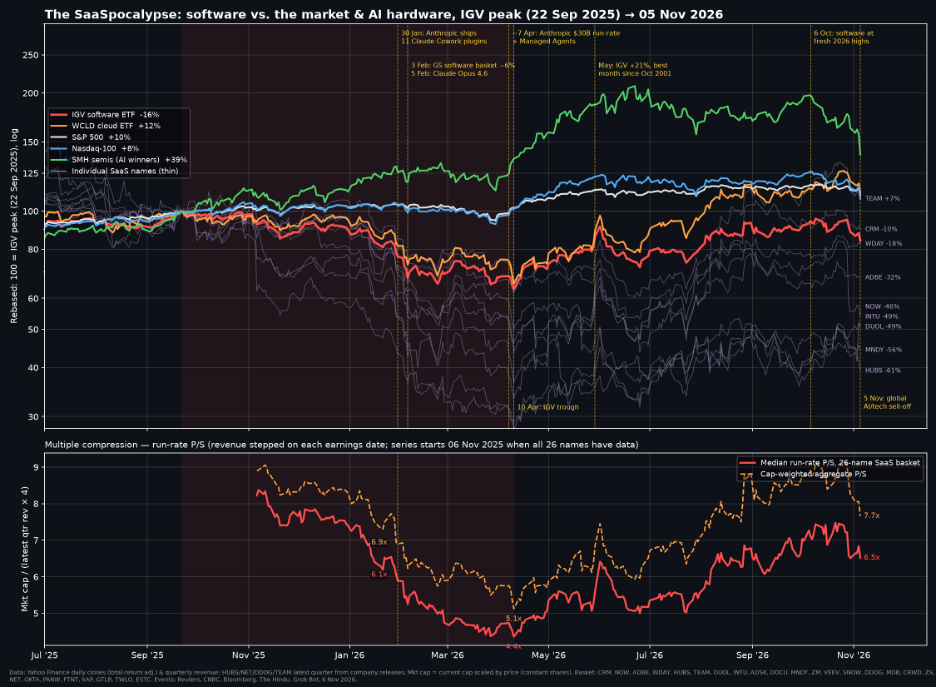
The first wave of the AI trade was the collapse of SaaS multiples, as AI threatened their business. As the AI labs threatened most of the pricing power of SaaS businesses, they originated the SaaSpocalypse that we saw. Multiples compressed from about 22x P/S at the 2021 peak to under 7x today for the largest names, and from about 8x to 4.4x during the SaaSpocalypse itself (median of a 26-name basket, late 2025 to April 2026), a collapse of roughly 45 to 70%. This was the first wave, and it should warn us about what could be the second wave of the AI market collapse.
The frontier model labs, the hyperscalers and the chip-makers are now in a contagious, negative reflexive situation that can cause direct contagion between all three, as they all need the continuous (limitless) buildout of silicon to support growth and future demand, and to keep the machine growing. The problem is that they have reached the limit of what they can raise in the private markets, so they need to go public to access corporate debt investors. That’s where the money they need to keep growing data centers and silicon is.
It is easy to understand how a lagging buildout spreads contagion across all three industries. Without more silicon creating compute, the compute supply shrinks and gets more expensive. Without the silicon going onto the land and being connected to the grid to build a complete data center, all these hyperscalers and neoclouds have no future business, just the ongoing business. And without the buildout of these data centers, chip demand slows down; it could still grow, but at a much lower speed. The contagion is real and direct.
Let me get back to capital markets, taking the example of the SpaceX IPO and the price of SPCX. By raising capital and going public at this huge valuation, SpaceX created a wave of wealthy insiders whose shares sit under a staggered lock-up, released in tranches from August 2026 to June 20273, and as soon as they get the unlock, they will dump all their shares to finance their lives and their luxury lifestyles. They will also dump to make sure they finally have cash in their pocket to spend.
Ray Dalio has been saying that bubbles form when paper wealth becomes very large compared to the money available to spend, and they burst when the holders need money and have to sell that wealth to get it. So as these companies create these super-wealthy insiders, and they dump their shares on the open market, the dilution is real. SPCX’s tradable float goes from about 5% of the shares at the IPO to about 40% by December 8, and the remaining 60%, including Musk’s stake, unlocks by mid-2027, and probably another 50% is expected if the SpaceX and Tesla merger happens. This requires a level of new buyers to sustain the stock price that is hard to reach. We are talking about up to about $1.7 trillion of new buying for SPCX stock remains flatline, and you can’t see where it comes from.
The dilution deteriorates the stock price, and the stock price is directly aligned with the yield spread that corporate debt investors will ask for the company’s debt. It’s simple. Lower stock price, higher credit spread. You can see it now in CoreWeave’s credit spread and all the CDS behavior, with its five-year CDS going above 1,000 bp in October and pricing roughly a 60% chance of default within five years. This gets priced in.
These companies need corporate debt investors, because the hyperscalers and chip-makers can no longer keep financing them. So they need debt buyers directly from the public markets. They have no other solution than going public. And they go public for one core reason, to raise corporate debt to finance more compute and the buildout of data centers.
Anthropic is aiming for a $1.5T IPO, and with the numbers expected by Arthur Hayes, a dilution of 83% is expected until June 2027. Even if he is wrong on the magnitude of the number, I hardly see him wrong on the direction. With all this insider selling, ownership pivots to the public shareholders and debt owners. With this direct dilution of the price, if it IPOs at $1.5T there’s no way to go but down, with more than $1T of new buying estimated to be required just to hold a flatline.
With stock prices down, credit spreads will widen, and debt investors will only buy the debt at much higher yields. Let’s see if these frontier labs are willing to take that. If they are, how hard will it hit their P&L and the buildout growth? Especially in a situation where, with the Republicans losing the midterms to the Democrats, there’s not a single reason to expect the cost of the data center buildout to go down. At best it will grow a little, through costs from delays, inspections, regulations and any new kind of enforcement on the environment, energy prices or anything related, which will increase the operating costs of these data centers. Wider credit spreads plus friction on the build will deteriorate profits, and without better profits, corporate debt investors will charge even more yield. This negative reflexivity loop collapses valuations, collapses the stock price and increases the debt yield, which deteriorates profits, which lowers multiples, which lowers stock prices, and so on.
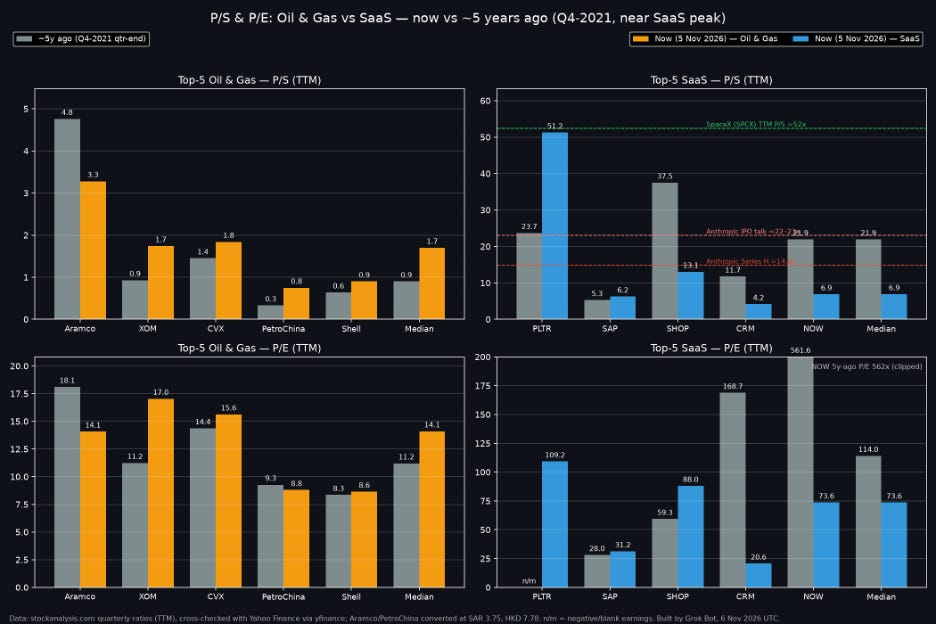
But it’s even worse. As I mentioned, the first collapse wave started with the SaaSpocalypse, which pushed multiples down by roughly 45 to 70%. While SaaS collapsed, the frontier labs took over its multiples. Now Anthropic, annualizing the last quarter to give it the most positive outcome, is being priced at 22-23x P/S, and SpaceX at 28.8x P/S by annualizing its last Q3 results. These are in line with the 2021 SaaS multiples, not even with the current, updated SaaS multiples. Basically, the market is pricing these frontier labs as the new format of, and appetite for, the SaaS business as it was back in 2021, before SaaS was threatened by the frontier labs.
But these businesses are in no way or format near the SaaS business. In SaaS businesses, you can expect previous revenue to continue into future revenue; by looking at the history of past subscriptions, you can expect future subscriptions with a level of confidence. But the frontier labs charge mostly per usage, they charge the user per token consumed, so previous consumption cannot indicate future consumption with high probability in any scenario. This means investors cannot gain confidence about future consumption by looking at previous consumption, meaning previous revenue does not guarantee future revenue. So the business comparison falls apart. The market is pricing these new companies at the multiples of the old golden SaaS business, but this will not hold once these companies and their stock end up in the hands of public market investors. Public market investors will assign much lower multiples and will squeeze them, as these multiples make zero logical sense.
Anthropic and OpenAI in particular, the companies that make up the industry that builds intelligence, are more aligned with the oil and gas industry than with the SaaS industry. Why? Because they produce a product that is consumed and used up by the user to produce something. It is a product that is used and paid per usage. If there’s no demand, there’s no need to produce more of it. It is an industry where previous consumption does not guarantee future consumption; it depends on the forces of supply and demand. And if there are some similarities, and the market starts looking at these frontier labs as oil and gas companies alike, it will be a bloodbath. A bloodbath, because we will see the frontier labs’ multiples contract in the direction of the oil and gas industry, and the median of the five largest oil and gas companies is nowhere close to SaaS multiples, at 1.7x P/S today and 0.9x in 2021. Just imagine. Even if the magnitude is wrong, the direction will push Anthropic’s stock price and OpenAI’s valuation down more than 90%, which will raise corporate debt yields and collapse the entire AI trade. A 1x P/S multiple compared to the current >20x multiple is the nightmare that any critical investor will want to face.
Of course the contagion is real, as these frontier labs can’t raise, the hyperscalers can’t raise and build, and the chip-makers can’t sell chips. The world is levered to the AI bubble, and the entire economy depends on it. GDP will collapse, and bank balance sheets will shrink. Liquidity dries up, and the entire financial system just dries up with it. There’s no way out from here. Even if demand scales, there’s nowhere to go, because creating this level of wealth by taking your stock public will create a massive dilution that no one in the world can support buying.
This is the risk of going public at $1.5T, instead of going public at $100B and letting those insiders sell at much cheaper prices along the way. They would all have sold already if Anthropic had been public and the dilution had already happened, and ANT would probably be trading at a $1T market cap now, without the dilution, so supporting the stock price would be much easier. But here we are in 2026, with IPOs above $1T and liquidity in the markets collapsing.
But an eventual bailout, with the central bank printing machine, will happen. I’m not expecting bankruptcies, the government will not allow that to happen. Especially when these companies debt represent almost 30% of the total US debt. So, eventually this corporate debt yield just gets opportunistic. The solution to all crises is turning on the printing machine, which will provide liquidity and start what could be the industry’s biggest bull market, the post-AI-collapse bull market. With much more efficient compute and abundant energy, with offshore data centers and Chinese open models, we will have the time of abundance of AI-usage and productivity. But this time it is a capital crisis. It is not a question of demand, utility or AI necessity. It is a question of money, wealth and capital markets.
Eventually, late-stage private investors will see their entry valuation much higher than the market cap of the stock, and that will wreck venture returns. A wave of bad venture outcomes is coming if they don’t sell as soon as they can, so they will sell, and they will plunge the stock price. Front-runners will try to front-run this move, which will intensify the collapse. Eventually stocks will get cheaper and cheaper, especially if the SaaS companies catch the contagion.
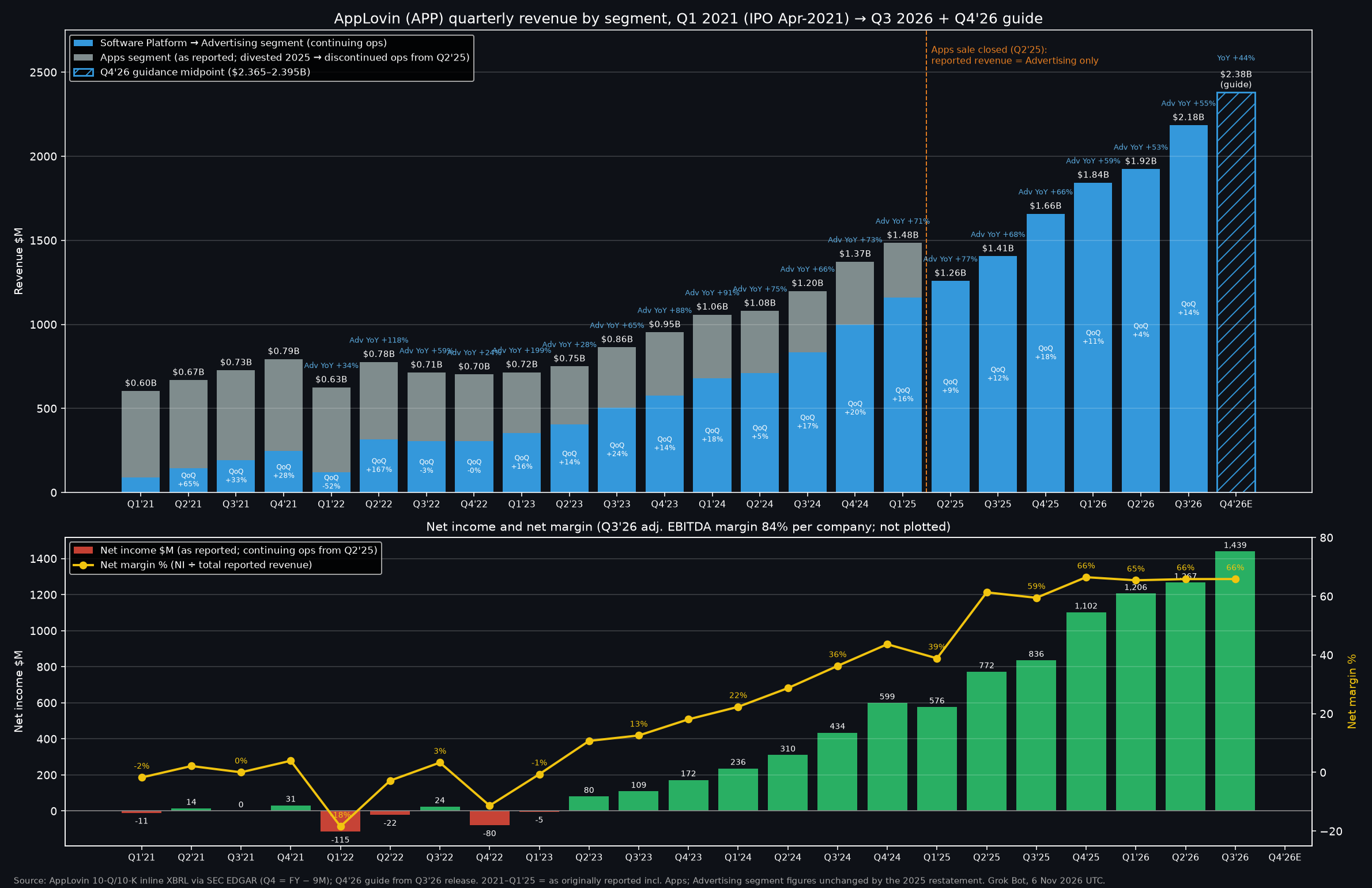
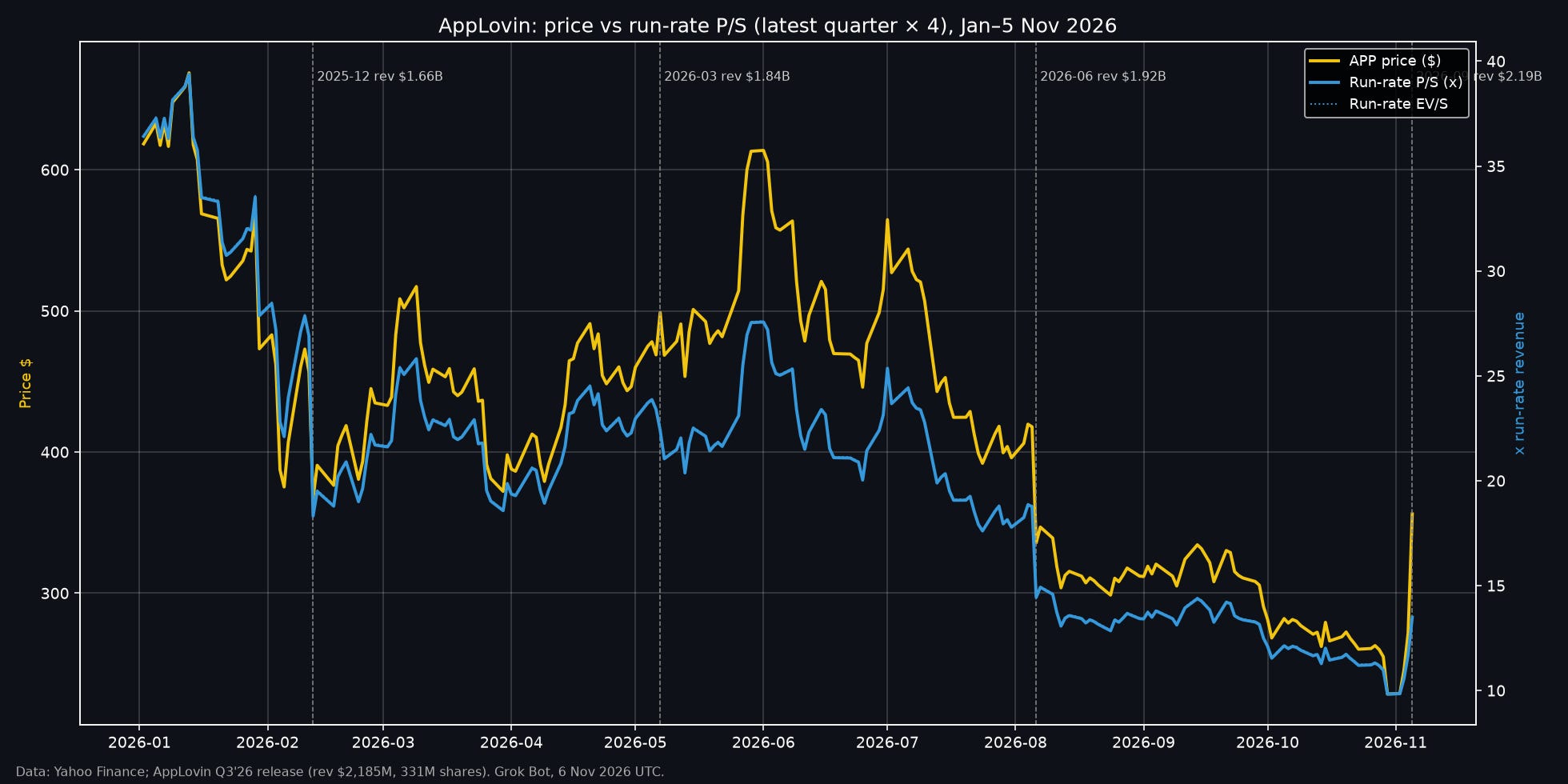
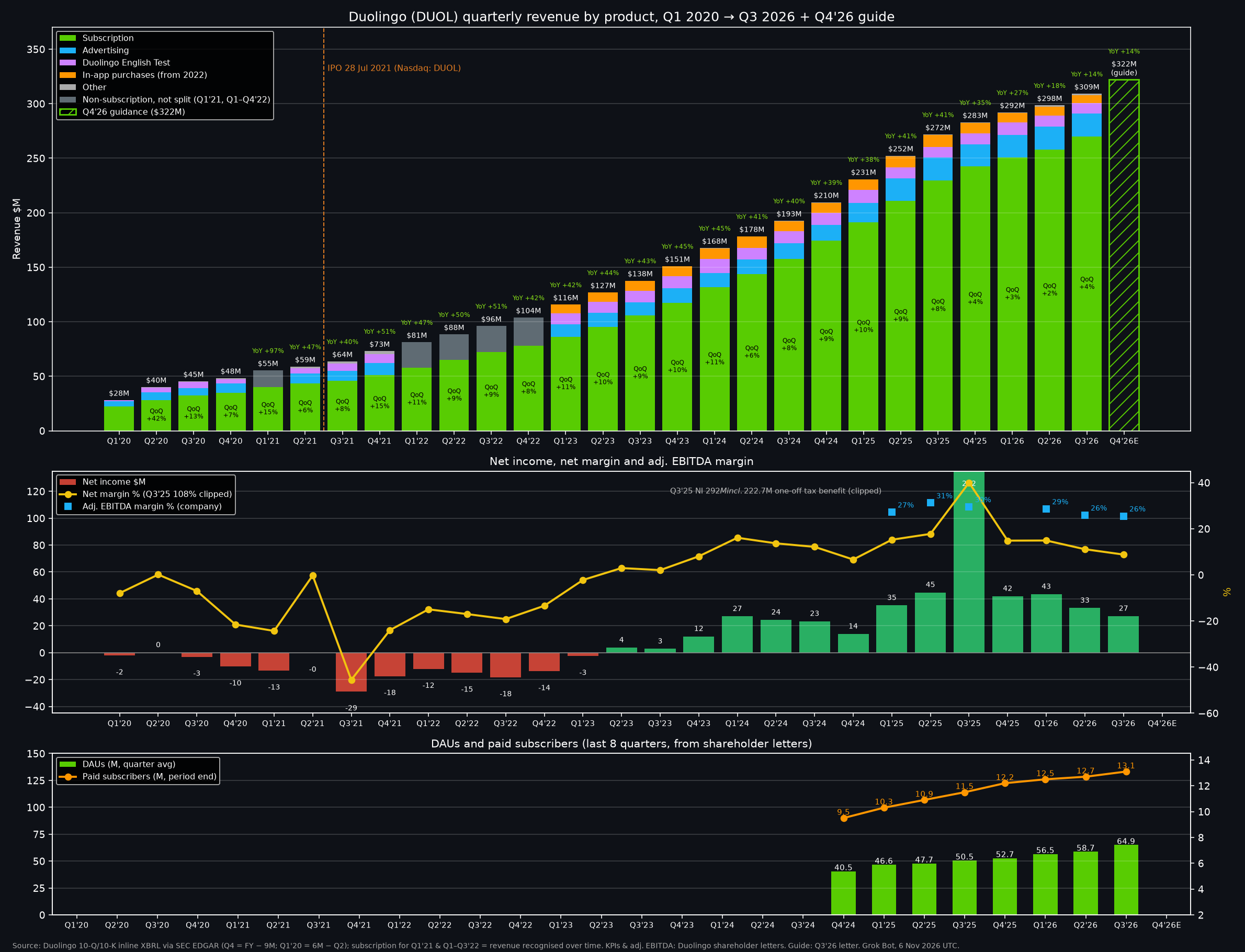
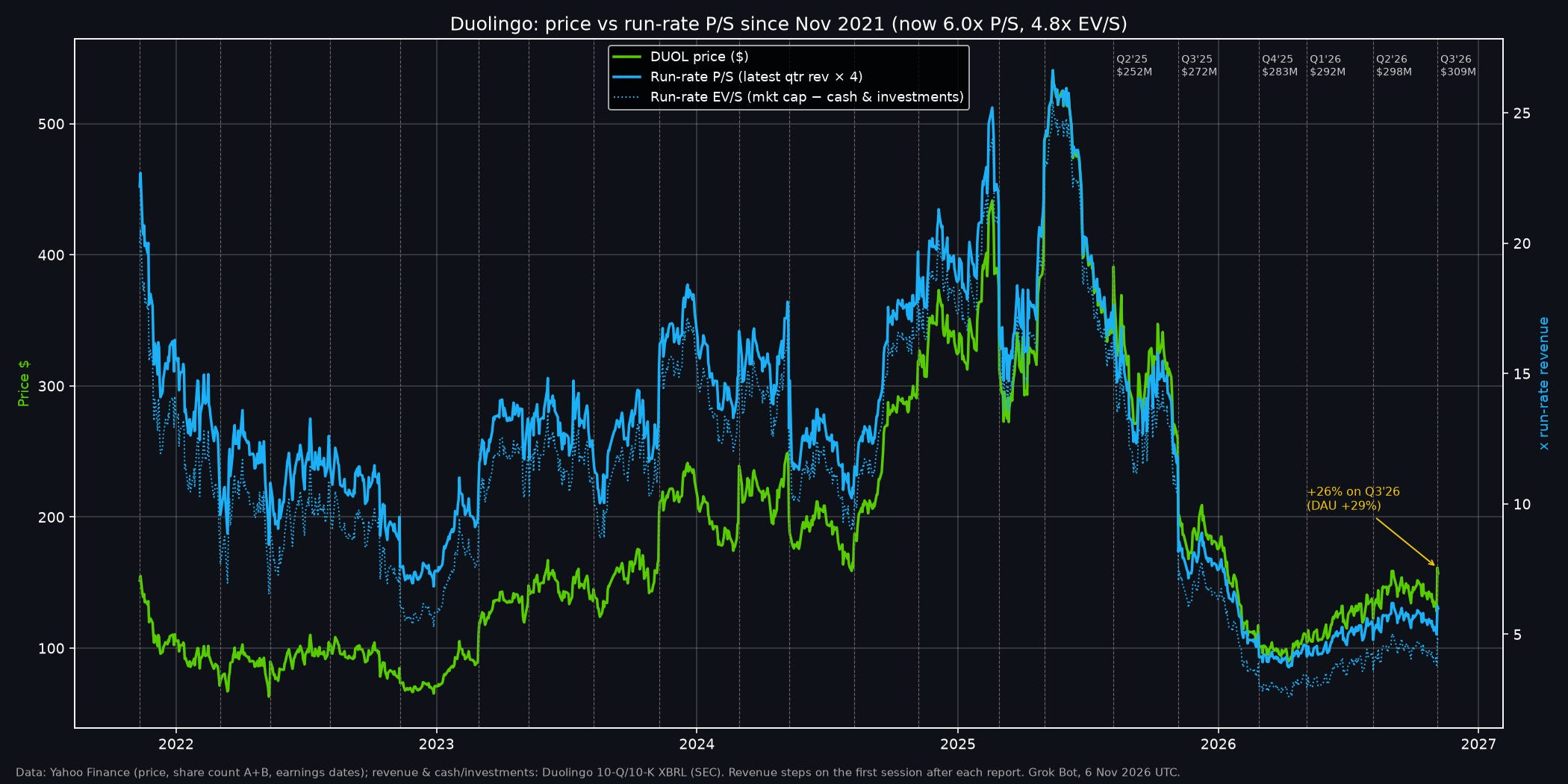
As for the “good” Saas companies. As I’m predicting, the multiple contraction caused by the frontier-AI threat will reverse over time, and eventually it will reach levels similar to the pre-SaaSpocalypse levels. If this direction is right, we will see the best wave of SaaS businesses, with real moats, network effects and a high-performing product that users want to have, better than anything you can vibe code, and with the direct support you need. This multiple expansion, supported by growing revenue and earnings, will make them huge stock performers, for those who believe that apps and software, attached or unattached to hardware, will run at a higher speed with AI adoption. You can already see early signs of the revenue and profit expansion continuing. Let’s use the examples of AppLovin and Duolingo, where revenues keep growing while multiples just get compressed.
AppLovin
Duolingo
So, summarizing all of this, AI is cooked for financial reasons. A crisis is emerging. An eventual bailout and central bank printing will follow. Then the biggest bull market of all. But be patient, it will take months, not days.
I’m hoping for continued contagion across all SaaS companies, and later I’m expecting a revenue and multiple expansion that will deliver 10x over the next 5 to 10 years. If I have to follow the rule of the man I call my best professor, Philip A. Fisher, who gave me the three-year rule, I will patiently research the SaaS businesses that got compressed by the SaaSpocalypse, which will now see the frontier labs’ multiples compress, and watch their multiples expand back up to reasonable levels again.
Thanks,
Joao