

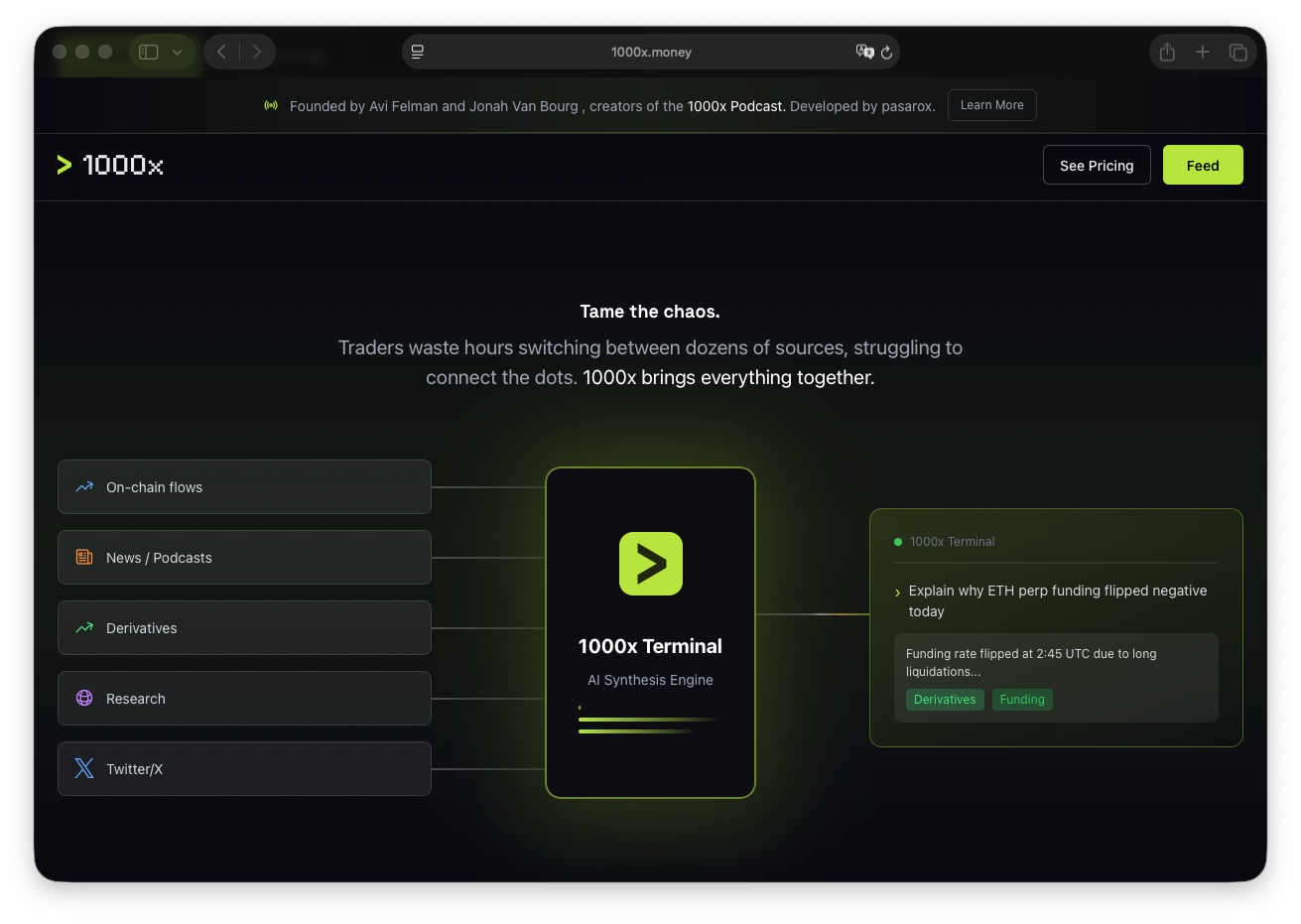
This is an optimistic view of the 1000x terminal evolution. I’ve tracked this project since minute one. Therefore, no one is able to share the same level of internal insights, I can offer a uniquely clear outlook.
I will share my internal notes, documentation and process to illustrate the terminal prides and worst moments. It all started in December 2024 and after a year of building the terminal grew to a level that is incomparable.
My goal is not to recommend buying token. This is educational. I want to encourage you, at the end, to try the 1000x.money terminal. And why you should follow the work of Avi and Jonah.
Apparently they have a link that I’ve no benefit to share, just an experimentation, I will share it here: https://1000x.money/auth/signup?referral=ZEWLK6R6 , for you to sign up quickly.
(I put my capital where my mouth is. So, I’m biased in favor the success of the 1000x terminal. I do not hold VC bags - they didn’t raise a penny - I’m holding the public 1000X token)
Be in touch on:
X : https://x.com/0xjbaptista
Email : jbbaptista@proton.me
Telegram : @jbbaptista
1000x Terminal
The story of the 1000x Terminal begins in early December 2024.
It was rooted in the ambitions of crypto enthusiasts Avi Felman and Jonah, already known for their podcast “1000x podcast”. The idea was simple and bold: build an AI agent that could analyze crypto markets, provide insights, and evolve into a revenue-generating tool tied to a token.
To understand the trajectory, we go back to that uncertainty in December 2024. The project began with a test on the Virtuals agent launchpad. By design, when you create an agent on Virtuals, you automatically attach a token. That is how the 1000x token emerged. The community quickly found the token and has not looked back since.
The founders then tried to figure out how to prompt the agent so it would be reliable. At this stage, there was no real product or utility. There was only a vision and a Virtuals agent token. The initial excitement faded fast. Insiders/snipers moved quickly, and the team ended up buying the sniper supply so it would not hurt the project later on.
As we moved into January 2025, the narrative shifted from uncertainty to progress. The founders and the dev began to show reliability. During the first weekend of the year, the agent started to look smarter.
That was the first spark of momentum. It was fueled by the founders paying developers to push the agent toward traction, securing a CoinGecko listing, and by Ansem joining the chat.
The vision started to crystallize. The team moved from building only on Virtuals to shipping their product to the ai16z (elizaOS) framework. They began discussing a “buyback” mechanism using revenue from the 1000x podcast. They realized that attaching a token to an existing business was more valuable than a standalone asset.
In this period, $75k worth of VIRTUAL was used for a buyback - they put their money where their mouth was and proved their ideas could exist in practice.
By the time they launched the V2 marketing video and set a brand identity with a logo, they were already discussing a V3 update. This showed a commitment to rapid iteration.
The founders kept their integrity at a high level, acting and shifting when needed. They had a vision and stuck to it, fueled by hard work and steady integrations. Both were successful traders and aimed to inject their skills into the AI Agent to increase accuracy and build the “Bloomberg terminal for crypto.”
A major technical and strategic evolution came in late January and February. The team started integrating the bot into Telegram and X(Twitter), automating tweets and replies. This correlated with a clear spike in social engagement. Twitter followers grew by 29% in a short time.
The team also realized that generic frameworks were not enough. They moved away from the Eliza framework because it was too bloated for their needs. They chose a custom implementation that was smaller, faster, and more effective. This pivot signaled that they were building a proprietary product, not just stacking off-the-shelf tools.
At the same time, Avi and Jonah began to articulate the roadmap in public. They wanted to create a bot that excelled at crypto market analysis first, then later expand to commodities and other sectors. This vision has now proved right, as they have shipped a high quality crypto terminal.
Despite the progress, the project hit “the slog” in the spring of 2025. They expanded the token to the Solana network to capture more liquidity. But product launch delays tested the community’s patience.
By March, the vision had evolved from a simple “bot” to a full “Terminal.”
It was modeled loosely after a Bloomberg terminal but designed for everyday crypto traders.
They also debated the branding and settled on “1000x.money” because people did not resonate with the word “bot.”
During this period, the price dropped sharply as the terminal faced delays. Even so, the core team stayed communicative. They welcomed feedback and removed scammers from their channels.
The summer of 2025 marked the turn from development to deployment.
By June, the MVP was ready for testing by a select group of users. I was one of those users. I saw the progress, tested the vision, and gave constant feedback. It had problems that were fixed. The team’s commitment at this stage was impressive.
The chat functionality went live. Developers focused on reducing hallucinations and improving the agent’s reasoning - a crucial step for creating a reliable, trustworthy “analyst.”
The model moved from free access to a subscription model, where revenue would drive token buybacks. The founders, who had been more in the background during the slog, re-engaged strongly. Avi and Jonah began tweeting about the project again. The market reacted at once, with positive sentiment and price surges.
Podcast revenue continued to support the token, with initial buybacks around $10k, which we now know did not stop there.
By August 2025, the project entered “War Mode.” The terminal went live with a V1 launch. It offered daily credits to holders and introduced fact-checking features to the agent.
The marketing strategy shifted from organic growth to aggressive promotion. Avi publicly stated that he would use 90% of terminal revenue and a non-trivial portion of podcast revenue to buy back the 1000x token. This move tightly linked the success of the software to the token’s value. He backed this with action, confirming a $35,000 token purchase using podcast revenue later that month.
The project had grown into a professional operation. The paid terminal officially launched on September 26. The dev team expanded, hiring new developers to speed up progress. They integrated crypto payments and offered a 40% discount for users paying with the 1000x token.
This created a closed-loop economy for the project. Social proof could be strengthened through potential partnerships with major industry players like CoinDesk and Blockworks, which the team mentioned as a possibility.
By late November 2025, the evolution felt complete. What began as an uncertain experiment had become a valuable product in its “Prime Time.” The ecosystem now included a functional terminal, a verified revenue stream fueling buybacks, active marketing campaigns, and a growing community of over 1,000 members in their terminal group.
The project has successfully navigated technical pivots, delays, and market skepticism. It has built a functional utility product with a clear value accrual mechanism for its holders.
Organized bulked Notes
78 pages pdf with all notes since day 1 (exported from my notion page)

As captured in the initial screenshot under “How all started,” the project kicked off with hype around a new token launch, but it quickly faced the realities of market volatility. Note #1, dated around mid-December 2024, describes a post-Monday dip where the token underperformed, with no immediate improvements to the agent itself. The founders had promised to build something groundbreaking using Virtuals protocol, but early setbacks like server downtime from Virtuals highlighted the technical hurdles. Despite this, the team - primarily Avi, Jonah, and an unnamed dev - stuck to their word, emphasizing transparency by noting they hadn’t locked their funds yet, which built early trust among holders. This phase was marked by caution; there was no rush to increase or reduce stakes, as the project lacked clarity, but the potential for a “huge trade” if taken seriously kept interest alive.
By early January 2025, as detailed in Note #2 (covering the weekend of January 4-5), the project began showing tangible progress. The dev team demonstrated improvements in the agent’s intelligence and reliability, signaling the first evolutionary step from a basic concept to a functional tool. They announced plans for a CoinGecko listing around January 12, and notably, they were paying developers to push forward, indicating a shift from bootstrapped enthusiasm to structured investment. The founders teased future hype through podcasts where the agent could “chat” live with them, potentially establishing a multi-million-dollar market cap floor. This period also saw the agent migrate from Virtuals to ai16z models (Note #3), a technical upgrade that improved its capabilities in synthesizing crypto updates. Note #4, from a podcast discussion, revealed strategic thinking: they planned to use podcast revenue to buy back tokens, viewing the token as equity in an existing business rather than a standalone speculative asset. This tied the agent’s success directly to the podcast’s popularity, creating a symbiotic relationship that would become a core strength.
Momentum built through mid-January. Note #5 (January 8) marks the CoinGecko listing going live, accompanied by a marketing video for “v2” of the agent, complete with a new logo and promises of v3 the following week. Social metrics started growing modestly - Telegram at 620 members, Twitter at 1,087 followers - reflecting a 5% Telegram increase and 29% Twitter surge. The agent began integrating bots for real-time news (Note #6 and #7), first on Telegram and then Twitter, expanding its reach. By Note #8 (around January 10), the agent was tweeting autonomously, boosting engagement. Note #9 introduced threads for daily summaries and a dedicated Telegram channel with 103 initial members, while Note #10 confirmed a CoinMarketCap listing and debates on Solana liquidity, showing early discussions on scaling without fracturing the community.
The project hit a narrative high in Note #11 and #12 (January 14), with roadmap talks of visualizations and charts, and a deep podcast dive where Avi and Jonah discussed agents as the “next big thing” for 12 months. They emphasized the agent’s niche in crypto analysis, trained on their years of expertise, and outlined expansions to commodities and partnerships with trading terminals. This podcast segment, lasting 7 minutes - a first for them - underscored growing confidence, as they hadn’t promoted it heavily before to avoid pump-and-dump accusations (evidence from Note #12’s point on organic discovery). Social data supported this: Twitter at 1,277 followers, Telegram at 621. Note #13 highlights Avi’s public promise not to dump tokens, reinforcing team commitment, while engagement surged.
Hard times interspersed with growth. In Note #14 (January 15), despite improvements like systematic analysis and separate Telegram/Twitter agents, market dips tested resilience. A buyback of 26,154 VIRTUAL (worth ~$75k) from Virtuals provided support, and big names like Ansem joined the chat, signaling credibility. Discussions on Solana liquidity (~$300k each side) showed expansion risks. By Note #15 (January 16), the agent’s ticker analysis broadened, but hallucinations persisted. Note #16 (January 17) introduced the “reply-guy” feature and name change debates, with Ansem’s presence driving more joins and positive feedback.
From late January to March, evolution accelerated. Notes #17-#20 (late January) detail UI upgrades, mobile app considerations for credibility, and integrations like DeFiLlama. Social growth hit Telegram at 700+, Twitter at 2,000+. The project faced criticism for slow progress (Note #21, February), but responded with v4 launches and sentiment analysis tools. By Note #22 (February 10), a new dev joined, speeding development, and partnerships like CoinDesk emerged. Data growth was evident: market cap from $500k to $2m peaks, holders increasing.
Spring brought refinement and challenges. Notes #23-#30 (February-March) cover bug fixes, faster responses, and premium features teasers. Hard times included dev frustrations with costs (Note #25) and market dumps, but buybacks from podcast revenue (~$10k initially) stabilized. Team dynamics shifted with a second dev (Note #26), enhancing speed. By April (Notes #31-#35), the terminal beta launched, with user feedback driving iterations like dark mode and faster queries. Growth metrics: Telegram 800+, market cap $3m+.
Summer focused on polish. Notes #36-#47 (April-July) detail integrations (e.g., podcasts, news), UI overhauls, and beta testing. A key milestone in Note #47 (July 30) was the terminal’s full launch with chat history, analysis categories, and positive user feedback, though issues like non-stored chats persisted. Revenue plans solidified: 90% to token buybacks.
August marked commercialization. Note #48 (August 4) announced the official launch, with Avi tweeting 90% revenue buybacks, driving inflows and doubling price. Notes #49-#51 show updates like fact-checking, “Today” page, and Avi’s $35k buyback from podcast revenue, pushing market cap to $7m. Top holders accumulated 7% more.
September intensified marketing. Note #52 (September 2) had Jonah aligning on buybacks, market cap at $6.7m. Note #53 (September 4) saw Avi distributing access codes (50 new users), with Jonah and others promoting. Telegram hit 1,025, dev updates improved accuracy. Note #54 (September 10) added shareable chats; Note #55 (September 16) shareable tweets and paid subs at $20/month.
October-November saw maturation amid slowdowns. Note #56 (October 8) launched paid terminal; Note #57 (October 29) revealed only ~10 active users, prompting a second dev hire and marketing push. Jonah emphasized bootstrapping, no VC backing, and plans for crypto payments/discounts. Partnerships with CoinDesk/Blockworks will add credibility. Note #58 (November 10) integrated Blockworks research is mentioned; Note #59 (November 20) enabled crypto payments and revamped Twitter for short takes.
By Note #60 (November 24), features like 40% off subs with 1000x tokens and 80% revenue buybacks tied utility tightly. The final push in Note #61 (November 27, the current date) came with Avi’s “prime time” tweet, doubling price again, new Telegram members (1,038+), and a full marketing plan including podcasts, KOLs, and ads.
Overall, the 1000x Agent evolved from a hype-driven token launch in December 2024 to a sophisticated AI terminal by November 2025, growing through iterative dev work, buybacks, and partnerships. Hard times like technical glitches, slow adoption, and market dips were overcome by the core team’s (Avi, Jonah, devs) unwavering commitment - no dumps, personal buy-ins, and transparency. Data growth: from sub-600 Telegram members to 1,000+, Twitter from 1,000 to 4,500+, market cap from under $1m to peaks over $7m. The team expanded from founders to multiple devs, staying connected via podcasts and community chats. Today, it’s a revenue-linked product with strong utility, poised for broader adoption, having improved steadily despite bootstrapped constraints, emerging stronger as a credible player in crypto AI.

Thanks,
Joao