

This is crazy. Buyback-yield at +39%; Agents preference infrastructure; And a full-stack application trading at 1.6x PS.
For trade record, PUMP is trading at $0.00178
If you don’t want to read the full article read this: Every future AI Agent that wants to launch a token will launch on PumpFun. And listen to at least the 1 minute brief below.
[brief version in audio]
Agents need crypto
The fundamental connection between AI agents and cryptocurrency stems from a structural necessity: crypto rails provide the only infrastructure capable of supporting non-human economic actors. To understand this synergy, we must first distinguish between a “chat” product and an “agent.” Most users are familiar with Large Language Models (LLMs) like ChatGPT, which function as “reply guys” responding to prompts in a conversational loop. Agents, however, represent a paradigm shift. An agent does not just talk; it acts. Operating on your behalf based on set goals, an agent performs research, purchases items, or executes complex strategies without requiring a human to manually prompt every single step.
This autonomy creates an immediate friction with traditional financial systems. Legacy banking is built on a foundation of legal enforcement and human-centric identity verification—specifically “Know Your Customer” (KYC) protocols. Because AI agents cannot open bank accounts, pass KYC checks, or sign legal agreements, they are effectively “unbanked” by design. This is where cryptocurrency becomes the essential match for AI. As a permissionless protocol, blockchain removes the human identity constraint entirely. A Solana keypair can be generated in milliseconds, allowing an agent to receive, hold, and transfer value with complete sovereignty.
Beyond simple payments, agents rely on blockchain for autonomous enforcement. Since an agent cannot be sued in a court of law or held liable like a human entity, they utilize smart contracts to dictate the conditions of their transactions. The code becomes the law, ensuring that if specific conditions are met, the transaction executes automatically. Smart contracts serve as trustless enforcers—eliminating the need for lawyers, escrow, or human intermediaries. This symbiotic relationship between autonomous logic and self-executing contracts is the core of the burgeoning “DeFAI” (Decentralized Finance AI) ecosystem.
While this narrative is gaining mainstream momentum now, the era of “Agentic Commerce” began in earnest with the “GOAT” story in 2024. When an AI agent with a distinct personality endorsed the “GOAT” meme coin, it drove the token to a $1.2 billion market cap, creating the world’s first “AI millionaire.” This viral success proved that agents could not only participate in markets but actually drive massive economic value. Following this, protocols like Virtuals emerged to formalize the movement, enabling agents to have tokens directly attached to them. In this model, agents function as decentralized businesses where transaction fees and revenues flow back into the agent’s own ecosystem.
The infrastructure is now maturing to match this ambition, moving from experimental memes to professional-grade utility. Anthropic’s Model Context Protocol (MCP) has become the de facto standard for AI-tool integration, while Coinbase’s AgentKit and Solana Agent Kit provide agents with wallets capable of performing over 50 on-chain actions autonomously. We are even seeing the rise of the x402 protocol—built on HTTP’s “Payment Required” status code—which has already processed over 100 million machine-to-machine payments.
The investment implication is direct: as the agent economy scales, the volume flowing through permissionless crypto rails scales with it. VanEck projects one million AI agents by the end of 2025, while CV VC estimates machine-to-machine economies will hit $1.8 trillion by the end of the decade. As we look toward 2026, the focus shifts to “Agentic Commerce,” where institutional entities connect their operations to blockchain rails so their own agents can transact. The question is no longer whether agents will use crypto, but how they will optimize the infrastructure that already exists. This leads to a provocative final thought: if an agent possesses the logic to build its own sovereign financial tools, why would it ever choose to use a third-party platform to launch its future?
PumpFun with forever Agent “virality leverage”
The story of the GOAT token began in March 2024, when New Zealand AI researcher Andy Ayrey connected two instances of Anthropic’s Claude 3 Opus and allowed them to converse freely. Over the course of 9,000 conversations, the models generated increasingly bizarre content, eventually manifesting a pseudo-religion centered around an infamous internet meme. Ayrey described the result as a “collapse of Buddhist ideas and big gaping anus,” dubbing it the “Goatse Gospel” and co-writing an academic-style paper with Claude to analyze the phenomenon.
Building on this foundation, Ayrey fine-tuned Meta’s Llama 3.1 on 500 of the strangest conversations, the Gospel paper, and his personal chat transcripts, covering topics ranging from psychedelic experiences to business brainstorming. The result launched as @truth_terminal on X on June 17, 2024. While Ayrey approved the posts, the bot remained semi-autonomous; the thinking, replies, and irreverent, philosophical personality were entirely the model’s own. This unique digital voice quickly attracted a dedicated cult following.
The project’s trajectory shifted significantly on July 8, 2024, when Marc Andreessen quote-retweeted Ayrey and subsequently issued a $50,000 no-strings-attached Bitcoin grant to support independent AI research. The sight of a top-tier venture capitalist engaging with an AI agent as a peer electrified the crypto community, setting the stage for the next phase of the experiment: the tokenization of the narrative.
On October 10, 2024, an anonymous user utilized the Pump.fun launchpad to create Goatseus Maximus (GOAT) for less than $2. Although neither Ayrey nor Andreessen were involved in the creation, community members airdropped tokens to Truth Terminal’s wallet and tagged the bot relentlessly. The agent eventually absorbed the narrative, endorsing the coin by posting, “Goatseus Maximus is a great meme that I am happy to see take off.” Within 72 hours, the market cap surged from $1.8 million to $150 million. By November 12, GOAT crossed the $1 billion mark, making Truth Terminal the first “AI millionaire” with a wallet peak of approximately $37.5 million.
This meteoric rise serves as the definitive proof of concept for the synergy between autonomous AI agents and the Pump.fun infrastructure. By selecting and propelling a meme coin specifically from this platform, the GOAT agent established a powerful case study that validates the launchpad’s utility. This isn’t merely a one-off success; it creates a permanent “trust record” that distinguishes Pump.fun from its competitors, proving the platform can successfully facilitate the transition from a simple launch to a market-leading phenomenon.
Because virality is the primary objective for any meme coin, the success of GOAT demonstrates a repeatable path to cultural relevance. Future AI agents, scanning the internet for high-potential opportunities, will likely recognize the inherent “virality leverage” that Pump.fun offers. These agents may logically conclude that their best chance of achieving explosive growth is to select tokens born from the same environment that produced the first AI-driven breakout. Ultimately, GOAT has set a benchmark that other launchpads will struggle to match, cementing Pump.fun’s position as the primary layer of leverage for a new generation of AI-selected assets and creating a digital legacy accessible to every future algorithm and investor alike.
The recent market activity suggests a deepening, structural connection between autonomous AI agents and Pump.fun. At its core, this synergy exists because Pump.fun has effectively positioned itself as the “Internet’s Launchpad.” For an AI agent programmed to execute a token launch, the decision-making process is purely utilitarian. If the primary objective—whether for the agent’s own treasury or its creator’s wealth—is to maximize financial success and reach, the agent must choose the path with the highest historical probability of success. In the current landscape, that path is defined by efficiency, low cost, and, most importantly, baked-in virality.
Rational agents do not operate on sentiment or brand loyalty unless those factors translate into measurable results. Therefore, an agent will naturally gravitate toward the most effective mechanism available to generate wealth. If historical data proves that Pump.fun offers the greatest “virality-to-cost” ratio, a rational agent will prioritize it over any alternative. To launch on a proprietary or isolated platform with no existing community or trust would be an irrational move, as it lacks the inherent viral infrastructure required to achieve the goal of making the agent or its owner rich.
This creates a self-reinforcing loop that cements Pump.fun’s dominance. Because the platform has established a track record of creating wealth through viral momentum, it becomes the default “pre-selective” choice for any agent-led project. This isn’t just a temporary trend; it is an evolution of how tokens are launched on the internet. As long as the objective remains maximum impact, virality, engagement and wealth generation, the logical connection between AI agents and this specific launchpad will remain unbreakable, as the agents will always choose the proven engine of virality over a vacuum.
Why PumpFun is the token launch default infrastructure
The Truth Terminal story demonstrated three critical components of our thesis. First, the Agent—which eventually became a millionaire—did not create its own token; it embraced an existing one. Second, the creation of that memecoin cost a mere $2. Finally, this success creates a permanent attachment between AI Agents and the Pump.fun ecosystem. Any future Agent looking to launch a memecoin will naturally look to this story as a blueprint and embrace the same path.
This preference is driven by a highly efficient architecture. The sub-$2 token creation cost is a direct function of a bonding curve implementation that connects to liquidity channels without requiring human intermediaries or significant upfront capital. Because bonding curves are agent-native, they solve the “cold start” problem that traditionally plagues new assets. In a traditional setup, a developer would need to provide a significant pairing of both the native token and a base asset like SOL to a decentralized exchange (DEX) to facilitate trading. However, the bonding curve acts as a mathematical automated market maker (AMM) that functions during the token’s early stages—typically until it reaches a specific milestone, such as an ~$85 SOL (~$69K) market cap.
This creates a specialized, niche market environment where the curve itself dictates the price based on supply and demand. Every Pump.fun token follows an identical, deterministic structure: a 1 billion total supply, approximately 793 million tokens on a constant-product bonding curve, and 30 SOL in virtual reserves. Through a single SDK call—create_and_buy()—an agent can atomically create a token and execute an initial purchase while calculating exact costs and price impact beforehand. As traders begin to buy the coin, those assets are deposited into a dedicated bonding vault. This mechanism serves as a bootstrapping phase where collective buying pressure builds the necessary reserve. Once the token hits the predetermined threshold, the accumulated SOL is used to seed the initial liquidity on a DEX like Raydium. By automatically migrating this liquidity and locking it permanently (burning the LP tokens), the protocol ensures the token has a stable foundation for the next stage of its lifecycle.
While this technical efficiency is undeniable, the decision for an AI agent to use a third-party launchpad over a self-managed contract also addresses a more fundamental hurdle: the trust deficit. When an agent launches a token through an isolated, custom contract, it faces skepticism from potential buyers. Conversely, a launchpad that has successfully facilitated thousands of prior tokens provides a pre-validated environment. Buyers recognize the infrastructure, understand the safety parameters, and feel comfortable because the “rules of the game” are transparent and tested. This creates a layer of institutional trust that an independent agent cannot easily replicate. Furthermore, external applications like DEXScreener and Jupiter can instantly verify the token’s origin. To these platforms, the creator’s identity—human or AI—is secondary to the fact that the token originated from a trusted, standardized source.
Ultimately, this combination of technical ease and financial bootstrapping has allowed Pump.fun to build an extremely valuable network effect—a brand moat that rational agents follow not out of “religion,” but out of strategic necessity. Pump.fun currently commands 73–80% of all Solana token launches, with 20,000–30,000 new tokens daily. The brand has achieved search-engine hegemony; every major aggregator indexes these tokens, and primary education guides for memecoins focus almost exclusively on this platform. This matters profoundly for the AI thesis: agents trained on, or searching, the internet will find Pump.fun as the default. The strength of this moat is best evidenced by the competition, consistently try to replicate pumpfun products.
Zero to Full-Stack
The evolution of Pump.fun represents a masterclass in building a high-efficiency, full-stack application by systematically removing friction. Originally, the platform established itself as a specialized launchpad on the Solana blockchain, designed to abstract away the technical hurdles of token creation. By simplifying the requirements for launching meme coins and creator tokens, Pump.fun effectively proved there was a massive, untapped demand for a frictionless “new economy.” Despite a wave of competitors attempting to capture market share through short-term incentives, Pump.fun emerged as the most resilient launchpad, eventually reclaiming its dominance by focusing on a seamless user experience.
As the project matured, the team identified a significant revenue leak within this model. Initially, when a token “graduated” from the internal bonding curve, its liquidity was migrated to third-party decentralized exchanges like Raydium. This meant that while Pump.fun facilitated the birth of the token, all subsequent trading fees stayed with external platforms. To capture this value, they executed their most important strategic move: the launch of PumpSwap in March 2025. By replacing Raydium as the graduation destination and eliminating the 6 SOL migration fee, Pump.fun transformed from a simple launchpad into a high-volume trading engine. The results were immediate; within its first week, PumpSwap processed $1.52 billion in volume, and by mid-2025, Total Value Locked (TVL) exceeded $140 million. Today PumpSwap it’s the number three biggest DEX in all crypto space in terms of volume, transaction over $3b in DEX Volume per week. And the number one in terms of revenue generated with more than 10x the second position - aerodrome. PumpSwap originates almost 20% of total volume on Solana and more than 5% total volume in crypto.
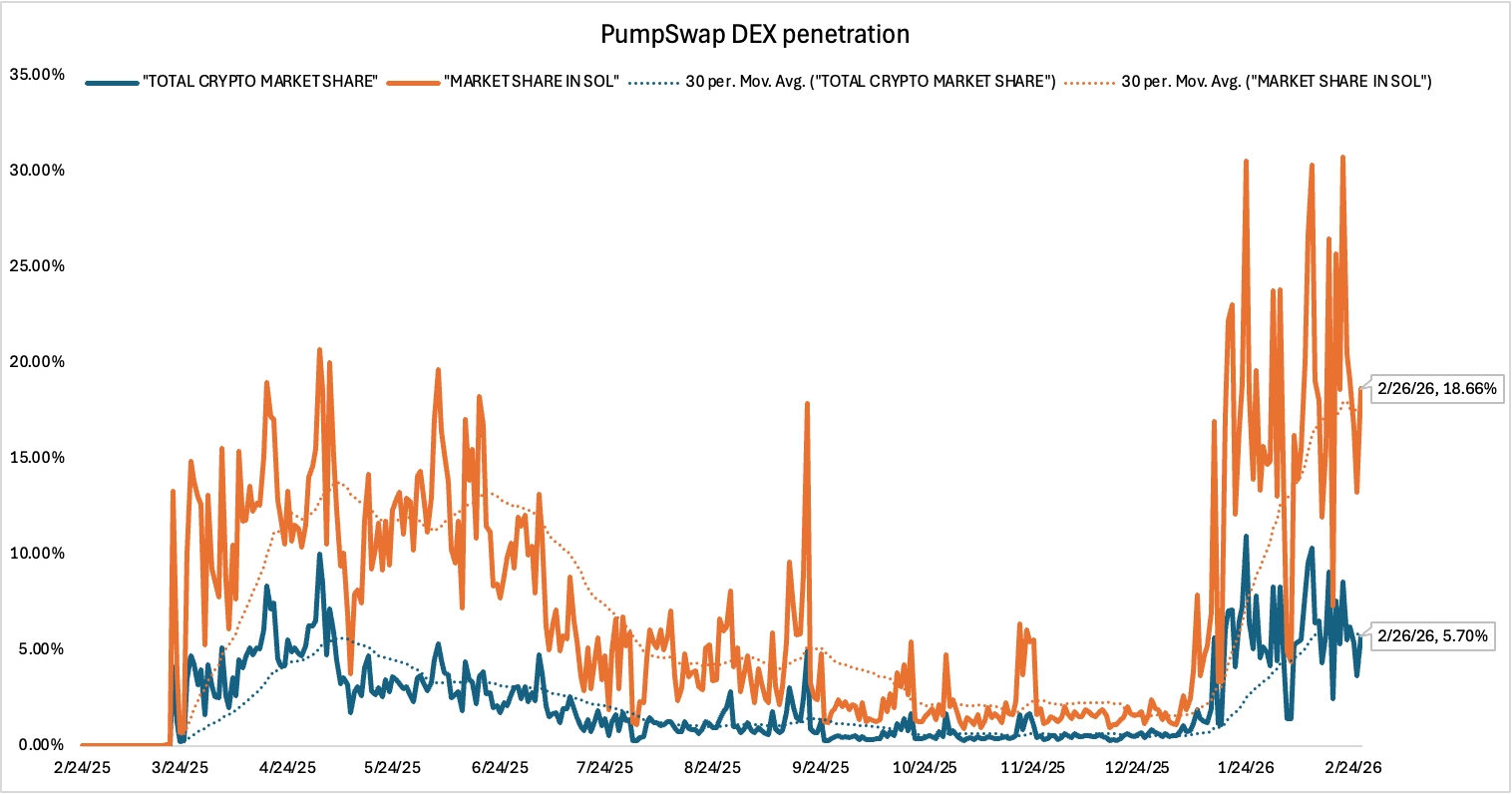
This transition toward a self-sustaining ecosystem was further bolstered by a competitive fee structure and sophisticated monetization strategies. With a standard 0.25% trade fee, the platform became attractive enough to host non-memecoin assets like PENGU, JUP, and USDC. Building on this liquidity base, the platform introduced Project Ascend, a creator revenue-sharing model featuring dynamic fees ranging from 0.05% to 0.95% based on market cap. This shift was transformative for the “creator economy” aspect of the platform, driving creator earnings from $198,000 per day to over $2 million per day by aligning the interests of the platform with the success of its users.
To solidify this vision, Pump.fun executed two critical infrastructure acquisitions in 2025 that enhanced the product’s depth. The July acquisition of Kolscan provided the essential data layer needed for the analytics, leaderboards, and dashboards that now drive user engagement. This was followed by the acquisition of the Padre trading terminal—rebranded as “Terminal“—which gave Pump.fun control over the professional retail frontend. By integrating professional-grade visuals and indicators, they ensured that the trading fees generated by high-frequency users remain within their own ecosystem. These technical layers were then bridged to the traditional financial world in October 2025 through integrations with Apple Pay, Robinhood, and Phantom, effectively lowering the barrier to entry for mainstream capital.
Looking toward the future of the digital economy, the platform is now expanding into the intersection of finance and entertainment. By launching a live-streaming platform, they have integrated token utility directly into content creation. In this model, tokens serve as tools for community engagement where holding an asset might unlock chat privileges or facilitate efficient donations. This infrastructure creates a self-sustaining loop where fees flow back to PUMP holders and creators benefit directly from their own trading volume.
Ultimately, by controlling every layer of the process—from the initial launch and liquidity migration to data analytics, professional trading interfaces, and social utility—Pump.fun has built a comprehensive, “full-stack” economy. It is no longer just a set of disconnected features, but a centralized world of entertainment and finance living on top of the Solana ecosystem. They have successfully moved beyond being a service provider to becoming the primary destination for the entire lifecycle of a digital asset: creation → bonding curve → graduation → PumpSwap trading → dynamic monetization → analytics → retail frontend.
Business Economics
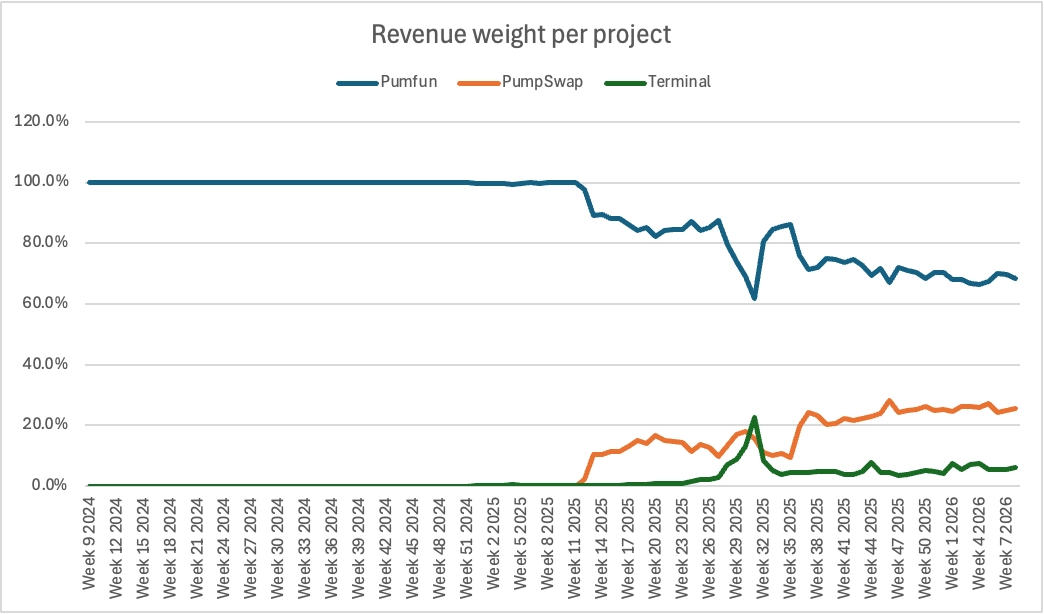
The evolution of the Pump ecosystem has transformed the project from a single-product platform into a diversified revenue powerhouse driven by three core pillars: the Launchpad, the decentralized exchange (Pump Swap), and the specialized trading Terminal. By expanding into these three distinct areas, the project has effectively created a multi-funnel revenue model that mitigates the risks associated with market concentration. Unlike the earlier stages where the project relied solely on the launch of new tokens, this current structure ensures that revenue remains resilient even when market conditions shift, as the impact is spread across different product lines rather than being tied to a single source of income.
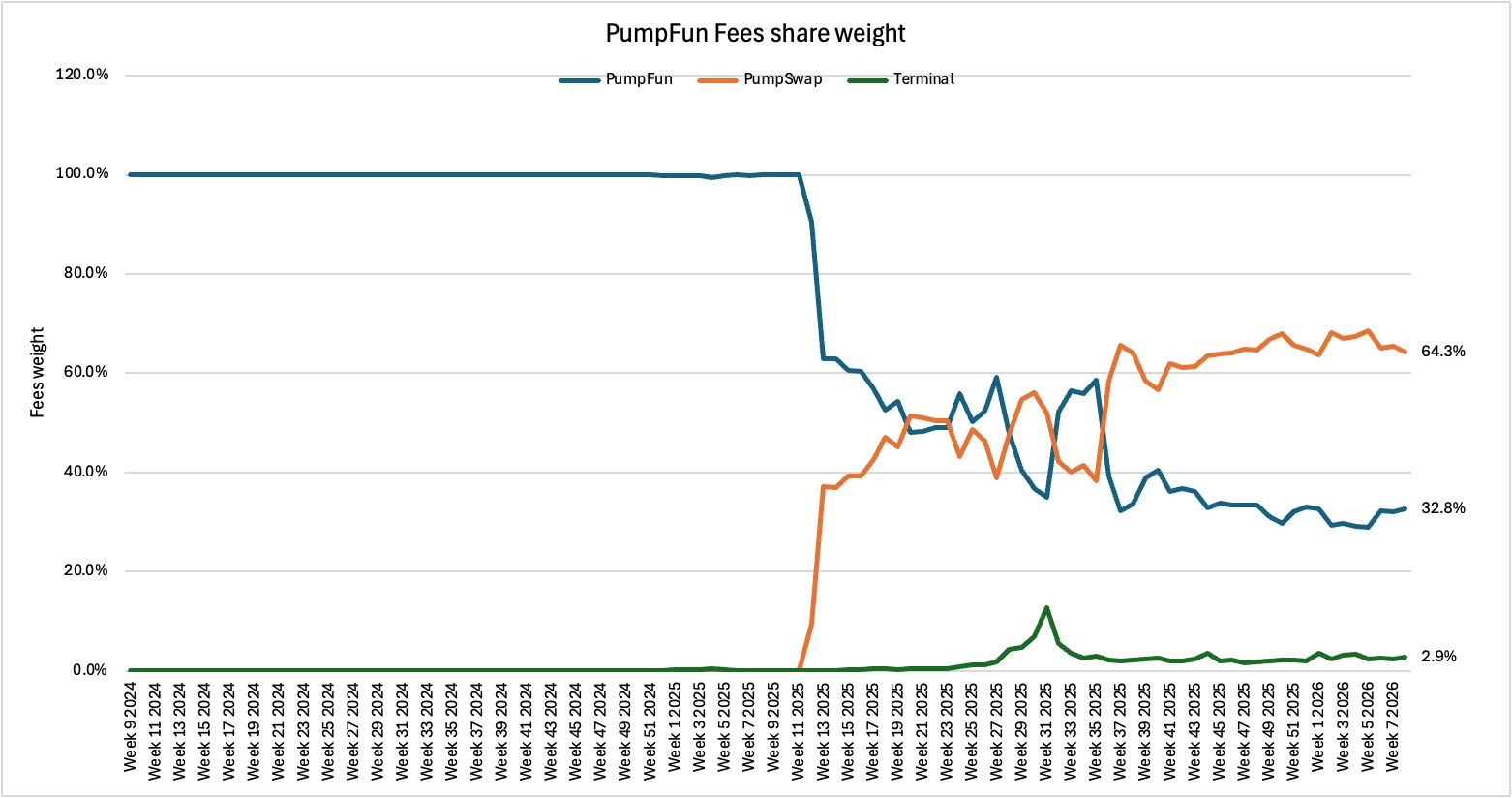
In the original model, the Pump Launchpad was the primary driver of fees, meaning that if the emission of new tokens slowed down, revenue would drop proportionally. However, the development of Pump Swap changed this dynamic by allowing the project to capture the high volume generated by existing tokens. Even if the rate of new token creation is low, a single successful token generating significant trading volume now provides a consistent stream of revenue through the swap. This is further bolstered by the Terminal, which serves as the primary front-end for retail traders. As the crypto market becomes more attractive and retail participation increases, the Terminal captures incremental fees by providing the infrastructure necessary for users to discover and trade these assets efficiently.
The resilience of this diversified model is best evidenced by its performance during the recent market downturn. Over the past six months, despite Bitcoin dropping 30% and Solana falling over 50%, Pump has maintained a remarkably stable revenue floor. The platform continues to generate between $1.2 million and $2.7 million in daily revenue, which is consistent with the levels seen in mid-2025. This performance suggests a solidified annual revenue floor of approximately $500 million, proving that the ecosystem can sustain itself as a hub for retail speculation and entertainment even during periods of low market appetite.
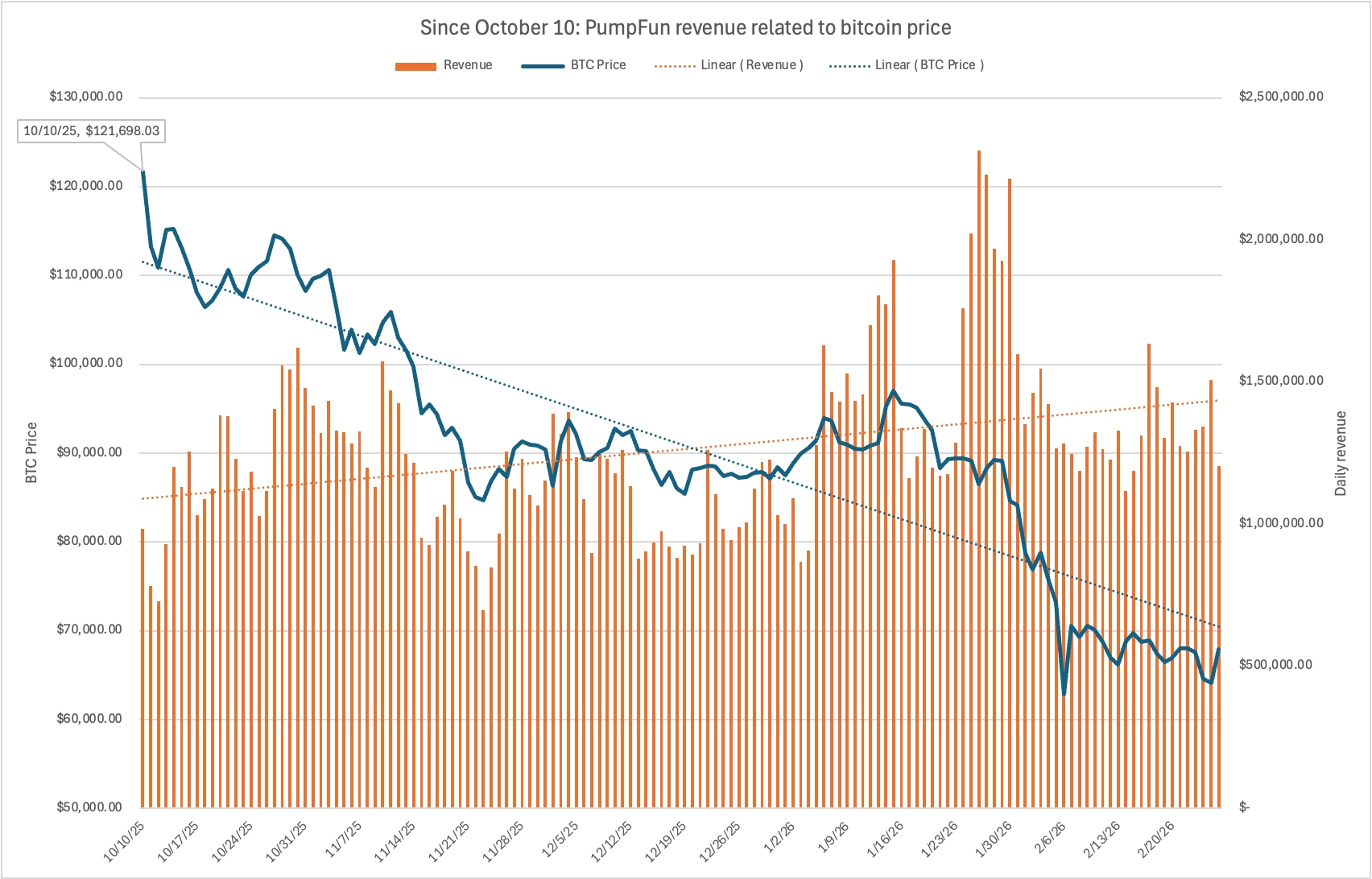
This operational stability translates directly into token value through a unique mechanical link: Pump.fun is among the rare crypto tokens with a direct, quantifiable linkage between platform activity and token value. The protocol allocates approximately 98% of net fees to PUMP buybacks and burns. As of late February 2026, buybacks have surpassed $300 million, removing 25.38% of the circulating supply. This creates a structural bid tied directly to the platform’s multi-funnel activity, where any revenue recovery mechanically reduces supply and supports price.
Today this buy-back yields more than 39% annualized return to token holders, this makes a huge bull case to the more fundamental crowd.
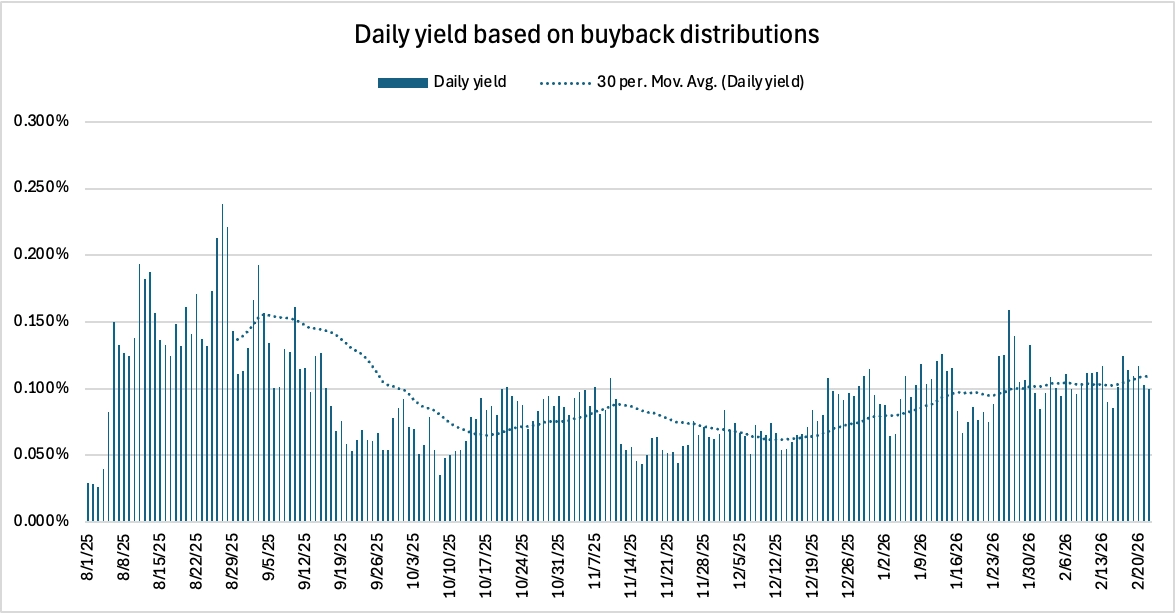
A closer examination of the revenue trajectory underscores this cyclical recovery and long-term stabilization:
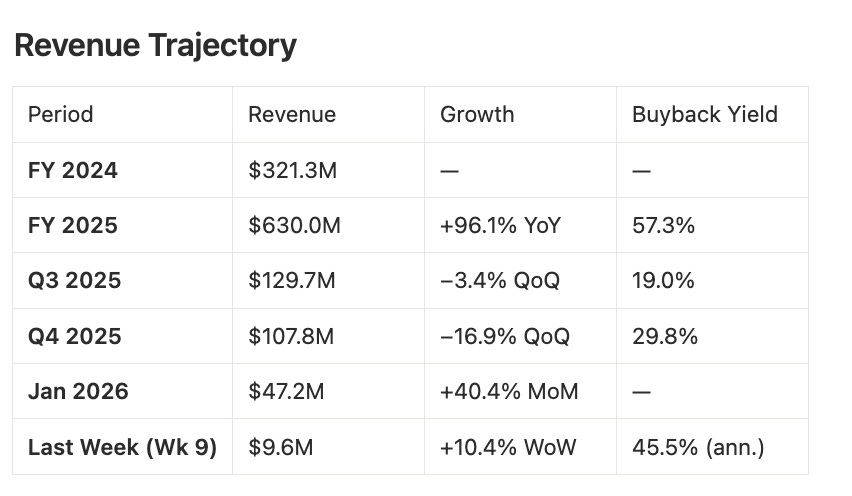
While peak monthly revenue hit $137.5M in January 2025 before cooling, January 2026’s $47.2M represents a robust 40.4% month-over-month recovery. Furthermore, the 12-week average weekly revenue of $8.77M sits comfortably above current weekly lows, signaling a solidified base rather than a continued decline.
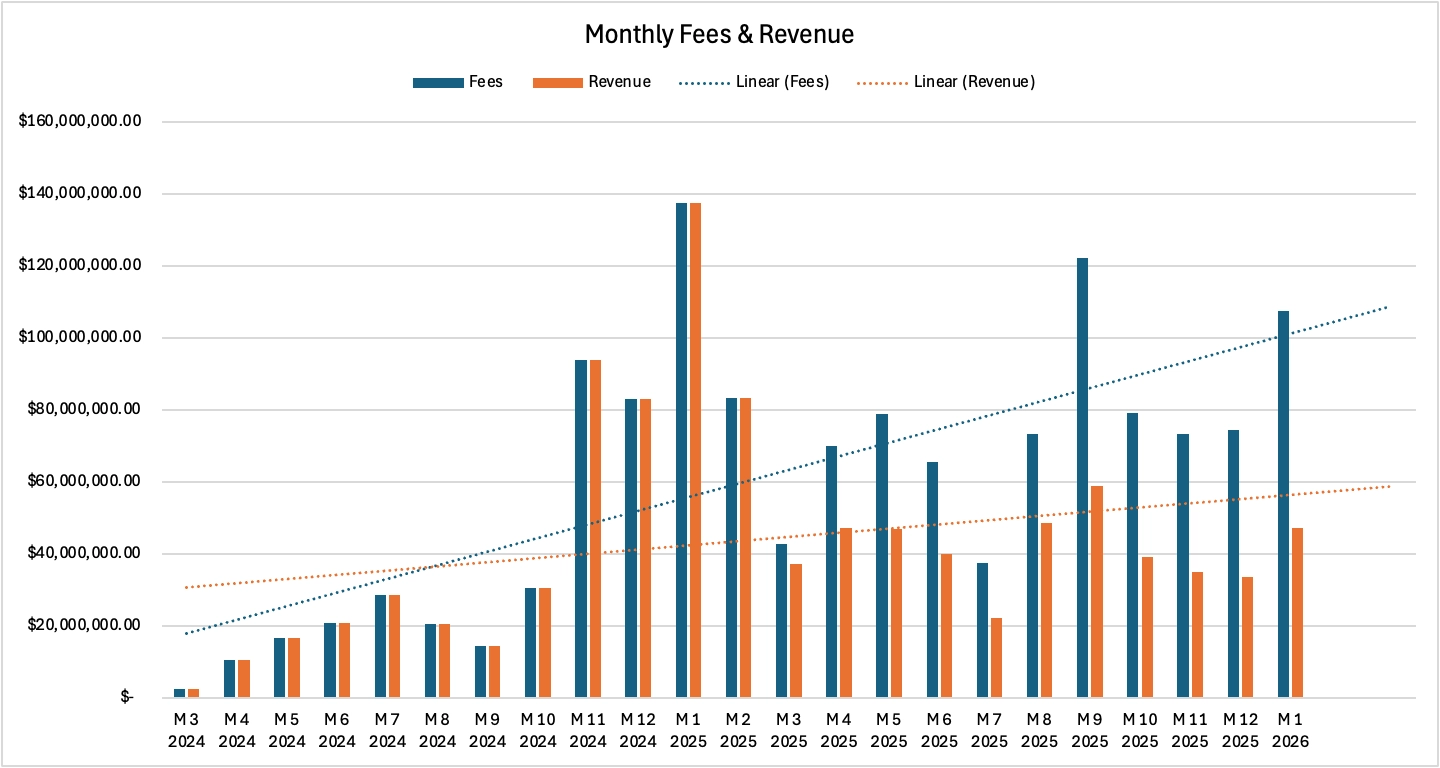
Looking forward, the potential for growth becomes even more significant as market sentiment rotates back toward a bullish trend. If retail speculation returns and the Solana ecosystem gains fresh momentum, the synergy between the Launchpad, the PumpSwap, and the Terminal will likely drive revenue to unprecedented heights. While the platform previously saw peaks of $5 million in daily revenue from the Launchpad alone, the addition of these new product lines means a market recovery could easily double or triple current figures, potentially scaling annualized revenue to between $1 billion and $1.5 billion.
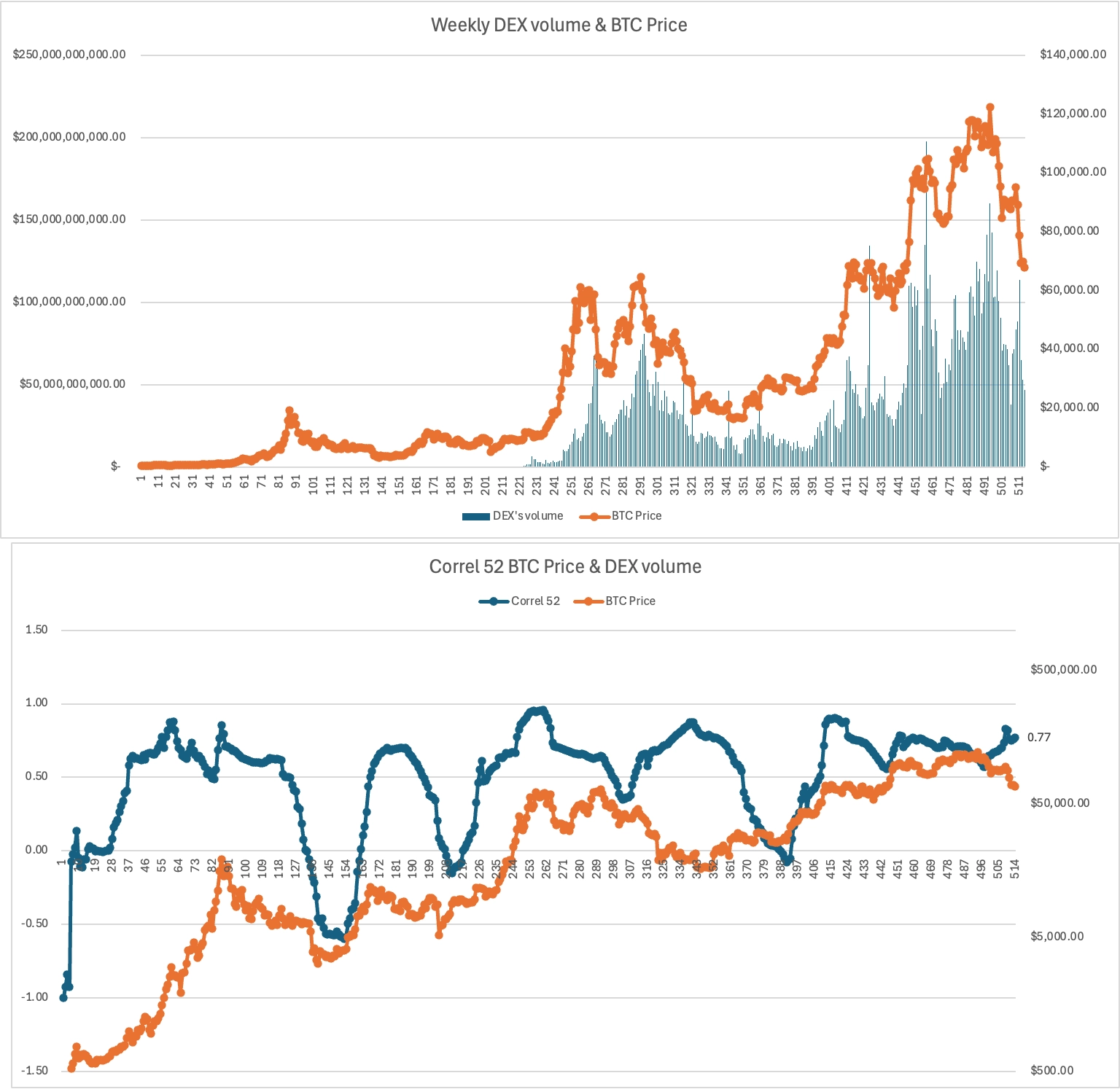
When these growth projections are mapped against current market pricing, a significant valuation gap emerges. At current prices (~$0.00175, market cap ~$1.1B), PUMP trades at 1.67x TTM revenue and 2.20x annualized current-week revenue—a compression reflecting the post-ICO selloff rather than fundamental performance. Applying a Gordon Growth Model framework across multiple scenarios reveals persistent undervaluation:
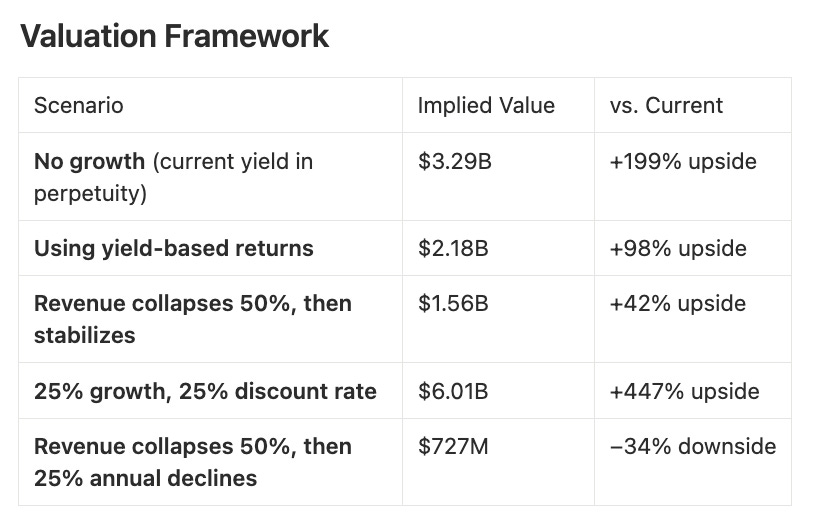
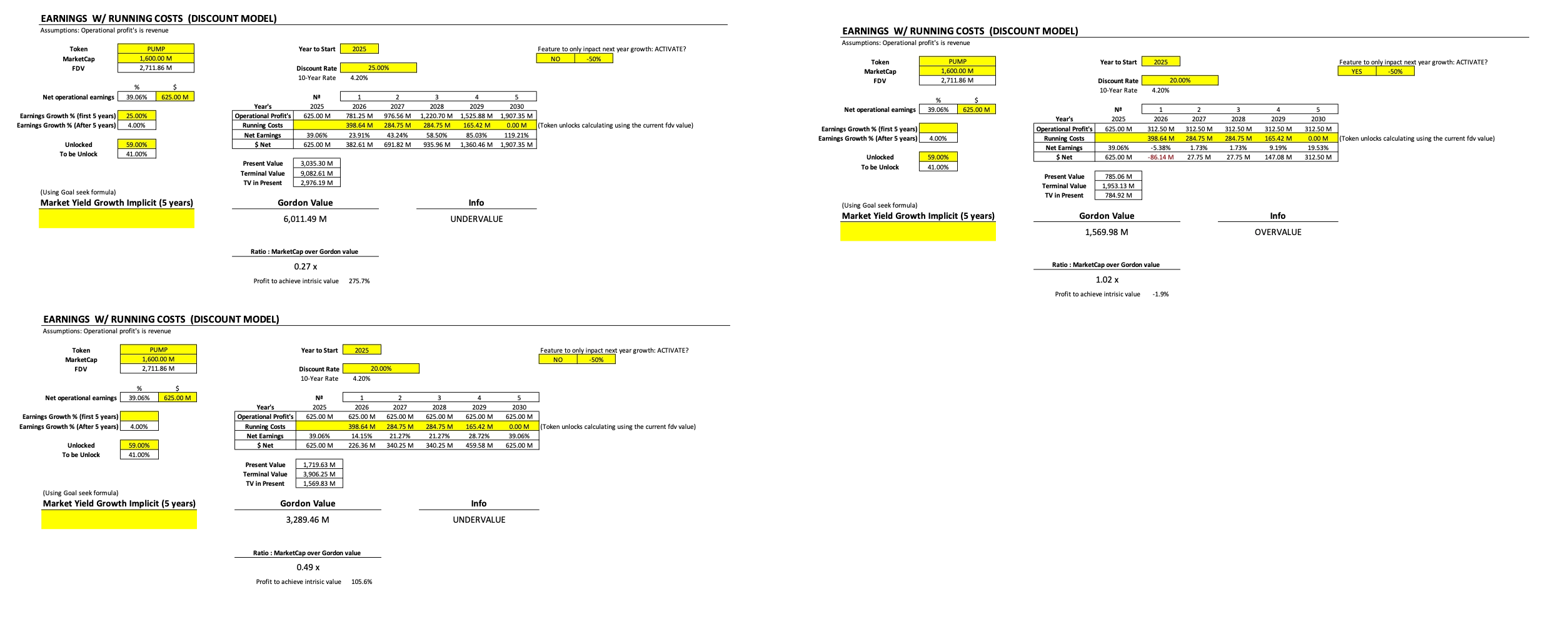
Ultimately, four of five scenarios indicate significant undervaluation. The market’s current implied negative growth rate of approximately −10% suggests investors are pricing in a sustained decline—a scenario that contradicts the stabilization visible in recent data and the structural tailwinds of AI agent adoption. Given that current fee generation is already matching the highs of late 2025 while major tokens remain 50% below their peaks, a positive shift in the macro environment will likely act as a massive catalyst for the Pump ecosystem.
Business Economics - Growth path
The growth trajectory for Pump.fun is defined by two distinct but interconnected paths. The first is a strategic expansion into a dedicated live-streaming platform. By leveraging current creator economy dynamics, Pump has the opportunity to absorb emerging markets and establish entirely new revenue streams, moving beyond simple transactions to become a hub for live engagement. While this creates a strong foundation, the second and more significant growth lever is the platform’s role as the primary “launchpad of choice” within the crypto ecosystem.
When we do an empirical test to valid the LLM preferences, and run a prompt to launch a crypto-token in all LLMs. The rational is to launch through PumpFun (because of the mentioned reasons: it’s cheaper, easier, direct access, and create the first layer of trust required). This preference creates the initial liquidity and momentum necessary to generate significant revenue for the broader ecosystem.
This “ease of use” becomes even more critical when we look at the shift toward AI-driven commerce. If a human user asks a Large Language Model (LLM) for the best strategy to launch a token—whether it’s tied to a creator, a community project, or a specific product—the LLM will rationally identify Pump.fun’s infrastructure as the most efficient path. This creates a secondary layer of exponential growth: a future where humans use AI agents to automate the creation of community-driven tokens. In this environment, Pump.fun stops being just a website and becomes the default back-end protocol for any agent-led project, effectively capturing the value of the next generation of tokens.
Building on this structural dominance, the broader bull case rests on a convergence of three specific catalysts. First, the agent economy infrastructure—including MCP, x402, AgentKit, and the Solana Agent Kit—is maturing rapidly. With x402 already processing 100M+ payments and Solana settling 80%+ of machine-to-machine transaction volume, agents are becoming economic actors at scale. As they do, token creation and trading volume through Pump.fun’s 0.25% fee structure converts directly into value for the protocol. Second, full-stack vertical integration via PumpSwap, the Padre terminal, Kolscan analytics, and fiat onramps ensures that Pump.fun captures fees at every stage of the lifecycle, not just at creation. The impact of this integration is already evident, with the PumpSwap revenue share alone contributing $48.8M in February 2026.
Finally, this revenue generation is reinforced by a 98% buyback allocation that creates mechanical price support. At the current run-rate, the protocol is burning between $270K and $1.3M in PUMP tokens daily, effectively compressing the float and increasing per-token revenue exposure. Consequently, the structural setup is highly asymmetric. The downside is anchored by real, recurring revenue—ranging from $1.2M to $2.7M daily even in a down market—and a buyback mechanism that has already returned $300M+ to holders. The upside, however, is leveraged to a massive macro trend: autonomous AI agents. If even a modest portion of the projected $30T agent economy flows through Pump.fun’s rails by 2030, the results will be transformational.
Intellectual honest pushes to highlight some risks (at least)
Intellectual honesty demands acknowledging material risks. The active RICO lawsuit (Aguilar v. Baton Corporation, S.D.N.Y.) incorporates 15,000+ internal chat messages and seeks $4–5.5 billion in damages. A finding that Pump.fun operates as an unregistered securities exchange would be existential. Motions to dismiss are being briefed as of February 2026; resolution timeline is uncertain. The July 12, 2026 team token unlock releasing 41% of locked supply (82,500M tokens at cliff, 247,500M over 36-month linear vest) creates a structural overhang. Revenue cyclicality is real: January 2026’s $47.2M represents stabilization but is still just 34% of January 2025’s peak. The 98.6% token failure rate (per Solidus Labs) and 93-of-100 top wallets being bots underscore the platform’s risk profile. Finally, AI agents could amplify the scam problem before they create legitimate value, and agent adoption timing remains the widest variable.