

The bet, in short
I view 1000X as a venture-style investment in a publicly traded token: a perpetual call option with a payout of ]-1;20[ - I expect either to lose what I put in, or to make a 10-20x return on the investment. The founders come first: Avi and Jonah launched the token in December 2024, didn’t dump at the worst possible moment, and now control roughly 23.93% of the total supply. The market, I believe, is pricing survival mode at $1.5m market value; the PWERM Grid, using two different methods, lands at an expected value of $45 to $55m FDV - a direct 30 to 37x increase on the current FDV. ANSEM is running a very similar playbook, and clearly the market appreciates ANSEM. Meanwhile 1000X is up 40% since Jan-2025, with BTC down more than 30%. I believe the market is not pricing the token correctly; I take the other side. So I buy and hold.
Why I bet on 1000X
A venture bet, not a trade
The important side note I can give is to view this as a venture-style adventure - nfa. 1000X is a publicly traded token, trading on Base chain, and still I view it as a venture-style investment. And this is important. I say “venture-style” because this instrument has the same properties as a venture investment, even while trading onchain: (1) it has a market valuation around a pre-seed round; (2) the liquidity is not strong - if you scale a position, you end up without a sustainable exit liquidity unless market valuations grow.
In all my venture bets, particularly pre-seed and seed rounds, I see the position as a perpetual call option. Perpetual, because it has no pre-determined expiry date; a call option, because it carries two expected values: -1x and infinite x’s. Realistically, under this current investment, the payout return sits in ]-1;20[. Under this hypothesis, I expect either to lose what I put in, or to make a 10-20x return on the investment - maybe higher if all my assumptions and the founding fathers are aligned.
The golden rule
In my frameworks I keep a golden rule, which I share with you all: I never sell because the price is down; I never buy because the price is up. The inverse is not true - I could sell because the price is up, and buy because the price is down. This is a golden rule that I printed, and it walks with me through all my day-to-day work. It’s crucial to keep in mind. But, moving on…
The founders come first
Above all my possible financial assumptions, it is the founding team that matters. The founder(s). A “never give up” mentality is what I want to see - it is crucial to the survival of any startup: a founder that gives you goosebumps to back him up. Before everything, the stickiness of the founders is the first variable to be tested. The majority of startups have hard starts, and the resilience of the founders is tested on day 2.
Above all my scenarios, and with all my support for the founding fathers, I rationally keep holding the 1000X token, aligned with the founders. As they said on the podcast on 17 Feb 2026 - “We are not abandoning this project. We will never abandon you.” - I share the same words, adding “never on these valuations.” I didn’t dump when the price collapsed, and they didn’t dump at the worst possible moment for the token and the product: the core dev moving away, core partnerships changing, and a broken platform. Today we are on the platform’s strongest path, with stronger partnerships and a much stronger foundation. Comparably, the price doesn’t dictate the health of this product.
Skin in the game: Avi and Jonah
Investors love to see founders with skin in the game. They get even more interested when founders are able to double down on their commitment by acquiring more ownership of their startup. It reinforces the “never give up” founder mentality. This is one of many reasons why I bet on 1000X.
1000x was founded by Avi and Jonah, two founders who are super technical in trading. Jonah carries a high degree of professional institutional trading, at institutions like Goldman Sachs, Vitol and Cumberland. Avi is a crypto-native trader who traded at institutions like BlockTower and GoldenTree. If you can bet on anyone to build a crypto terminal - scaling AI infrastructure, with helpful frameworks that help retail traders trade the crypto markets, and more - it is these two. They understand the trading engine: how you test trading strategies, validate and run your hypotheses, run probability tests, backtesting and simulations.
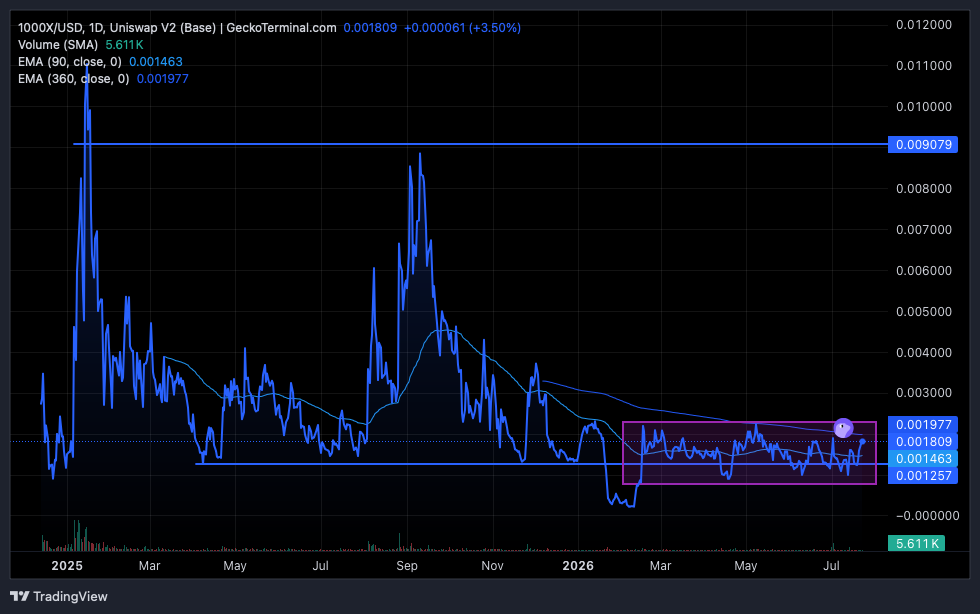
These two are highly profitable, successful traders; they don’t need to create and sell products. They could stick to their line and keep growing. Instead, they took the hard route. And the highest proof that these founders are willing to tolerate high pain is that they launched in December 2024 - almost 2 years ago - and they didn’t give up. They don’t need a pump-and-dump scheme; they also don’t need a successful project to be successful. They already are successful. They also have no commitment to anyone - with the token “lagging” upside, if they wanted, they could simply shut down. Their willingness to stick, upgrade, and improve the product they envision is what brings confidence that they are not going to give up, nor ghost their own project. They are building trust, and trust matters, particularly when a publicly traded instrument tracks your startup’s success. In April of this year, the token was down -90%, the product didn’t work, and the podcast didn’t have a clear purpose (it still belonged to Blockworks). The founders’ ability to stay focused on the vision, without fucking it up - and in fact Avi doubled down, buying supply when the token was down aggressively - creates the trust required to venture-bet. Investors love that.
What was 1000X before, and what is it now?
My first published paper on 1000X came out in November 2025, after almost a full year of tracking everyday updates, information, and onchain movements:
The bet on 1000X

This is an optimistic view of the 1000x terminal evolution. I’ve tracked this project since minute one. Therefore, no one is able to share the same level of internal insights, I can offer a uniquely clear outlook.
As you could read in that paper, 1000X was created without a clear intent - they were testing the Virtuals platform. Fortunately enough, they launched the token; otherwise, today we would have no possible upside in betting on these two.
Let’s get real.
Since inception, 1000X has represented direct exposure to the terminal’s upside. It is the most reliable instrument for accruing value from the terminal’s posture. When it launched, they changed the revenue-buyback mechanics to bring more sustainability to the project: it started at 100% of revenue going to buy back the token, and was pushed down to 50% of profits. It is legit and reasonable that a portion of revenue is required for operational costs, and they did the TGE without a low-float / high-FDV setup, so revenue is required to leverage growth. This is a 1:1 mcap-to-FDV value, with all tokens launched: 87.5% publicly purchasable on the bonding curve, and 12.5% seeded into DEX liquidity at graduation. No team or investor allocation. The founders, Avi and Jonah, bought on the bonding-curve launch, and ended up buying the sniper and buying dips on the token itself. They now control roughly 23.93% of the total supply - an ownership stake that has kept increasing since launch - with Avi alone owning 9.05% of the total supply. Approximately 52.67% of the total supply sits on the market, held by long-tail retail distributed across 83 thousand wallets. Even with all these metrics, the top 100 holders control 88.33% of the total supply, and that share is growing.
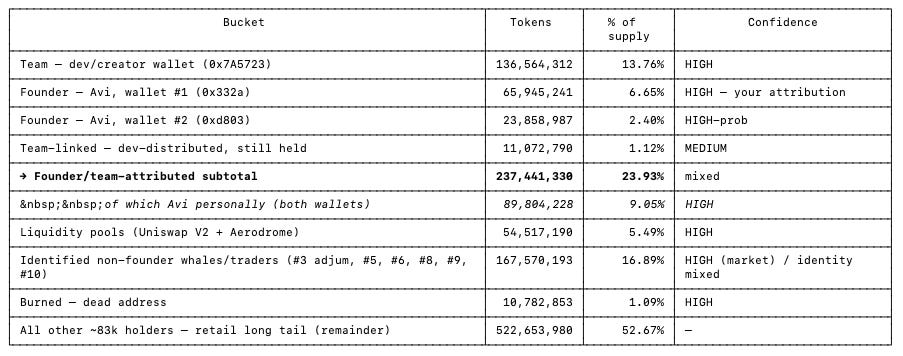
In this act, “skin in the game” can’t be questioned. The mission is still aligned with their principles since the day they figured out that a terminal could have some value for their retail community.
The Network
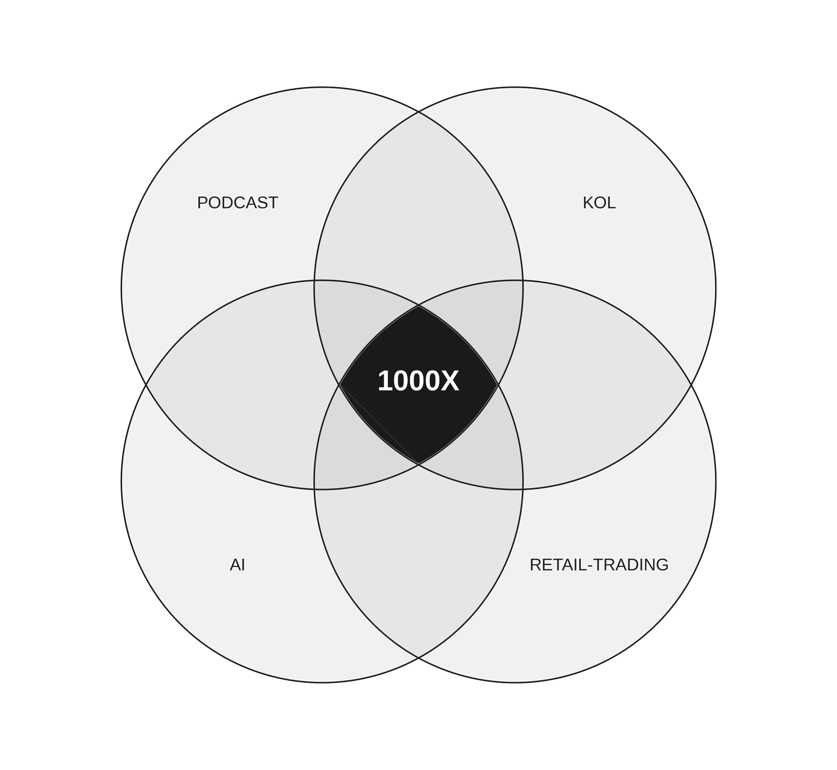
It is true they have three different products: the social media presence, the podcast, and the terminal. Together they create “The Network.” 1000X leverages the network - I will explain how. Directly or indirectly, 1000X is the value captured by the network.
We have the founders’ X accounts, the trader-focused podcast, and the retail-focused terminal. For now, the token only directly accrues value from the network by capturing the terminal upside (only). I put a high probability on the network merging with the terminal, because these are interconnected projects, and expanding the token to represent the network - rather than only the terminal - would give much more value to the owners than any other possibility. Especially when the attention and the audience are on the network, but the revenue is on the terminal.
Facts justify this possibility. Early on, in January 2025, the first buyback happened: $75k worth of tokens, from the Virtuals protocol revenue. Later, in August 2025, a buyback worth $35k happened from podcast revenue. These buybacks make this outcome probable: even if they haven’t mentioned it recently (at least not in a super clear way), the token has been connected to the network since inception. When the world - US regulation - allows, they will create the attachment; I’m almost certain. The Clarity Act could be the catalyst that unlocks this, or blocks this possibility, but over the long term the path is clear. But until that, 1000X represents only terminal value.
The funnel: X → podcast → terminal
All three products create the network effects required for the terminal to be successful. Creating these three products is rationally smart - it leverages all sides. Activity on X and on the podcast originates new leads, new funnel distributions to the terminal, the monetization product. Let me explain how. The social media presence creates the first foundation: it unlocks the first users, the testers, and validates the MVP fast enough. You could see it - they rapidly passed 10k followers on the podcast X account and more than 1,000 users inside the terminal telegram group chat. A super active community, only possible because they have social media validation: people know them. X sends users over to listen to the podcast; the podcast creates more trust, reliability and validation, because they know what they are talking about - they are putting their energy and their reputation into the things they say, and that is valuable in the modern era. Eventually both funnels originate leads, as more and more people come inside the network. If people like what the founders are saying, you trust them; and when they create a product that really helps you on your trading journey, you want to be involved - you don’t want to miss it. These two products bring people in, talk to them, and help them make money, so you follow the products that help you achieve that goal. It is worth the shot; it is worth getting involved. The terminal is the final format for monetizing the network in a valuable way. All these people circulate between the podcast and the social media, consuming information and alpha for free; eventually they will use the terminal as the final validation and fit. The strength of the network will strengthen the terminal’s users. It is all interconnected, and the terminal is the final product that connects all the dots and generates real revenue for the network creators and for the token owners. The playbook is real and smart.
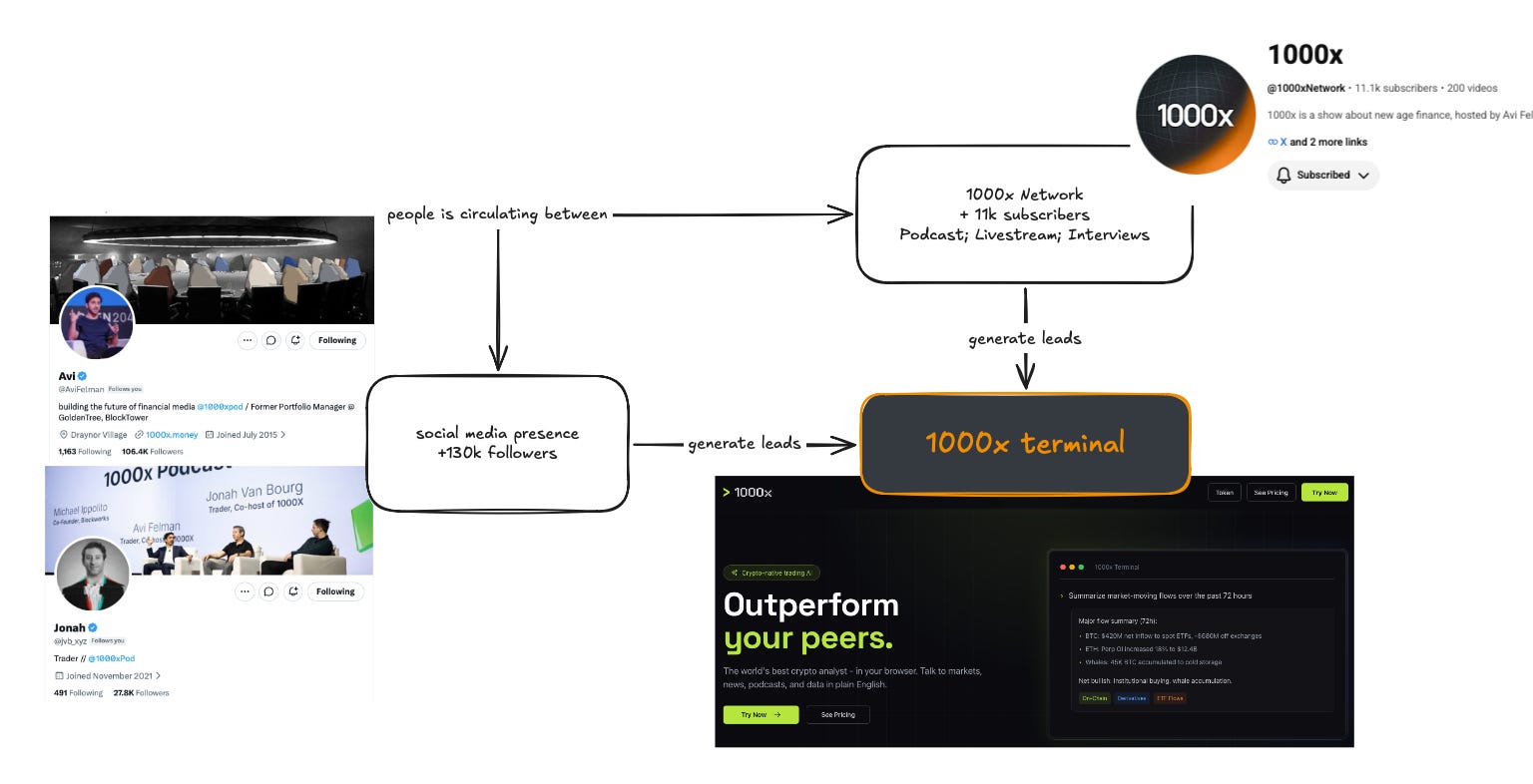
At first sight there is a limitation on the token’s upside: it is connected only to the terminal, not to “all the network.” But eventually all revenue ends up on the terminal. All real customers - the ones able to spend a little capital on this network - end up spending it on the terminal. The terminal is the fair product to monetize, with a user return above the user cost: the monthly value a retail user gets from the terminal is above the monthly cost. And this is how you monetize your audience, your network with ethics.
They just need to create reasons for the listeners to spend on the terminal. So far, there are multiple reasons: trading-reasoning chat functions, injected frameworks, simulations and computations, 1-1 chatting with the founders on the highest-tier plan, and so, so on. There is already real validation of the product, and for any retail trader who aims to be profitable, the 1000x terminal is a good terminal to be involved with.
From broken chat to workable product
It didn’t start this way. When the product started being launched 2 years ago, there were a lot of things broken.
The terminal pivoted from a broken chat function - a ChatGPT wrapper, failing multiple times, dumb conversations - to a workable product. They changed the team behind it, changed partners, and changed the terminal’s positioning. I believe there is still a lot that can be improved, a lot that can be done - and that is the next upside wave I can envision. But attention is required for them to build the customers needed to lead this retail-driven product, and that is the network’s value.
The market is bigger than it looks
Many say the size is not there - that the market for serving retail traders is not necessarily big enough to drive value to the token. I couldn’t disagree more. The TAM is not that small if we only consider crypto trading onchain, and it is much bigger when you expand the vision to all the centralized cohorts and other markets. The network starts as a crypto-first podcast, not yet moving directly to commodities and equities trading as well. You could 1000x the size of the TAM when the terminal is able to expand their own industry-focus.
There are over 7m unique addresses on the 6 major chains: Solana with 3.2m DAU; BNB with 2.7m; Ethereum with 509k; Robinhood Chain with 323k; Base with 274k; and Hyperliquid with 7.5k on the most recent data - with 150m daily transactions on all those chains combined. This is not a tiny market; these are numbers that can justify serving this community of onchain buyers and sellers (degens).

Of course, we have to discount all these unique addresses down to a more tangible number of humans behind the wallets. Many are just bots or sybils; other users have multiple wallets and are present on multiple chains. There is a huge discount on this number: from 7.1m DAU shared across these 6 chains, we get approximately 150 thousand potential humans behind those addresses. We should take this adjusted number as our tangible market for a retail product that touches these users - unique users who are onboarded to onchain finance and degen enough to live onchain and test a crypto-focused product.
Because all crypto-traders have at least one active wallet running daily, these onchain users are a good proxy for the humans who could be interested in the 1000x terminal.

On top of these onchain humans, there is a crossover follower count of over 130k on X, more than 10 thousand on YouTube, and more than 1 thousand in the Telegram chat group. They have a reach of more than 100 thousand people, whom they must try to convert to the product they created - the one that provides the highest value-add to these followers.
In a well-executed environment, they should be able to expand this network, maybe doubling every year, and they should be able to absorb at least 5 to 10% of their reachable market. That is the core goal, and it is what we try to engage here as a possible TAM - taking the huge assumption of well-executed management. This is over 20 thousand users eventually converted to the 1000x terminal.
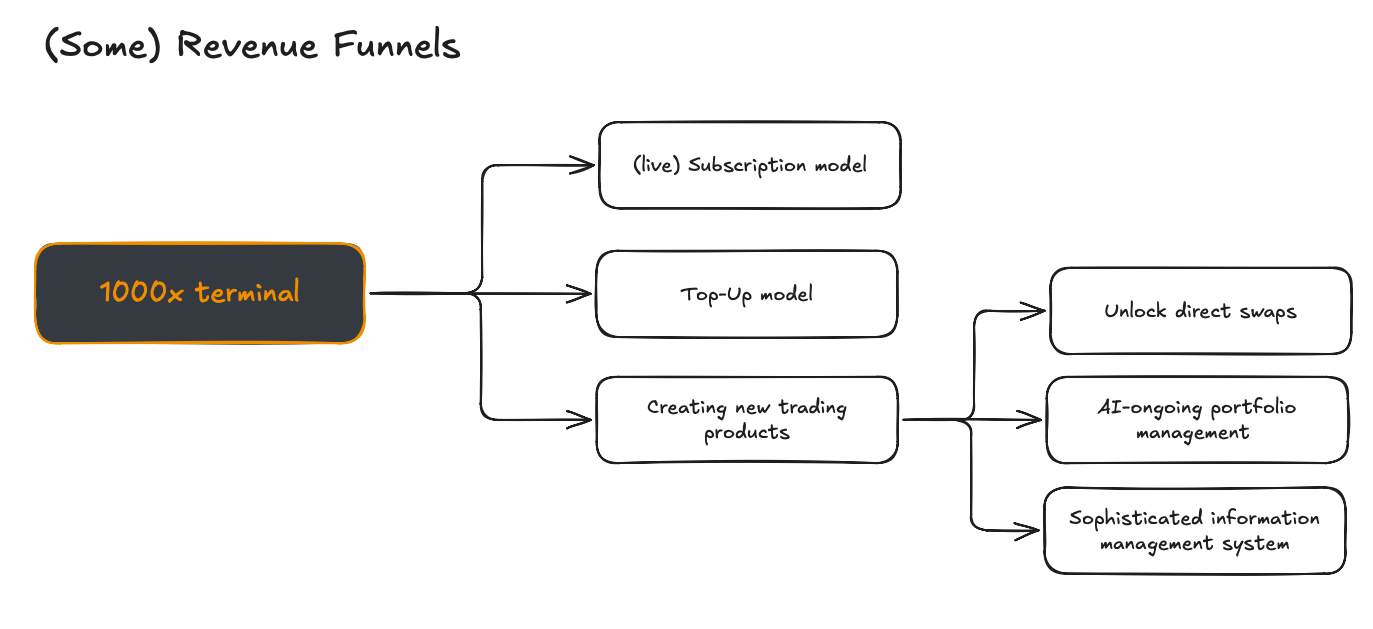
So far the 1000x terminal has a single point of creating cash: a subscription model. As they grow, they can scale to more than one source of revenue: top-up revenue (as users reach their token-spend limits); AI portfolio-management tools; an information system; allowing direct trading inside the terminal; and more. Many are the products that can be created as soon as they drive their audience to their good terminal. The most direct ones are: Subscription model; TopUp model and direct trading fees.
Valuation: the PWERM Grid points to $45 to $55m FDV
The ability of this terminal to generate real revenue is valuable. They own and control a network of traders, and they move them to a product that is cheap enough and helps them be more profitable. They are growing the pie of traders inside their network and merging them into a terminal that will help them. Under a PWERM Grid simulation, we get an expected value for the token representing this terminal, under the assumption that they run three direct products on the terminal. At scale this will be a much bigger product - a much bigger difference - and they should be able to monetize that difference as they scale the types of services they offer inside the terminal. At the end game, users should be able to watch the podcast and interviews inside the terminal only, with YouTube as a delayed distribution channel. That, I believe, should be the goal for this terminal: a place where traders live inside - open chats and discord-type functions live there, alerts, a mobile application, and agents alive to help traders do their work, particularly retail traders. At scale they will grow the market’s pie and move in multiple directions, particularly the podcast.
Putting numbers under assumptions and hypotheses: there is, of course, a scenario where I am super wrong - the founders fuck my vision up, change plans, or just get tired. I am humble about that, even being delusionally bullish, and I need to give a reasonable probability to this “go-to-zero” possibility. I assign that scenario a 20% probability - significant; it could happen. There is another 25% probability that the project sits in survival mode: some users, but struggling to grow. That, I believe, is what the market is pricing now, at $1.5m market value. There is a 40% probability of them generating some traction - getting users and reaching a 5% market share of the users we track - and then 15% distributed across the growing and winning scenarios. On a PWERM Grid distribution, using two different methods, we end up with a proper current value - without expanding much the level of reach they can achieve - an expected value of $45 to $55m FDV, meaning a direct 30 to 37x increase on the current FDV. I believe the market is not pricing the token correctly: it is not considering the upside if this all works out, not considering the short-term direct expansion vision, not considering the risk-return trade here - and, realistically, not believing in the value of the founders. I take the other side.

I am trying to be rational about a short-to-medium-term fair value for the current project, taking probability assumptions under multiple scenarios. And, being honest, I am not considering the value they can generate by growing the network and expanding to a multi-asset industry - commodities, equities and crypto. That is the clear expansion.
Now the 1000x terminal offers two plans: one at $12.5 a month, the other at $100 a month. The terminal is now offering derivatives and options flow, whale tracking, Polymarket access, TradFi backtesting, Python execution, and a memory system - all sitting on an Apache Iceberg and AWS S3 vectors data layer.
There is a lot to expand. Fundamentally.
The ANSEM case study
On June 17, someone anonymously deployed a token called ANSEM and airdropped 650m tokens - 65% of the supply - to the trader-KOL Ansem. Ansem is a crypto-native OG personality who used to share screen time with Avi on the podcast “Untitled Crypto Podcast,” published under the account “UpOnly” 4 years ago, when both were 26 years old.
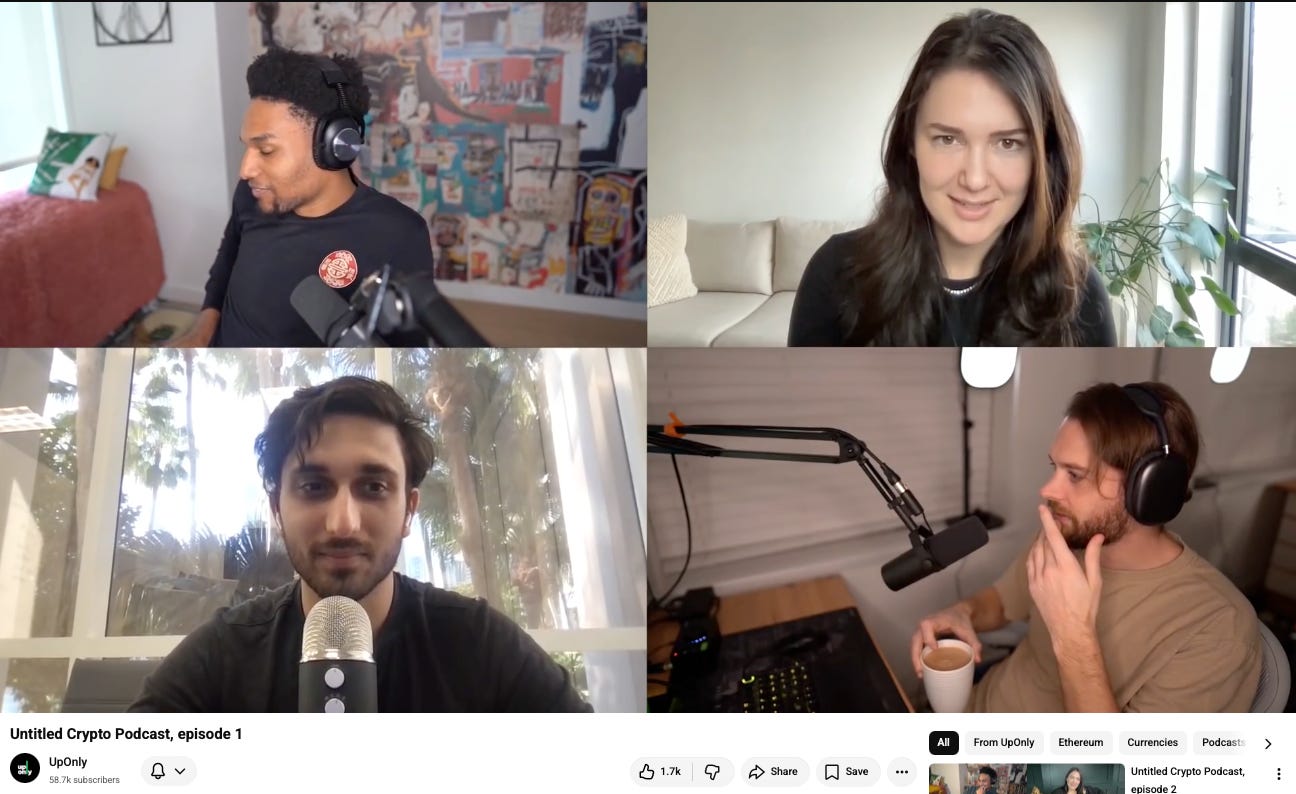
Ansem owns more than 1 million followers on X. He embraced the token and published a paper with his own thesis on it - and, spoiler alert: it matches.
The ANSEM token reached a $450m FDV at its peak on July 7, 2026, a few days ago, and is now trading at around $200m FDV. I am not attempting to discuss the fair market value of the ANSEM token, nor pretending to say whether it is fairly valued, overvalued or undervalued. I take this token as a good proxy for 1000X: the playbook is very similar, and together they are creating a new sector of the “creator economy,” driven by two well-connected crypto-OG traders owning a network of traders with retail-focused products. Let me explain deeper.
The same playbook
Ansem was able to create this level of attention by embracing the token, under the narrative that this token represents his own audience and the products he is involved in.
What is ANSEM, the token? The immediate view is that this token represents Ansem’s ability to generate continuous attention for this memecoin. But it is not only that - that minimizes the vision of Ansem. Ansem owns two other products: BullpenFi, and a podcast called “MarketBubble.” The same playbook is playing out here: he is creating a network of crypto-interested people - this is how they bring their community together and create knowledge and expertise - pushing users from the social media account and creating a network using a livestream platform called MarketBubble. This network is valuable because, at the end, they are able to move a significant audience to go trade the markets using their own product, BullpenFi. BullpenFi is the monetization layer - it is where they are able to monetize their own network. Do you see the similarities? They are there. The vision is “the same.”
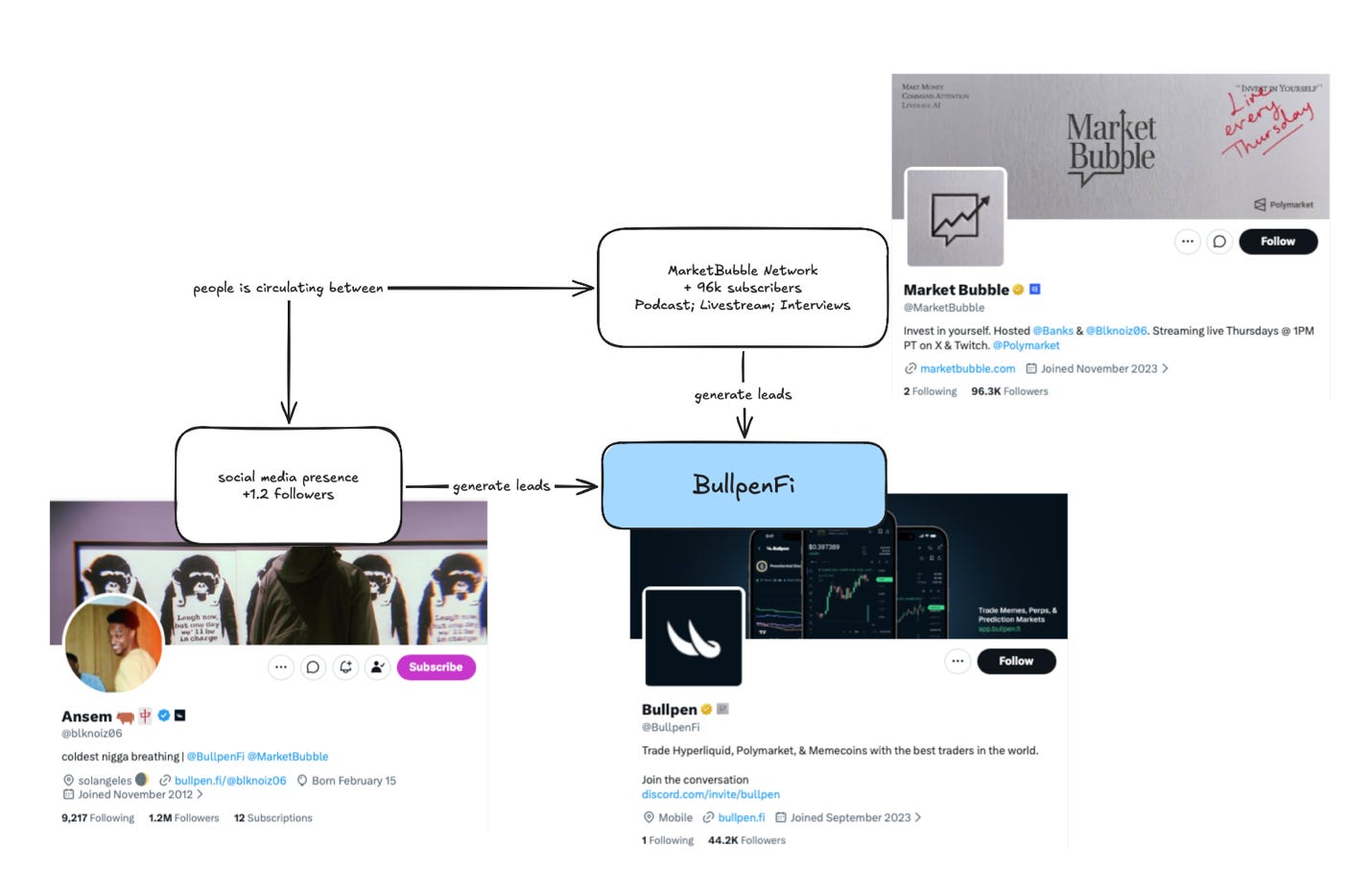
You are seeing a very similar playbook in ANSEM and in the 1000X token. These two tokens set a new market - a huge market that can attach multiples to a memecoin with a foundation that can generate real revenue, distributed to the token that represents it all.
I am not arguing that you should buy one or the other. But clearly the market appreciates ANSEM. 1000X was much sooner; it just didn’t start gathering the attention required to own the market and convert it into a max valuation that expands the vision.
The moat: the “creator” token
The playbook is smart - super smart. They understand the industry, and they understand where we are going: a world of hyper-gamification, hyper-trading. The retail community lives on the internet, watching people talk, giving feedback, and sharing information. Retail people are now the market. Trying to directly monetize your audience is unethical - and these are super legit OG crypto traders; you never bet against them. They really understand the crypto industry, and they are willing to monetize if they are able to give a positive EV on each dollar their audience spends.
The moat sits in the creation of a new “creator” token - one that represents not only the attention of the founders, but their network and the revenue of the product these founders created. This is a much bigger vision, a palpable market.
Relative performance: up 40% since Jan-2025
In comparison, 1000X is not performing as badly as you would expect for a $1.5m FDV token. It is up 40% since Jan-2025; BTC is down more than 30%; VIRTUALS down more than 85%; and AIXBT down more than 95%. In relative comparison, 1000X is a token that has held up well in this bearish market.

Execution
I can’t say that execution has been perfect. We should not expect it to be. From studying many other startups, I believe a better execution can be implemented. But it is unquestionable how good they are at this new “plan”: creating a network that leverages, by consequence, all the rest.
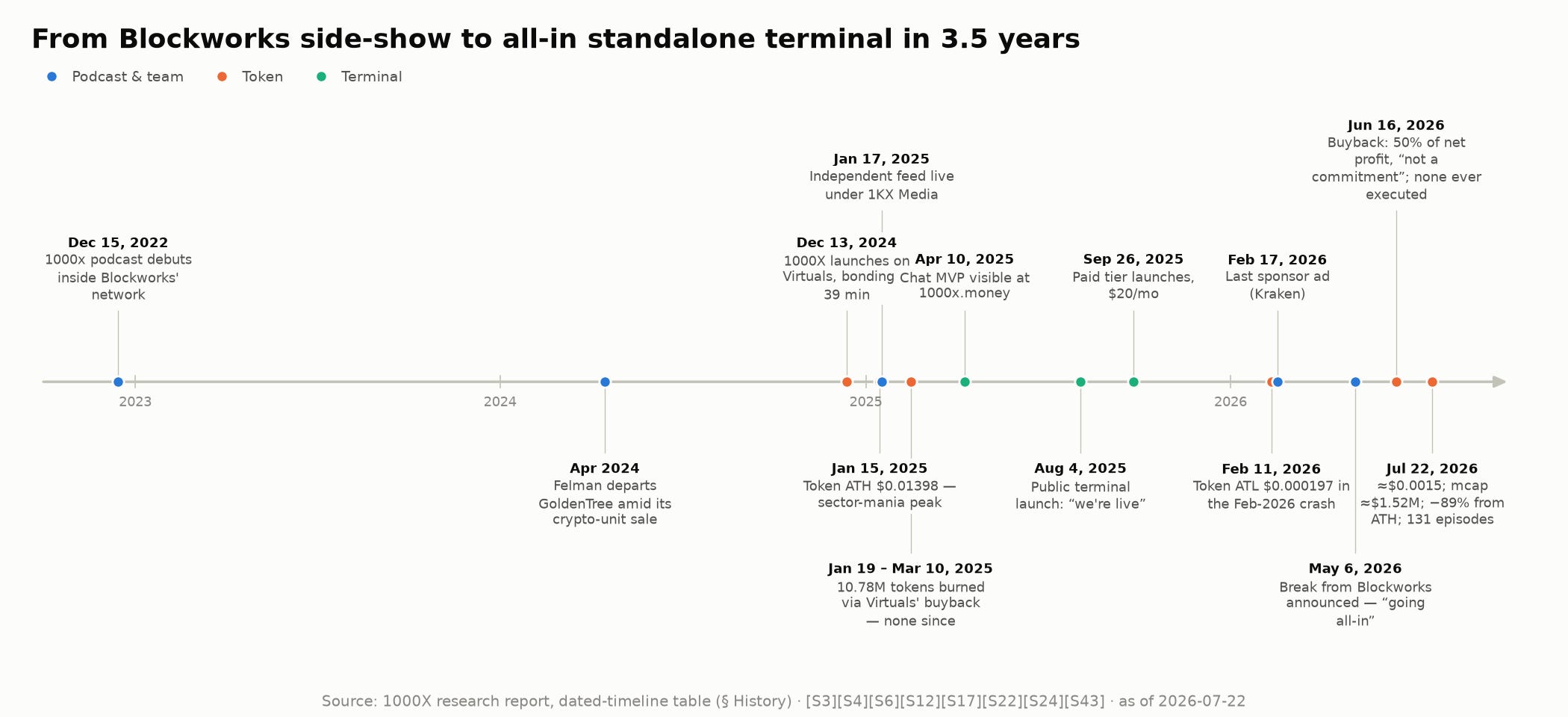
Zoom out a little and we see ups and downs - and we are now in a comfortable place, where I believe the floor is in - in terms of price and product execution. There are no active sellers of the token, and the product sits in a comfortable place to engage real users. There is no blockage by Blockworks, and the network is live - no “forced” sponsors; they created an entire new format. The vision is now clear: since May 2026 they have been building the 1000x network they envision. The 1000x terminal is now much more aligned with the network vision than with the Blockworks vision.
The follow-up steps are clear: improve the terminal and the chat function - make it much smarter. Unlock agentic frameworks, where a user can develop agents that live on the terminal. Put the 1000x network live on the terminal, with some social-engineering tooling. Research can be published on the terminal - independent writing, with access to data the user can validate under this format - and agents can validate the research each one publishes. Create a much bigger vision with the terminal: being creative and engaging with the network of real people inside a terminal that has real users there - watching, reading, talking, communicating, chatting. A real network. And the market is big.
Things they can improve on the terminal
Integrate the podcast videos and livestreams inside the terminal. Give subscribers some early watching, or behind-the-scenes type content.
Build an internal chat network on the terminal, where people can in fact share trading opinions. It creates community-trading.
Create advertising for the terminal that runs on the podcast - if you are publishing any advertising, publish your own product.
Eventually allow people to see charts and trade on the terminal. You will generate a lot of fees.
Integrate voice chatting - like calling traders to check what they are saying.
Build a BD team that is out there closing deals and partnerships.
My position: Buy and hold
I wrote about 1000X ventures in November 2025. I was bullish, and I had a position. I continue being bullish, and I increased my position. Since that time, a lot changed fundamentally, and a lot happened in that period. I experienced extreme downs on the token price, and also on the management team; I felt the product being near the end - but I also felt the “never give up” mentality from the founders. These two create a level of trust and stickiness. Doubling down in the worst possible moments was one of the key bullish variables.
Since the launch of the token project in December 2024, I have done my due diligence every day. I believe there is no other person better than myself to manage and update the 1000x thesis.
I love to adventure on a publicly traded venture. I feel all startups should be this way, where you can feel and identify the volatility as new headlines, articles, and posts come live. People undervalue the quality of work that can be done when a venture-style investment trades in a volatile market. Volatility hits my neurotransmitters and strikes a dopamine rush. I must manage my dopamine and hold through the volatility, in a well-executed long-term plan - always keeping in mind that this is a -1x or +20x payout. In risk-reward terms the odds are on my side: if each payout carries a 50/50 probability, my expected return sits well above any possible benchmark. So I hold.
Thanks,
Joao